Artículo Original
Biodegradation of pesticides by compost-isolated microorganisms
Biodegradación de pesticidas por microorganismos aislados de compost

 Jimmy Romario Clemente Rivera jimmy.clemente@espoch.edu.ec
Talía Luzmila Barragán Rodríguez talia.barragan@espoch.edu.ec
Jimmy Romario Clemente Rivera jimmy.clemente@espoch.edu.ec
Talía Luzmila Barragán Rodríguez talia.barragan@espoch.edu.ec
Biodegradation of pesticides by compost-isolated microorganisms
Siembra, vol. 12, núm. 2, e6949, 2025
Universidad Central del Ecuador

Esta obra está bajo una Licencia Creative Commons Atribución 4.0 Internacional.
Recepción: 15 Julio 2024
Revisado: 07 Noviembre 2024
Aprobación: 11 Junio 2025
Abstract: Soil degradation and low agricultural productivity have often been linked to the indiscriminate use of pesticides. In recent years, to restore soil fertility, farmers have increasingly turned to organic fertilizers, which supply both macronutrients and micronutrients to enhance crop production. However, the microbial load of these fertilizers can significantly impact soil biological populations, their diversity, and their activity. In this context, the objectives of this study were to assess the microbiological quality of compost samples and to conduct pesticide degradation tests. Microbiological analyses revealed that the compost’s microbial load was primarily composed of phytopathogenic fungi, such as Fusarium spp. and Cladosporium spp., as well as phytopathogenic bacteria, including Pseudomonas spp. and Enterobacteriaceae, which are pathogenic to humans and animals. The population and diversity of actinomycetes were notably low. Previous analyses identified the persistence of pesticides such as glyphosate, chlorfenapyr, and difenoconazole in the samples. The most abundant bacteria and actinomycetes, identified as Pseudomonas spp. and Streptomyces spp. (ACP1 and ACP2), were effective in degrading these pesticides under in vitro conditions. Specifically, difenoconazole was degraded by up to 70%, chlorfenapyr by 44%, and glyphosate by 30%, both individually and in mixtures. These results demonstrate the potential of these microorganisms for use in decontamination and bioremediation processes by reducing pesticide concentrations in soil.
Keywords: agricultural production, pesticides, fertilizers, phytopathogenic fungi, microbiodiversity.
Resumen: La degradación del suelo y la baja productividad agrícola a menudo se han relacionado con el uso indiscriminado de pesticidas. En los últimos años, con el objetivo de restaurar la fertilidad del suelo, los agricultores han recurrido al uso de fertilizantes orgánicos, los cuales aportan tanto macronutrientes como micronutrientes para mejorar la producción agrícola. Sin embargo, la carga microbiana de estos fertilizantes también puede afectar a las poblaciones biológicas del suelo, su diversidad y su actividad. En este contexto, los objetivos de este estudio fueron evaluar la calidad microbiológica de muestras de compost y realizar pruebas de degradación de pesticidas. Los análisis microbiológicos revelaron que la carga microbiana del compost estaba compuesta principalmente por hongos fitopatógenos, como Fusarium spp. y Cladosporium spp., así como por bacterias fitopatógenas, incluidas Pseudomonas spp. y enterobacterias, las cuales pueden ser patógenas para humanos y animales. La población y diversidad de actinomicetos fue notablemente baja. Análisis previos identificaron la persistencia de pesticidas como glifosato, clorfenapir y difenoconazol en las muestras. Las bacterias y actinomicetos más abundantes, caracterizados como Pseudomonas spp. y Streptomyces spp. (ACP1 y ACP2), fueron eficaces en la degradación de estos plaguicidas en condiciones in vitro. Específicamente, el difenoconazol se degradó hasta en un 70 %, el clorfenapir en un 44 % y el glifosato en un 30 %, tanto de forma individual como en mezclas, reduciendo así la concentración de estos contaminantes y demostrando el potencial de estos microorganismos en procesos de descontaminación y biorremediación.
Palabras clave: producción agrícola, pesticidas, fertilizantes, hongos fitopatógenos, microbiodiversidad.
1. Introduction
Agrochemicals are compounds widely used in agriculture to control weeds, diseases, and pests in crops. Their mode of action includes repelling, preventing, mitigating, or destroying weeds, pests, and diseases. Based on their purpose, agrochemicals can be classified into insecticides, herbicides, bactericides, fungicides, miticides, molluscicides, nematicides, wood preservatives, and rodenticides (Ahamad & Kumar, 2023; Durán-Lara et al., 2020; Parra-Arroyo et al., 2022).
Herbicides are commonly used to improve crop yield and quality by reducing or inhibiting weed growth. They also serve as desiccants for various grain crops, including cereals (e.g., wheat, barley, oats, corn, sorghum), oilseeds (e.g., soybean, canola), pulses (e.g., beans, peas, chickpeas, lentils), and pseudocereals (e.g., buckwheat, quinoa). Among herbicides, glyphosate-based herbicides (GBHs) are globally recognized and widely used to control perennial weeds such as quackgrass and thistle, as well as to accelerate crop drying for harvest (Fuchs et al., 2022; Xu et al., 2019).
However, glyphosate is considered toxicologically harmful and has been potentially linked to human carcinogenesis and other chronic diseases, including reproductive and mental health disorders. The challenges in analyzing and demonstrating its toxicity are likely due to its metal-chelating properties, interference from organic compounds in the environment, and the structural similarity between glyphosate and its by-products (Peillex & Pelletier, 2020; Valle et al., 2019).
Other pesticides, such as chlorfenapyr, have also raised concerns. After its initial registration for use on green onions in 1996, chlorfenapyr usage in South Korea increased significantly, from 5,539 metric tons in 2006 to 15,821 metric tons in 2014. This increase has raised concerns about the potential health risks of pesticide residues, despite the establishment of maximum residue limits and preharvest intervals for crops (An et al., 2024; Jeong et al., 2019).
Similarly, overuse of difenoconazole may cause chronic and irreversible harm to human health and adverse ecological effects. Previous studies have shown that difenoconazole binds to human serum albumin and is associated with an increased incidence of hepatocellular adenomas and carcinomas in mice following long-term dietary exposure. As a result, determining difenoconazole residues in postharvest fruits and vegetables has become essential to ensure food safety for producers, regulatory authorities, and consumers (Qin et al., 2021; Shalaby et al., 2022; Wang et al., 2019).
The behavior of pesticides in soil and the environment is governed primarily by two processes: adsorption/desorption and degradation. Pesticides applied to the soil are absorbed by organic matter, which is often added in the form of organic fertilizers (Rassol et al., 2022).
Organic fertilizers, or manures, are considered biodegradable and are mostly derived from plant or animal sources, municipal solid waste, food industry by-products, crop residues, and various types of composts, such as vermicompost, kitchen waste compost, and distillery effluents (Jakubus & Michalak-Oparowska, 2022). These organic materials not only supply essential nutrients to plants but also help reduce the need for chemical fertilizers - particularly micronutrients - and eliminate the need for waste management or disposal (Sing et al., 2020b; Van Gijn et al., 2021).
However, organic materials may also contain traces of pesticides and their metabolic by-products, which can accumulate in soil in excessive amounts due to diffusion through water and air, or due to their persistence in plantations (Lau et al., 2023). Pesticide residues can degrade in both soil and organic waste materials through microbial activity, chemical interactions, or ultraviolet radiation. The degradation rate and removal of pesticides are influenced by environmental factors such as water availability, soil pH, temperature, and the chemical properties of the pesticides. Key factors include solubility, volatility, ionization, hydrophilicity, and lipophilicity. Pesticide breakdown occurs via three primary mechanisms: microbiological, chemical, and thermal (Carpio et al., 2021; Lau et al., 2023; Rassol et al., 2022).
In this context, the objectives of this study were to evaluate the microbial quality of compost samples and to assess pesticide degradation mediated by microbial activity.
2. Materials and Methods
2.1. Microbiological quality of compost
Compost samples were collected using the quartering method from piles totaling 12 tons of product, with five sub-samples taken (Buol et al., 2011; Salazar Calvo et al., 2020). In the Biological Sciences Laboratory, Faculty of Natural Resources, ESPOCH, the pH of the samples was determined. Serial dilutions were prepared from 10-1 to 10-6, and 100 µL from each dilution was used to inoculate nutrient agar [NA], potato dextrose agar [PDA], Sabouraud dextrose agar [SDA], and selective media: eosin methylene blue [EMB] agar for enterobacteria, Pseudomonas agar [PA] for the Pseudomonas genus, and glucose yeast extract agar [GYM] for actinomycetes. All isolates were incubated at room temperature, ranging from 17°C to 22°C. Bacterial growth was evaluated at 72 hours, while fungal and actinomycete growth was evaluated at 120 hours. The number of colony-forming units per gram of soil was calculated (Bhimani et al., 2024; Harrigan & McCance, 2014; Ibrahim & Hameed, 2015; O’Hara, 2005; Wellington & Toth, 1994; Williams & Cross, 1971).
2.2. Isolation and characterization of microorganisms with degradative capacity from compost samples
The most abundant bacterial colonies were selected for pure culture isolation, and the isolates were characterized based on macroscopic and microscopic morphology, as well as biochemical tests. For identification of the Pseudomonas genus, the API E20 test was used (Mashi, 2018; Mohammad et al., 2020), along with MacConkey agar (Midhat & Abed, 2023; Pant et al., 2022). The predominant fungal population was isolated and characterized through both macroscopic and microscopic morphology (Agu & Chidozie, 2021; Fischer & Dott, 2002). Additionally, the most abundant actinomycete colonies were isolated to obtain pure cultures. Using GYM medium, their aerial mycelium, substrate mycelium, diffusible pigments, microscopic morphology, and growth on different amino acids were characterized (Kumar & Jadeja, 2016; Rodríguez et al., 2018; Sapkota et al., 2020).
2.3. Pesticide degradation assays under in vitro conditions
Three of the most abundant microorganisms from the compost were selected for pesticide degradation tests: a bacterium identified as Pseudomonas spp. and two actinomycete cultures, ACP1 and ACP2. A fungus from the DCB collection was used as a reference for degradation.
The culture medium used in the degradation tests consisted of a commercial pesticide dissolved in distilled water and solidified with bacto agar. The concentrations were 4.6 ppm of glyphosate, 4.4 ppm of chlorfenapyr, and 4.1 ppm of difenoconazole, while the pesticide mixture reached a concentration of 13.21 ppm. In each culture medium, 50 µL of microbial suspension was added. The concentrations of the microorganisms were as follows: (1) Pseudomonas spp. (5.25 × 10⁷ CFU µL-1), (2) ACP1 (3.80 × 10⁷ CFU µL-1), (3) ACP2 (1.20 × 10⁷ CFU µL-1), (4) T. harzianum (2.75 × 10⁷ CFU µL-1), and (5) the control treatment, which received 50 µL of sterile distilled water (Esimbekova et al., 2022; Pizzul et al., 2009; Rossi et al., 2021).
The tests were incubated at room temperature (17°C ± 5°C) for 15 days. The degradative capacity of the microorganisms was evaluated by measuring the diameter of the colonies and assessing their morphology. Pesticide residues in the culture medium were analyzed using gas chromatography and mass spectrometry [GC-MS/MS], following the Lab 1-01-105 procedure by Agrolab Company (Lab Innovation Analytical, a Tentamus Company) (Hernández-Mesa & Moreno-González, 2022; Riedo et al., 2023).
3. Results and Discussion
3.1 Microbiological quality of compost suge
The microbial load of the compost samples was dominated by fungi and bacteria, with lower levels of actinomycetes (Table 1). These findings are consistent with previous studies describing microbial communities during composting, which typically include bacteria, fungi, and protozoa. The composition of these communities varies depending on factors such as temperature, moisture content, C/N ratio, and the nature of the organic materials used. Bacteria and fungi are generally the most abundant and rapidly emerging microorganisms during composting, as the substrates and indigenous microbiota significantly influence the quality of the final compost (Palaniveloo et al., 2020; Rastogi et al., 2020; Singh et al., 2022).
| Sample | Bacteria | Fungí | Actinomycetes | |||||
| NA | PA | EBM | PDA | SDA | GYM | |||
| Compost 1 | 5.73E+05 | 7.80E+05 | 3.59E+05 | 5.30E+05 | 2.50E+04 | 3.63E+05 | ||
| Compost 2 | 4.52E+06 | 6.14E+05 | 3.81E+05 | 4.87E+05 | 2.32E+04 | 3.30E+05 | ||
| Compost 3 | 6.02E+05 | 7.10E+05 | 3.09E+05 | 4.95E+05 | 2.41E+04 | 3.17E+05 | ||
| Compost 4 | 5.11E+05 | 6.57E+05 | 3.47E+05 | 5.53E+05 | 2.55E+04 | 3.84E+05 | ||
| Compost 5 | 5.81E+05 | 7.80E+05 | 3.24E+05 | 5.76E+06 | 2.76E+04 | 3.69E+05 | ||
| ẋ | 1.36E+06 | 7.08E+05 | 3.44E+05 | 1.57E+06 | 2.51E+04 | 3.53E+05 | ||
It has been demonstrated that during the mesophilic and thermophilic phases of composting, the relative abundance of plant-pathogenic fungi decreases significantly due to high temperatures, which are critical for their elimination. However, during the cooling and maturation stages, the abundance of pathogenic fungi can return to initial levels, suggesting that some species survive the composting process. While certain fungi lose viability, others can recolonize the compost as temperatures drop during maturation. Our results align with previous findings reporting increased fungal abundance during the cooling phase, likely due to nutrient conditions in mature compost that favor fungal growth (Danish et al., 2021; Lv et al., 2023; Xu et al., 2024).
Notably, the fungal population was predominantly composed of phytopathogenic species, which contrasts with other reports indicating fungal absence due to inhibition during decomposition (Boiu-Sicuia et al., 2021). Morphological and microscopic characterization of fungal colonies revealed the presence of Fusarium sp., Aspergillus sp., Penicillium sp., and Cladosporium sp. (Ameen & Al-Homaidan, 2020; Chorolque et al., 2021). The abundance of Aspergillus and Penicillium species in our samples is consistent with other studies reporting these genera as the most common and widespread during various composting processes (Akyol et al., 2019; Kurakov & Bilanenko, 2023; Zhang et al., 2022).
The bacterial population in the samples analyzed showed diversity levels comparable to those reported in the literature. Bacterial richness tends to increase as composting progresses, typically peaking in mature compost. However, microbial diversity is also strongly influenced by the types of waste used, which directly and indirectly affect compost quality, particularly in terms of stability and phytotoxicity, due to their broad biochemical capabilities (Chen et al., 2024; Liu et al., 2023; Singh et al., 2023; Zhan et al., 2022; Zhao et al., 2018). Based on morphological, physiological, and biochemical traits, most bacterial colonies in our samples were identified as belonging to the Enterobacteriaceae family, Pseudomonas spp., and other Gram-negative bacteria (Liu et al., 2020; Meng et al., 2019; Naeem et al., 2022).
Actinomycetes, another key microbial group, were also identified in the compost samples. These microorganisms are well-documented in mature compost and natural environments. Many genera are known for promoting seed germination, root development, and biological control (Ayed et al., 2021; Ćwiertniewicz-Wojciechowska et al., 2023; Kannan & Kallapiran, 2022). Our findings are consistent with those of Buzón-Durán et al. (2020), who reported the proliferation of actinobacteria during low-temperature periods and their presence across a wide variety of composts, agricultural residues, and soils (Chopkova et al., 2023). Several studies suggest that actinomycete abundance increases with rising compost temperatures. The low diversity of actinomycetes observed in our samples may be attributed to physicochemical factors, particularly pH and temperature, which influence microbial communities throughout different composting phases (Grigorova-Pesheva et al., 2024; Narsing Rao & Li, 2022).
3.2 Isolation and characterization of microorganisms with degradative capacity from compost samples
Fungal isolates were excluded from the pesticide degradation study due to their pathogenic characteristics. The microbiota present in fertilizers such as compost can create adverse environmental conditions for native soil microbiota, adding a level of suppression beyond naturally occurring ones (Araujo, 2022; de Corato, 2020; Kraut-Cohen et al., 2023). While some phytopathogenic fungi have been reported to perform bioremediation, preserving microbial biodiversity remains essential for maintaining soil quality and promoting crop health (Ahmad, 2020; Esparza-Naranjo et al., 2021; Fauriah et al., 2021; Leskovac & Petrović, 2023; Matúš et al., 2023; Rigolin et al., 2024; Sharma, 2021; Tawfik Ali ElHaty et al., 2022).
The most abundant bacterial and actinomycete strains were re-isolated and characterized. Bacterial colony morphology (small, round colonies), microscopic features (curved bacilli, Gram-negative), and biochemical tests (catalase and oxidase positive), along with the production of a greenish-yellow fluorescent pigment under UV light, indicated that the isolate belonged to the genus Pseudomonas spp. (Figure 1), consistent with descriptions by several authors (de Sousa et al., 2021; Girard et al., 2021; Lakshmanan et al., 2020; Maleki et al., 2010; Ruiz-Hernandez et al., 2024; Nazem Shirazi et al., 2023).
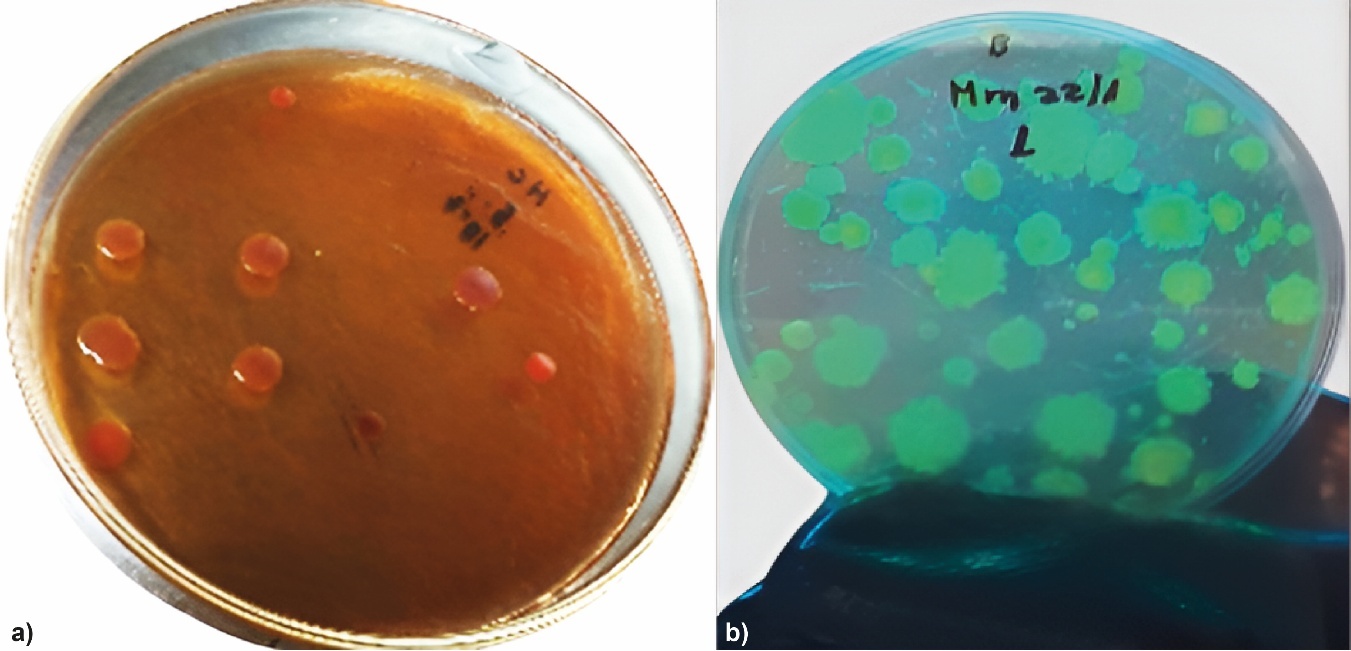
Figure 1
a) Colonies of Pseudomonas spp., on MacConkey agar, 72 hours of incubation at 26°C; b) Fluorescence on Pseudomonas agar.
Numerous Pseudomonas species have been reported as pesticide degraders, due to their genetic flexibility and metabolic versatility. These bacteria use a variety of mechanisms for degradation, including aerobic and anaerobic respiration, chemolithotrophy, extracellular enzyme activity, and fermentation. Although some limitations exist—such as incomplete mineralization or low efficiency in degrading complex pesticide mixtures—their molecular processes and catabolic potential are key to bioremediation (Ahmad et al., 2022; Randika et al., 2022; Rodríguez et al., 2020; Xu et al., 2023).
The actinomycete isolates were also characterized. Their aerial mycelium and diffusible pigments (Figure 2) described using the British Standard BS 381C color chart, along with colony morphology and spore microscopy (Table 2), confirmed that isolates ACP1 and ACP2 displayed typical characteristics of the genus Streptomyces. Growth assays on various carbon sources showed that both isolates could metabolize five of the eight tested substrates (Table 3). This ability to utilize different amino acids and organic sources is characteristic of actinomycetes, which play a key role in the carbon cycle by breaking down complex polymers and supporting microbial community dynamics (Grgas et al., 2023; Mehta & Jadeja, 2022; Oyedoh et al., 2023; Pérez-Corral et al., 2022; Rodríguez-Fonseca et al., 2021; Salem et al., 2023).
![Actinomycetes colonies in pure culture [GYM] and spore microscopy: a) ACP1: aerial mycelium, b) ACP1: diffusible pigment; c) ACP1: spores_1000X, d) ACP2: aerial mycelium, e) ACP2: diffusible pigment; f) ACP2: spores_1000X.](https://revistadigital.uce.edu.ec/index.php/SIEMBRA/article/download/6949/version/6918/11088/50119/653881812004_gf3.png)
Figure 2
Actinomycetes colonies in pure culture [GYM] and spore microscopy: a) ACP1: aerial mycelium, b) ACP1: diffusible pigment; c) ACP1: spores_1000X, d) ACP2: aerial mycelium, e) ACP2: diffusible pigment; f) ACP2: spores_1000X.
| Isolates | Aerial mycelium | Diffusible pigment | Spores |
| ACP1 | 380 Camouflage Desert Sand* | 592 International Orange* | Oval long chain |
| ACP2 | 460 Deep Buff* | 537 Signal Red* | Individual elongated |
| *BS 381C | *BS 381C | 1000 X |
| Aminoacids | Actinomycetes (120 h) | |||
| ACP1 | ACP2 | Control | ||
| Urea | 1 | 1 | 0 | |
| Glutamic acid | 1 | 1 | 0 | |
| Aspartic acid | 1 | 1 | 0 | |
| Asparagine | 1 | 1 | 0 | |
| Arginine | 1 | 1 | 0 | |
| Cysteine | 0 | 0 | 0 | |
| Glycine | 0 | 0 | 0 | |
| Tyrosine | 0 | 0 | 0 | |
| 1 growth | 0 no growth | |||
Actinomycetes also perform several beneficial functions, including nitrogen fixation, phosphate solubilization, phytohormone and enzyme production, organic matter decomposition, biocontrol of phytopathogens, and bioremediation in soil and substrates. For this reason, ACP1 and ACP2 were selected for pesticide degradation assays, exploring common microbial mechanisms such as competition for space and nutrients, secretion of antibiotics, siderophores, lytic enzymes, volatile organic compounds, phytohormone synthesis, and resistance induction (Nazari et al., 2022; Torres-Rodríguez et al., 2022).
Both Pseudomonas spp. and Streptomyces spp. contribute to degradation through biological and abiotic pathways. However, bioremediation via microbial activity is considered the most effective strategy for transforming pesticides into simpler, less toxic compounds due to the organisms' strong metabolic potential. This potential can be influenced by factors such as degradation efficiency, ease of cultivation, inoculum size, tolerance to high pesticide concentrations, adaptability, and competitiveness with native microbial communities (Conde-Avila et al., 2021; Dar et al., 2023; Guerrero Ramírez et al., 2023; Roumeng et al., 2023).
3.3 Pesticide degradation assays under in vitro conditions
The results of the pesticide degradation tests revealed notable changes in both the growth and morphology of the microorganisms evaluated. Pseudomonas spp. showed slow, irregular growth, and its colonies lost their characteristic brightness. For the actinomycete isolates ACP1 and ACP2, growth was also slow, the aerial mycelium lost pigmentation, and sporulation was accelerated but sparse. Trichoderma harzianum colonized the medium by 96 hours, with similarly accelerated but limited sporulation (Figure 3). These observations align with other studies reporting the morphological and physiological impacts of pesticides on microbial growth and viability (Mohapatra et al., 2022; Shahid et al., 2021).
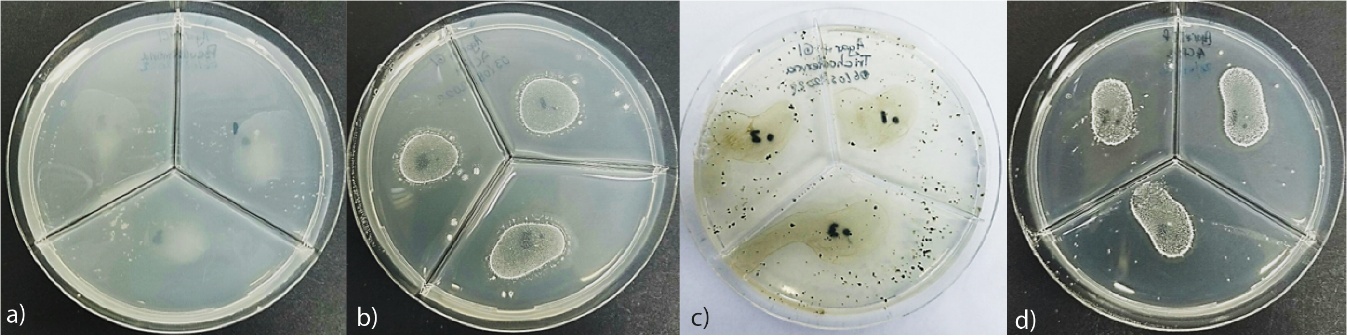
Figure 3
Morphological alterations of pesticide-degrading microorganism: a) Pseudomonas / Chlorfenapyr, b) ACP1 / Glyphosate c) Trichoderma harzianum / Glyphosate, d) ACP2 / Difenoconazole.
Residue analysis (Table 4) confirmed that all tested microorganisms effectively reduced pesticide concentrations (Figure 4). Among the compounds, difenoconazole was the most readily degraded, with a reduction of up to 87%. This is likely due to both microbial efficiency and aerobic conditions, which are known to favor rapid degradation. Aerobic composting processes have also been associated with enhanced difenoconazole breakdown, whereas anaerobic conditions hinder it. This is especially relevant considering the pesticide’s high toxicity, which includes neurotoxic effects and oxidative stress in eukaryotic organisms (Liu et al., 2022; Man et al., 2021).
| Pesticide | Microorganism | IC initial concentration | FC final concentration | Standard Deviation | Degradation |
| ppm | ppm | σ | (%) | ||
| Chlorfenapyr | Pseudomona spp. | 4.4 | 2.1 | 0.33040379 | 52.2 |
| ACP1 | 4.4 | 2.8 | 36.3 | ||
| ACP2 | 4.4 | 2.7 | 38.6 | ||
| Trichoderma harzianum | 4.4 | 2.3 | 47.7 | ||
| Control | 4.4 | 4.4 | 0 | ||
| Difenoconazole | Pseudomona spp. | 4.13 | 0.91 | 0.67406108 | 77.9 |
| ACP1 | 4.13 | 2 | 51.5 | ||
| ACP2 | 4.13 | 1.6 | 61.2 | ||
| Trichoderma harzianum | 4.13 | 0.5 | 87.8 | ||
| Control | 4.13 | 4.13 | 0 | ||
| Glyphosate | Pseudomona spp. | 4.68 | 3.2 | 0.71355915 | 31.6 |
| ACP1 | 4.68 | 2.3 | 50.8 | ||
| ACP2 | 4.68 | 3.7 | 20.9 | ||
| Trichoderma harzianum | 4.68 | 3.9 | 16.6 | ||
| Control | 4.68 | 4.68 | 0 | ||
| Mix_3 | Pseudomona spp. | 13.21 | 5.79 | 0.42762912 | 56.1 |
| ACP1 | 13.21 | 5 | 62.1 | ||
| ACP2 | 13.21 | 5.17 | 60.8 | ||
| Trichoderma harzianum | 13.21 | 5.84 | 55.7 |
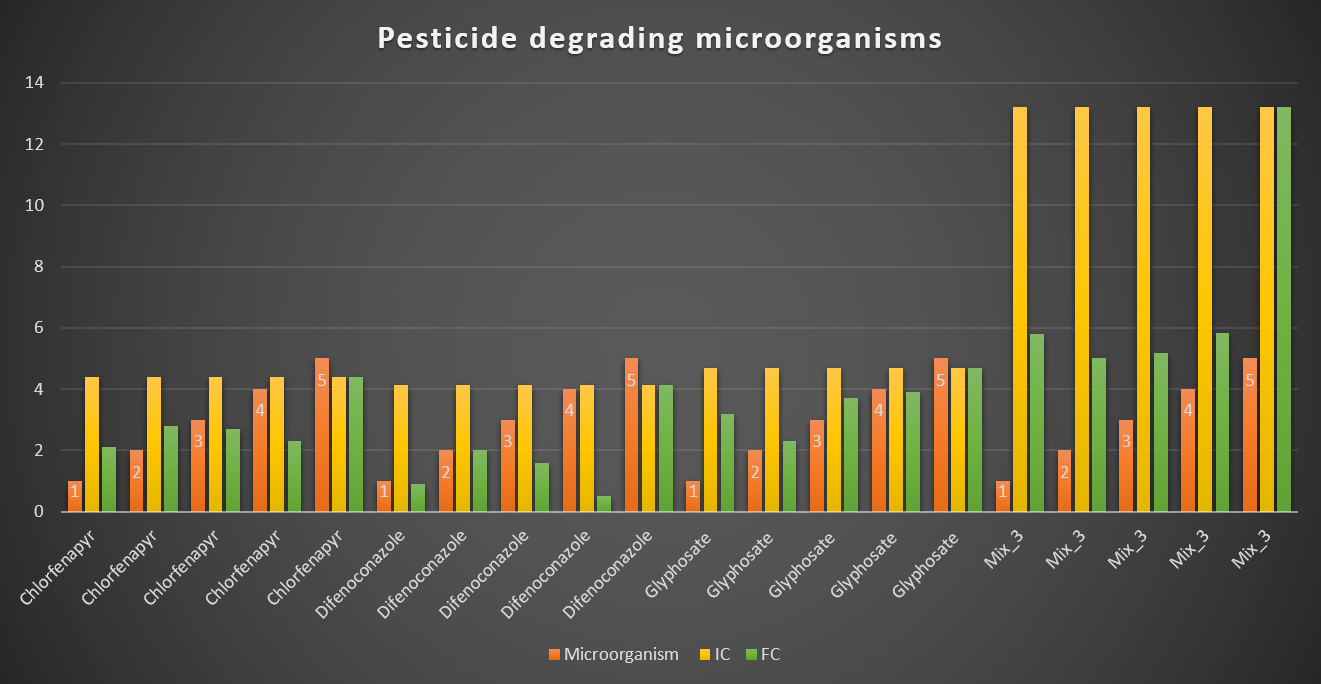
Figure 4
Degradation of pesticides by microbial action.
Chlorfenapyr was degraded by 52%, suggesting that the tested microorganisms lack some of the enzymatic pathways necessary for complete breakdown. Given its link to neurotoxic, gastrointestinal, and leukoencephalopathic effects, its persistence poses a potential risk. Although few microorganisms are reported to degrade chlorfenapyr, the observed reduction may involve enzymatic pathways—such as oxygenases—commonly found in Pseudomonas spp. (Cheng et al., 2022; Schaeffer & Wijntjes, 2022; Sun et al., 2023; Wu et al., 2020; Yang et al., 2020).
Glyphosate degradation reached only 50%, which is relatively low given the molecule's toxicological risks to human health and its documented lethality to plants and mammals at low concentrations (Singh et al., 2024). These findings are consistent with previous studies showing partial degradation of glyphosate by Pseudomonas spp. and Trichoderma harzianum (Rafieenia et al., 2022; Singh et al., 2020a).
In the pesticide mixture, degradation was higher, reaching 62%, suggesting synergistic degradation effects. This aligns with other studies highlighting the ability of bacterial, fungal, and actinomycete genera to degrade pesticide mixtures via enzymatic and metabolic pathways (Bamdad et al., 2022; Raffa & Chiampo, 2021). In this study, Pseudomonas spp. demonstrated its capacity to break down pollutants across different environments. Other genera—such as Flavobacterium, Achromobacterium, Sphingomonas, Arthrobacter, and Bacillus—have also shown promising results in pesticide degradation (Esikova et al., 2023; Huang et al., 2023; Mustapha et al., 2019).
Actinomycetes, particularly Streptomyces spp. isolates ACP1 and ACP2, also contributed significantly to degradation. ACP1 was most efficient at degrading difenoconazole, both alone and in combination, while ACP2 showed notable activity against difenoconazole alone and chlorfenapyr in the mixture. These results support previous findings that actinomycetes play key roles in degrading pesticides across various chemical classes—such as organophosphates, carbamates, triazinones, acetanilides, and sulfonylureas—through mechanisms including nutrient cycling and polymer decomposition (Castrejón-Godínez et al., 2021; Das et al., 2021; Srinivasulu et al., 2024).
Fungi such as Trichoderma spp. have also been reported for their bioremediation potential. In this study, T. harzianum efficiently degraded chlorfenapyr and difenoconazole. These findings align with recent reports of Trichoderma spp. acting as hyperaccumulators capable of absorbing heavy metals and degrading pesticide residues in soil (Correa et al., 2021; Khazal & Suhail, 2022; Kunanbayev et al., 2019; Sun et al., 2020; Wang et al., 2024; Zin & Badaluddin, 2020). Interestingly, while degradation of difenoconazole and chlorfenapyr was high, glyphosate concentrations in the mixture increased, possibly due to T. harzianum's hyperaccumulation behavior.
Statistical analysis of standard deviations (Table 4) revealed low variability across treatments, indicating consistent pesticide degradation by the microbial isolates used in this study.
4. Conclusions
The presence of abundant phytopathogenic fungi and enterobacteria indicates low microbiological quality in the compost samples analyzed, and their use poses a risk to the health of the soil, crops, and farmers. It is recommended to carry out pretreatments before use to reduce the presence of pathogens.
Pesticide degradation tests using microbial isolates obtained from compost—identified as Pseudomonas spp. and Streptomyces (ACP1 and ACP2)—demonstrated their potential as bioremediation agents for residues of glyphosate, chlorfenapyr, and difenoconazole.
Additionally, the reference strain Trichoderma harzianum was effective in pesticide degradation, confirming its potential role in bioremediation processes. Therefore, it is recommended to enrich compost with a defined concentration of fungal spores before application to promote biological activity, reduce phytopathogen populations, and enhance the additional beneficial mechanisms this fungus provides to soil and crops.
Contributor roles
-
Ana María Cunachi Pillajo: conceptualization, formal analysis, investigation, methodology, resources, supervision, writing – review & editing.
-
Jimmy Romario Clemente Rivera: investigation, funding acquisition, methodology.
-
Talía Luzmila Barragán Rodríguez: investigation, funding acquisition, methodology.
Ethical implications
Ethics approval not applicable.
Conflict of interest
The authors declare that they have no affiliation with any organization with a direct or indirect financial interest that could have appeared to influence the work reported.
References
Agu, K. C., & Chidozie, C. P. (2021). An improved slide culture technique for the microscopic identification of fungal species. International Journal of Trend in Scientific Research and Development, 6(1), 243-254. https://www.ijtsrd.com/papers/ijtsrd45058.pdf
Ahamad, A., & Kumar, J. (2023). Pyrethroid pesticides: An overview on classification, toxicological assessment and monitoring. Journal of Hazardous Materials Advances, 10, 100284. https://doi.org/10.1016/j.hazadv.2023.100284
Ahmad, K. S. (2020). Remedial potential of bacterial and fungal strains (Bacillus subtilis, Aspergillus niger, Aspergillus flavus and Penicillium chrysogenum) against organochlorine insecticide Endosulfan. Folia microbiologica, 65(5), 801-810. https://doi.org/10.1007/s12223-020-00792-7
Ahmad, S., Ahmad, H. W., & Bhatt, P. (2022). Microbial adaptation and impact into the pesticide’s degradation. Archives of Microbiology, 204(5), 288. https://doi.org/10.1007/s00203-022-02899-6
Akyol, Ç., Ince, O., & Ince, B. (2019). Crop-based composting of lignocellulosic digestates: Focus on bacterial and fungal diversity. Bioresource technology, 288, 121549. https://doi.org/10.1016/j.biortech.2019.121549
Ameen, F., & Al-Homaidan, A. A. (2020). Compost inoculated with fungi from a mangrove habitat improved the growth and disease defense of vegetable plants. Sustainability, 13(1), 124. https://doi.org/10.3390/su13010124
An, Y. Q., Dong, Y. L., Hao, S. N., Xiao, H., Tian, Y. P., & Gong, Y. (2024). Survival after chlorfenapyr intoxication by non-gastrointestinal route. Clinical Toxicology, 62(2), 134-135. https://doi.org/10.1080/15563650.2024.2310748
Araujo, R. (2022). Advances in soil engineering: sustainable strategies for rhizosphere and bulk soil microbiome enrichment. Frontiers in Bioscience-Landmark, 27(6), 195. https://doi.org/10.31083/j.fbl2706195
Ayed, F., Abdallah, R. A. B., Jabnoun-Khiareddine, H., & Daami-Remadi, M. (2021). Selection of compost-derived actinomycetes with plant-growth promoting and tomato stem rot biocontrol potentialities. Journal of Phytopathology and Disease Management, 8(1), 79-91. https://core.ac.uk/download/483700402.pdf
Bamdad, H., Papari, S., Lazarovits, G., & Berruti, F. (2022). Soil amendments for sustainable agriculture: Microbial organic fertilizers. Soil Use and Management, 38(1), 94-120. https://doi.org/10.1111/sum.12762
Bhimani, A. A., Bhimani, H. D., Vaghela, N. R., & Gohel, S. D. (2024). Cultivation methods, characterization, and biocatalytic potential of organic solid waste degrading bacteria isolated from sugarcane rhizospheric soil and compost. Biologia, 79(3), 953-974. https://doi.org/10.1007/s11756-023-01592-3
Boiu-Sicuia, O.-A., Stan, V., & Cornea, C. P. (2021). The compost, a source of plant beneficial bacteria with biocontrol potential. Current Trends in Natural Sciences, 10(20), 32-38. https://doi.org/10.47068/ctns.2021.v10i20.004
Buol, S. W., Southard, R. J., Graham, R. C., & McDaniel, P. A. (2011). Soil Genesis and Classification. John Wiley & Sons. https://doi.org/10.1002/9780470960622
Buzón-Durán, L., Pérez-Lebeña, E., Martín-Gil, J., Sánchez-Báscones, M., & Martín-Ramos, P. (2020). Applications of Streptomyces spp. Enhanced Compost in Sustainable Agriculture. In M. Meghvansi & A. Varma (eds.), Biology of Composts. Soil Biology (Vol. 58, pp. 257-291). Springer. https://doi.org/10.1007/978-3-030-39173-7_13
Carpio, M. J., Sánchez-Martín, M. J., Rodríguez-Cruz, M. S., & Marín-Benito, J. M. (2021). Effect of organic residues on pesticide behavior in soils: a review of laboratory research. Environments, 8(4), 32. https://doi.org/10.3390/environments8040032
Castrejón-Godínez, M. L., Tovar-Sánchez, E., Valencia-Cuevas, L., Rosas-Ramírez, M. E., Rodríguez, A., & Mussali-Galante, P. (2021). Glyphosate pollution treatment and microbial degradation alternatives, a review. Microorganisms, 9(11), 2322. https://doi.org/10.3390/microorganisms9112322
Chen, L., Zhang, H., Jia, X., Fang, Y., & Lin, C. (2024). Soil fertility and bacterial community composition in response to the composting of biochar-amended chicken manure. Agronomy, 14(5), 886. https://doi.org/10.3390/agronomy14050886
Cheng, M., Chen, D., Parales, R. E., & Jiang, J. (2022). Oxygenases as powerful weapons in the microbial degradation of pesticides. Annual Review of Microbiology, 76(1), 325-348. https://doi.org/10.1146/annurev-micro-041320-091758
Chopkova, V., Petkova, M., & Shilev, S. (2023). Uncovering bacterial diversity during mesophilic and thermophilic phases of biowaste composting through next-generation sequencing. Applied Sciences, 13(5), 3111. https://doi.org/10.3390/app13053111
Chorolque, A., Pellejero, G., Sosa, M. C., Palacios, J., Aschkar, G., García-Delgado, C., & Jiménez-Ballesta, R. (2021). Biological control of soil-borne phytopathogenic fungi through onion waste composting: implications for circular economy perspective. International Journal of Environmental Science and Technology, 19(7), 6411-6420. https://doi.org/10.1007/s13762-021-03561-2
Conde-Avila, V., Ortega-Martínez, L. D., Loera, O., el Kassis, E. G., Dávila, J. G., Valenzuela, C. M., & Armendáriz, B. P. (2021). Pesticides degradation by immobilised microorganisms. International Journal of Environmental Analytical Chemistry, 101(15), 2975-3005. https://doi.org/10.1080/03067319.2020.1715375
Correa, L. O., Bezerra, A. F. M., Honorato, L. R. S., Cortêz, A. C. A., Souza, J. V. B., & Souza, E. S. (2021). Amazonian soil fungi are efficient degraders of glyphosate herbicide; novel isolates of Penicillium, Aspergillus, and Trichoderma. Brazilian Journal of Biology, 83, e242830. https://doi.org/10.1590/1519-6984.242830
Ćwiertniewicz-Wojciechowska, M., Ślipko, K., Banach-Wiśniewska, A., & Ziembińska-Buczyńska, A. (2023). Influence of the autochthonous cellulolytic bacteria on the domestic compost process improvement. BioTechnologia, 104(1), 5-20. https://doi.org/10.5114/bta.2023.125082
Danish, S. A., Haq, T., Liaqat, I., Rubab, S., Qureshi, M., & Zafar, U. (2021). Succession and Catabolic Properties of Fungal Community During Composting of Fruit Waste at Sub-Tropical Environment. https://doi.org/10.21203/rs.3.rs-704507/v1
Dar, M. A., Shahnawaz, M., Hussain, K., Gupta, P., Sirwal, M. Y., Sadaqat, B., Gazal, S., Akhtar, R., Parihar, S., Zhu, D., Adetunji, C. O., Fardos, T., Parihar, J., Omorefosa, O. O., Xie, R., & Sun, J. (2023). Natural compounds for bioremediation and biodegradation of pesticides. In S. N. Meena, V. Nandre, K. Kodam, & R. S. Meena (eds.), New Horizons in Natural Compound Research (pp. 445-488). Academic Press. https://doi.org/10.1016/B978-0-443-15232-0.00015-1
Das, P., Singh, S. K., Singh, P., Zeyad, M. T., Aamir, M., & Upadhyay, R. S. (2021). Actinomycetes as biostimulants and their application in agricultural practices. In J. White, A. Kumar, & S. Droby (eds.), Microbiome stimulants for crops (pp. 267-282). Woodhead Publishing. https://doi.org/10.1016/B978-0-12-822122-8.00021-2
de Corato, U. (2020). Disease-suppressive compost enhances natural soil suppressiveness against soil-borne plant pathogens: A critical review. Rhizosphere, 13, 100192. https://doi.org/10.1016/j.rhisph.2020.100192
de Sousa, T., Hébraud, M., Dapkevicius, M. L. N. E., Maltez, L., Pereira, J. E., Capita, R., Alonso-Calleja, C., Igrejas, G., & Poeta, P. (2021). Genomic and metabolic characteristics of the pathogenicity in Pseudomonas aeruginosa. International Journal of Molecular Sciences, 22(23), 12892. https://doi.org/10.3390/ijms222312892
Durán-Lara, E. F., Valderrama, A., & Marican, A. (2020). Natural organic compounds for application in organic farming. Agriculture, 10(2), 41. https://doi.org/10.3390/agriculture10020041
Esikova, T. Z., Anokhina, T. O., Suzina, N. E., Shushkova, T. V., Wu, Y., & Solyanikova, I. P. (2023). Characterization of a new Pseudomonas putida strain Ch2, a degrader of toxic anthropogenic compounds epsilon-caprolactam and glyphosate. Microorganisms, 11(3), 650. https://doi.org/10.3390/microorganisms11030650
Esimbekova, E. N., Kalyabina, V. P., Kopylova, K. v., Lonshakova-Mukina, V. I., Antashkevich, A. A., Torgashina, I. G., Lukyanenko, K. A., & Kratasyuk, V. A. (2022). The effects of commercial pesticide formulations on the function of in vitro and in vivo assay systems: A comparative analysis. Chemosensors, 10(8), 328. https://doi.org/10.3390/chemosensors10080328
Esparza-Naranjo, S. B., da Silva, G. F., Duque-Castaño, D. C., Araújo, W. L., Peres, C. K., Boroski, M., & Bonugli-Santos, R. C. (2021). Potential for the biodegradation of atrazine using leaf litter fungi from a subtropical protection area. Current Microbiology, 78, 358-368. https://doi.org/10.1007/s00284-020-02288-6
Fauriah, R., Amin, N., Daud, I. D., & Harsanti, E. S. (2021). The potential of endophytic fungi as biodegradation of chlorpyrifos in shallots. IOP Conference Series: Earth and Environmental Science, 807(3), 032058. https://doi.org/10.1088/1755-1315/807/3/032058
Fischer, G., & Dott, W. (2002). Quality assurance and good laboratory practice in the mycological laboratory – compilation of basic techniques for the identification of fungi. International Journal of Hygiene and Environmental Health, 205(6), 433-442. https://doi.org/10.1078/1438-4639-00190
Fuchs, B., Laihonen, M., Muola, A., Saikkonen, K., Dobrev, P. I., Vankova, R., & Helander, M. (2022). A glyphosate-based herbicide in soil differentially affects hormonal homeostasis and performance of non-target crop plants. Frontiers in Plant Science, 12, 787958. https://doi.org/10.3389/fpls.2021.787958
Girard, L., Lood, C., Höfte, M., Vandamme, P., Rokni-Zadeh, H., van Noort, V., Lavigne, R., & de Mot, R. (2021). The ever-expanding pseudomonas genus: description of 43 new species and partition of the Pseudomonas putida group. Microorganisms, 9(8), 1766. https://doi.org/10.3390/microorganisms9081766
Grgas, D., Rukavina, M., Bešlo, D., Štefanac, T., Crnek, V., Šikić, T., Habuda-Stanić, M., & Landeka Dragičević, T. (2023). The Bacterial Degradation of Lignin—A Review. Water, 15(7), 1272. https://doi.org/10.3390/w15071272
Grigorova-Pesheva, B., Malcheva, B., & Peshev, a. (2024). Microbial community dynamics of compost mixtures after application of microbiological additive. Scientific Papers. Series A. Agronomy, 67(1), 1. https://www.agronomyjournal.usamv.ro/index.php/scientific-papers/current?id=1723
Guerrero Ramírez, J. R., Ibarra Muñoz, L. A., Balagurusamy, N., Frías Ramírez, J. E., Alfaro Hernández, L., & Carrillo Campos, J. (2023). Microbiology and Biochemistry of Pesticides Biodegradation. International Journal of Molecular Sciences, 24(21), 15969. https://doi.org/10.3390/ijms242115969
Harrigan, W. F., & McCance, M. E. (2014). Laboratory methods in microbiology. Academic press.
Hernández-Mesa, M., & Moreno-González, D. (2022). Current role of mass spectrometry in the determination of pesticide residues in food. Separations, 9(6), 148. https://doi.org/10.3390/separations9060148
Huang, P., Yan, X., Yu, B., He, X., Lu, L., & Ren, Y. (2023). A comprehensive review of the current knowledge of chlorfenapyr: synthesis, mode of action, resistance, and environmental toxicology. Molecules, 28(22), 7673. https://doi.org/10.3390/molecules28227673
Ibrahim, I. A. J., & Hameed, T. A. K. (2015). Isolation, characterization and antimicrobial resistance patterns of lactose-fermenter enterobacteriaceae isolates from clinical and environmental samples. Open Journal of Medical Microbiology, 5(04), 169-176. http://dx.doi.org/10.4236/ojmm.2015.54021
Jakubus, M., & Michalak-Oparowska, W. (2022). Valorization of quality of vermicomposts and composts using various parameters. Agriculture, 12(2), 293. https://doi.org/10.3390/agriculture12020293
Jeong, D. K., Lee, H. J., Bae, J. Y., Jang, Y. S., Hong, S. M., & Kim, J. H. (2019). Chlorfenapyr residue in sweet persimmon from farm to table. Journal of food protection, 82(5), 810-814. https://doi.org/10.4315/0362-028X.JFP-18-503
Kannan, R., & Kallapiran, K. A. (2022). A Review on the Agricultural Waste Residues Management by Different Microbes. Journal of Agriculture and Ecology Research International, 23(6), 93-113. https://doi.org/10.9734/jaeri/2022/v23i6502
Khazal, S. S., & Suhail, F. M. (2022). Study of the analysis of microbial dusting pesticides caused by Pseudomonas bacteria and Trichoderma fungi. International Journal of Mechanical Engineering, 7(2), 1755-1315. https://kalaharijournals.com/resources/FebV7_I2_375%20(1).pdf
Kraut-Cohen, J., Zolti, A., Rotbart, N., Bar-Tal, A., Laor, Y., Medina, S., Shawahna, R., Saadi, I., Raviv, M., Green, S. J., Yermiyahu, U., & Minz, D. (2023). Short- and long-term effects of continuous compost amendment on soil microbiome community. Computational and Structural Biotechnology Journal, 21, 3280-3292. https://doi.org/10.1016/j.csbj.2023.05.030
Kumar, R. R., & Jadeja, V. J. (2016). Isolation of Actinomycetes: A Complete Approach. International Journal of Current Microbiology and Applied Sciences, 5(5), 606-618. https://doi.org/10.20546/ijcmas.2016.505.062
Kunanbayev, K., Churkinа, G., Rukavitsina, I., Filippova, N., & Utebayev, M. (2019). Potential attractiveness of soil fungus Trichoderma inhamatum for biodegradation of the glyphosate herbicide. Journal of Ecological Engineering, 20(11), 240-245. https://doi.org/10.12911/22998993/113580
Kurakov, A. V., & Bilanenko, E. N. (2023). Dynamics of mycobiota during composting of cow manure and straw. Eurasian Soil Science, 56(4), 453-469. https://doi.org/10.1134/S1064229322602554
Lakshmanan, R., Kalaimurugan, D., Sivasankar, P., Arokiyaraj, S., & Venkatesan, S. (2020). Identification and characterization of Pseudomonas aeruginosa derived bacteriocin for industrial applications. International Journal of Biological Macromolecules, 165, 2412-2418. https://doi.org/10.1016/j.ijbiomac.2020.10.126
Lau, Y. Y., Hernandes, E., Kristanti, R. A., Wijayanti, Y., & Emre, M. (2023). Exploring the potential of composting for bioremediation of pesticides in agricultural sector. Industrial and Domestic Waste Management, 3(1), 47-66. https://doi.org/10.53623/idwm.v3i1.245
Leskovac, A., & Petrović, S. (2023). Pesticide use and degradation strategies: food safety, challenges and perspectives. Foods, 12(14), 2709. https://doi.org/10.3390/foods12142709
Liu, F., Wang, Y., Chen, L., Bello, B. K., Zhang, T., Yang, H., Li, X., Pan, E., Feng, H., & Dong, J. (2022). Difenoconazole disrupts the blood-brain barrier and results in neurotoxicity in carp by inhibiting the Nrf2 pathway mediated ROS accumulation. Ecotoxicology and Environmental Safety, 244, 114081. https://doi.org/10.1016/j.ecoenv.2022.114081
Liu, G., Yang, Y., Ma, R., Jiang, J., Li, G., Wang, J., Wuyun, D., & Yuan, J. (2023). Thermophilic compost inoculating promoted the maturity and mature compost inoculating reduced the gaseous emissions during co-composting of kitchen waste and pig manure. Environmental Technology & Innovation, 32, 103427. https://doi.org/10.1016/j.eti.2023.103427
Liu, Y., Cheng, D., Xue, J., Weaver, L., Wakelin, S. A., Feng, Y., & Li, Z. (2020). Changes in microbial community structure during pig manure composting and its relationship to the fate of antibiotics and antibiotic resistance genes. Journal of Hazardous Materials, 389, 122082. https://doi.org/10.1016/j.jhazmat.2020.122082
Lv, Z., Tao, C., Zhang, J., Shen, Z., Wang, D., Wang, B., Liu, H., & Li, R. (2023). Moderately delayed maturation of composting promotes the reduction of guild-plant pathogenic fungi within vegetable waste. Research Square. https://doi.org/10.21203/rs.3.rs-3032959/v1
Maleki, M., Mostafaee, S., Mokhtarnejad, L., & Farzaneh, M. (2010). Characterization of Pseudomonas fluorescens strain CV6 isolated from cucumber rhizosphere in Varamin as a potential biocontrol agent. Australian Journal of Crop Science, 4(9), 676-683. https://www.cropj.com/maleki_4_9_2010_676_683.pdf
Man, Y., Stenrød, M., Wu, C., Almvik, M., Holten, R., Clarke, J. L., Yuan, S., Wu, X., Xu, J., Dong, F., Zheng, Y., & Liu, X. (2021). Degradation of difenoconazole in water and soil: Kinetics, degradation pathways, transformation products identification and ecotoxicity assessment. Journal of Hazardous Materials, 418, 126303. https://doi.org/10.1016/j.jhazmat.2021.126303
Mashi, B. H. (2018). Antibiotic Susceptibility Patterns of Pseudomonas spp. Isolated from Soil Samples. UMYU Journal of Microbiology Research (UJMR), 3(2), 27-31. https://doi.org/10.47430/ujmr.1832.005
Matúš, P., Littera, P., Farkas, B., & Urík, M. (2023). Review on performance of Aspergillus and Penicillium species in biodegradation of organochlorine and organophosphorus pesticides. Microorganisms, 11(6), 1485. https://doi.org/10.3390/microorganisms11061485
Mehta, J. S., & Jadeja, B. A. (2022). Biochemical and physiological characterization of actinomycetes isolated from rhizospheric regions in the soils of Arachis hypogea L. and Gossypium herbaceum L. near the Gir Wildlife Sanctuary. Journal of Pharmaceutical Negative Results, 13(8), 267-273. https://doi.org/10.47750/pnr.2022.13.S08.40
Meng, Q., Yang, W., Men, M., Bello, A., Xu, X., Xu, B., Deng, L., Jiang, X., Sheng, S., Wu, X., Han, Y., & Zhu, H. (2019). Microbial community succession and response to environmental variables during cow manure and corn straw composting. Frontiers in Microbiology, 10, 529. https://doi.org/10.3389/fmicb.2019.00529
Midhat, M. S., & Abed, S. M. (2023). Isolation and identification of pathogenic species of the genus Pseudomonas and study of antibiotic resistance. GSC Biological and Pharmaceutical Sciences, 23(1), 087-098. https://doi.org/10.30574/gscbps.2023.23.1.0144
Mohammad, A. O., Alkurtany, A. E., & Hassan, A. A. (2020). Evaluation of API 20E system in fluorescent Pseudomonas identification from button mushroom Agaricus bisporus cultivation casing soil. Notulae Scientia Biologicae, 12(2), 258-263. http://dx.doi.org/10.15835/nsb12210628
Mohapatra, D., Rath, S. K., & Mohapatra, P. K. (2022). Soil fungi for bioremediation of pesticide toxicants: A perspective. Geomicrobiology Journal, 39(3-5), 352-372. https://doi.org/10.1080/01490451.2021.2019855
Mustapha, M. U., Halimoon, N., Johar, W. L. W., & Abd Shukor, M. Y. (2019). An overview on biodegradation of carbamate pesticides by soil bacteria. Pertanika Journal of Science & Technology, 27(2), 547-563. http://psasir.upm.edu.my/id/eprint/68692/
Naeem, U., Afzaal, M., Haq, I. ul, Qazi, A., Naeem, A., & Mahfooz, Y. (2022). A Comparative Role of Competent Microbes for Value-added Composting of Agricultural Waste. Research Square. https://doi.org/10.21203/rs.3.rs-2087247/v1
Narsing Rao, M. P., & Li, W. J. (2022). Diversity of Actinobacteria in various habitats. In L. Karthik (ed.), Actinobacteria: Microbiology to Synthetic Biology (pp. 37-58). Springer Nature Singapore. https://doi.org/10.1007/978-981-16-5835-8_2
Nazari, M. T., Machado, B. S., Marchezi, G., Crestani, L., Ferrari, V., Colla, L. M., & Piccin, J. S. (2022). Use of soil actinomycetes for pharmaceutical, food, agricultural, and environmental purposes. 3 Biotech, 12(9), 232. https://doi.org/10.1007/s13205-022-03307-y
Nazem Shirazi, M. H., Soltani Majd, N., & Khodayari, M. (2023). Molecular and Biochemical Characterization of Pseudomonas aeruginosa Isolated from a Turkey Flock. Journal of Poultry Sciences and Avian Diseases, 1(2), 42-46. https://doi.org/10.61838/kman.jpsad.1.2.6
O'hara, C. M. (2005). Manual and automated instrumentation for identification of Enterobacteriaceae and other aerobic gram-negative bacilli. Clinical microbiology reviews, 18(1), 147-162. https://doi.org/10.1128/cmr.18.1.147-162.2005
Oyedoh, O. P., Yang, W., Dhanasekaran, D., Santoyo, G., Glick, B. R., & Babalola, O. O. (2023). Rare rhizo-Actinomycetes: A new source of agroactive metabolites. Biotechnology Advances, 67, 108205. https://doi.org/10.1016/j.biotechadv.2023.108205
Palaniveloo, K., Amran, M. A., Norhashim, N. A., Mohamad-Fauzi, N., Peng-Hui, F., Hui-Wen, L., Kai-Lin, Y., Jiale, L., Chian-Yee, M. G., Jing-Yi, L., Gunasekaran, B., & Razak, S. A. (2020). Food Waste Composting and Microbial Community Structure Profiling. Processes, 8(6), 723. https://doi.org/10.3390/pr8060723
Pant, R., Tiwari, K., Singh, A., Srivastava, S., Patrick, N., & Gupta, A. (2022). Screening, Isolation and characterization of Soil microbes at the banks of the Song River. Bulletin of Environment, Pharmacology and Life Sciences, 12(1), 141-148. https://bepls.com/dec_2022/20.pdf
Parra-Arroyo, L., González-González, R. B., Castillo-Zacarías, C., Melchor Martínez, E. M., Sosa-Hernández, J. E., Bilal, M., Iqbal, H. M. N., Barceló, D., & Parra-Saldívar, R. (2022). Highly hazardous pesticides and related pollutants: Toxicological, regulatory, and analytical aspects. Science of The Total Environment, 807, 151879. https://doi.org/10.1016/j.scitotenv.2021.151879
Peillex, C., & Pelletier, M. (2020). The impact and toxicity of glyphosate and glyphosate-based herbicides on health and immunity. Journal of immunotoxicology, 17(1), 163-174. https://doi.org/10.1080/1547691X.2020.1804492
Pérez-Corral, D. A., Ornelas-Paz, J. de J., Olivas-Orozco, G. I., Acosta-Muñiz, C. H., Salas-Marina, M. Á., Berlanga-Reyes, D. I., Ruiz-Cisneros, M. F., & Rios-Velasco, C. (2022). Molecular, morphological and biochemical characterization of actinomycetes and their antagonistic activity against phytopathogenic fungi. Revista Fitotecnia Mexicana, 45(1), 103. https://doi.org/10.35196/rfm.2022.1.103
Pizzul, L., Castillo, M. D. P., & Stenström, J. (2009). Degradation of glyphosate and other pesticides by ligninolytic enzymes. Biodegradation, 20, 751-759. https://doi.org/10.1007/s10532-009-9263-1
Qin, G., Chen, Y., He, F., Yang, B., Zou, K., Shen, N., Zuo, B., Liu, R., Zhang, W., & Li, Y. (2021). Risk assessment of fungicide pesticide residues in vegetables and fruits in the mid-western region of China. Journal of Food Composition and Analysis, 95, 103663. https://doi.org/10.1016/j.jfca.2020.103663
Raffa, C. M., & Chiampo, F. (2021). Bioremediation of agricultural soils polluted with pesticides: A review. Bioengineering, 8(7), 92. https://doi.org/10.3390/bioengineering8070092
Rafieenia, R., Mahmoud, M., El-Gohary, F., & Rossa, C. A. (2022). The degradation of glyphosate is enhanced in a microbial fuel cell: Electrochemical performance, degradation efficiency, and analysis of the anodic microbial community. Sustainable Energy Technologies and Assessments, 54, 102805. https://doi.org/10.1016/j.seta.2022.102805
Randika, J. L. P. C., Bandara, P. K. G. S. S., Soysa, H. S. M., Ruwandeepika, H. A. D., & Gunatilake, S. K. (2022). Bioremediation of pesticide-contaminated soil: a review on indispensable role of soil bacteria. Journal of Agricultural Sciences – Sri Lanka, 17(1), 19-43. https://doi.org/10.4038/jas.v17i1.9609
Rasool, S., Rasool, T., & Gani, K. M. (2022). A review of interactions of pesticides within various interfaces of intrinsic and organic residue amended soil environment. Chemical Engineering Journal Advances, 11, 100301. https://doi.org/10.1016/j.ceja.2022.100301
Rastogi, M., Nandal, M., & Khosla, B. (2020). Microbes as vital additives for solid waste composting. Heliyon, 6(2), e03343. https://doi.org/10.1016/j.heliyon.2020.e03343
Riedo, J., Wächter, D., Gubler, A., Wettstein, F. E., Meuli, R. G., & Bucheli, T. D. (2023). Pesticide residues in agricultural soils in light of their on-farm application history. Environmental Pollution, 331, 121892. https://doi.org/10.1016/j.envpol.2023.121892
Rigolin, F. R., Leite, C. A., Birolli, W. G., Porto, A. L., & Seleghim, M. H. (2024). Biodegradation of the pyrethroid pesticide gamma-cyhalothrin by fungi from a Brazilian cave. Journal of the Brazilian Chemical Society, 35, e-20240026. https://dx.doi.org/10.21577/0103-5053.20240026
Rodríguez, A., Castrejón-Godínez, M. L., Salazar-Bustamante, E., Gama-Martínez, Y., Sánchez-Salinas, E., Mussali-Galante, P., Tovar-Sánchez, E., & Ortiz-Hernández, Ma. L. (2020). Omics Approaches to Pesticide Biodegradation. Current Microbiology, 77(4), 545–563. https://doi.org/10.1007/s00284-020-01916-5
Rodríguez, C. A., Gavilánez, T. C., Chamorro, J. P., Vinueza, A. G., Salazar, D. M., & Arancibia, M. Y. (2018). Selective Isolation and Phenotypic Characterization of Bacteria and Actinomycetes from Oil-contaminated Soils. IOP Conference Series: Earth and Environmental Science, 151, 012039. https://doi.org/10.1088/1755-1315/151/1/012039
Rodríguez-Fonseca, M. F., Sánchez-Suárez, J., Valero, M. F., Ruiz-Balaguera, S., & Díaz, L. E. (2021). Streptomyces as potential synthetic polymer degraders: A systematic review. Bioengineering, 8(11), 154. https://doi.org/10.3390/bioengineering8110154
Rossi, F., Carles, L., Donnadieu, F., Batisson, I., & Artigas, J. (2021). Glyphosate-degrading behavior of five bacterial strains isolated from stream biofilms. Journal of Hazardous Materials, 420, 126651. https://doi.org/10.1016/j.jhazmat.2021.126651
Ruiz-Hernandez, I. H., Madrigal-Perez, L. A., & González-Hernández, J. C. (2024). The potential use of Pseudomonas in terrestrial and space agriculture. Brazilian Journal of Biology, 84. https://doi.org/10.1590/1519-6984.282664
Ruomeng, B., Meihao, O., Siru, Z., Shichen, G., Yixian, Z., Junhong, C., Ruijie, M., Yuan, L., Gezhi, X., Xingyu, C., Shiyi, Z., Aihui, Z., & Baishan, F. (2023). Degradation strategies of pesticide residue: From chemicals to synthetic biology. Synthetic and Systems Biotechnology, 8(2), 302-313. https://doi.org/10.1016/j.synbio.2023.03.005
Salazar Calvo, C., Moya García, A., González Venegas, J. P., Rodríguez Díaz, H., & Corrales Valverde, D. (2020). Comparación de dos métodos de muestreo para el análisis de fertilidad de suelos. Alcances Tecnológicos, 13(1), 31-39. https://doi.org/10.35486/at.v13i1.168
Salem, G. S., Baiu, S. H., & Ali, A. A. (2023). Isolation, examination and characterization of actinomycetes as a source of antimicrobial agents from Libyan soil. Advances in Bioscience and Biotechnology, 14(6), 322-336. https://doi.org/10.4236/abb.2023.146020
Sapkota, A., Thapa, A., Budhathoki, A., Sainju, M., Shrestha, P., & Aryal, S. (2020). Isolation, Characterization, and Screening of Antimicrobial-Producing Actinomycetes from Soil Samples. International Journal of Microbiology, 2020, 2716584. https://doi.org/10.1155/2020/2716584
Schaeffer, A., & Wijntjes, C. (2022). Changed degradation behavior of pesticides when present in mixtures. Eco-Environment & Health, 1(1), 23-30. https://doi.org/10.1016/j.eehl.2022.02.002
Shahid, M., Manoharadas, S., Altaf, M., & Alrefaei, A. F. (2021). Organochlorine pesticides negatively influenced the cellular growth, morphostructure, cell viability, and biofilm-formation and phosphate-solubilization activities of Enterobacter cloacae strain EAM 35. ACS omega, 6(8), 5548-5559. https://doi.org/10.1021/acsomega.0c05931
Shalaby, A. A., Rahman, A. E., & Shalaby, M. A. (2022). Study of Imidacloprid, Azoxystrobin and Difenoconazole Residues and their Biochemical effects on Cucumber. Journal of Plant Protection and Pathology, 13(7), 161-167. https://dx.doi.org/10.21608/jppp.2022.148665.1085
Sharma, I. (2021). Phytopathogenic fungi and their biocontrol applications. In Fungi Bio-Prospects in Sustainable Agriculture, Environment and Nano-Technology (pp. 155-188). Academic Press. https://doi.org/10.1016/B978-0-12-821394-0.00007-X
Singh, B., Bhadu, A., Sharma, J., Ali, O., Neogi, S., Gunri, S. K., & Roy, D. (2022). Effect of microbes in enhancing the composting process: a review. International Journal of Plant & Soil Science, 34(23), 630-641. https://doi.org/10.9734/ijpss/2022/v34i232469
Singh, R., Shukla, A., Kaur, G., Girdhar, M., Malik, T., & Mohan, A. (2024). Systemic analysis of glyphosate impact on environment and human health. ACS Omega, 9(6), 6165-6183. https://doi.org/10.1021/acsomega.3c08080
Singh, S., Kumar, V., Gill, J. P. K., Datta, S., Singh, S., Dhaka, V., Kapoor, D., Wani, A. B., Dhanjal, D. S., Kumar, M., Harikumar, S. L., & Singh, J. (2020a). Herbicide glyphosate: Toxicity and microbial degradation. International Journal of Environmental Research and Public Health, 17(20), 7519. https://doi.org/10.3390/ijerph17207519
Singh, T. B., Ali, A., Prasad, M., Yadav, A., Shrivastav, P., Goyal, D., & Dantu, P. K. (2020b). Role of organic fertilizers in improving soil fertility. In M. Naeem, A. A. Ansari, & S. S. Gill (eds.), Contaminants in Agriculture: Sources, Impacts and Management (pp. 61-77). Springer International Publishing. https://doi.org/10.1007/978-3-030-41552-5_3
Singh, Y. P., Arora, S., Mishra, V. K., Gupta, R. H., & Mishra, S. J. (2023). Changes in physicochemical and microbial properties during standardization of on-farm composting of municipal solid waste. Journal of Natural Resource Conservation and Management, 4(1), 40-49. https://10.51396/ANRCM.4.1.2023.40-49
Srinivasulu, M., Maddela, N. R., Chandra, M. S., Shankar, P. C., Rangaswamy, V., & Prasad, R. (2024). Microbe-pesticide interactions: Soil enzyme analysis and bacterial degradation of chlorpyrifos. Environmental Chemistry and Ecotoxicology, 6, 180-191. https://doi.org/10.1016/j.enceco.2024.05.004
Sun, J., Karuppiah, V., & Chen, J. (2020). The mechanism of heavy metal absorption and biodegradation of organophosphorus pesticides by Trichoderma. In V. K. Gupta, S. Zeilinger, H. B. Singh, & I. Druzhinina (eds.), New and future developments in microbial biotechnology and bioengineering (pp. 303-318). Elsevier. https://doi.org/10.1016/B978-0-12-819453-9.00014-3
Sun, M., Yi, X., Tong, Z., Dong, X., Chu, Y., Meng, D., & Duan, J. (2023). Residual behavior and dietary risk assessment of chlorfenapyr and its metabolites in radish. Molecules, 28(2), 580. https://doi.org/10.3390/molecules28020580
Tawfik Ali ElHaty, M., Ibrahim, M., & Mansour, M. (2022). Effectiveness of pesticides on soil fungal Biota and role of these fungi in bioremediation of pesticides residues. Alfarama Journal of Basic & Applied Sciences, 3(2), 239-252. https://doi.org/10.21608/ajbas.2022.118868.1086
Torres-Rodriguez, J. A., Reyes-Pérez, J. J., Quiñones-Aguilar, E. E., & Hernandez-Montiel, L. G. (2022). Actinomycete potential as biocontrol agent of phytopathogenic fungi: mechanisms, source, and applications. Plants, 11(23), 3201. https://doi.org/10.3390/plants11233201
Valle, A. L., Mello, F. C. C., Alves-Balvedi, R. P., Rodrigues, L. P., & Goulart, L. R. (2019). Glyphosate detection: methods, needs and challenges. Environmental Chemistry Letters, 17(1), 291-317. https://doi.org/10.1007/s10311-018-0789-5
Van Gijn, K., Chen, Y. L., Van Oudheusden, B., Gong, S., De Wilt, H. A., Rijnaarts, H. H. M., & Langenhoff, A. A. M. (2021). Optimizing biological effluent organic matter removal for subsequent micropollutant removal. Journal of Environmental Chemical Engineering, 9(5), 106247. https://doi.org/10.1016/j.jece.2021.106247
Wang, K., Sun, D. W., Pu, H., & Wei, Q. (2019). Surface-enhanced Raman scattering of core-shell Au@ Ag nanoparticles aggregates for rapid detection of difenoconazole in grapes. Talanta, 191, 449-456. https://doi.org/10.1016/j.talanta.2018.08.005
Wang, W., Peng, G., Sun, Y., & Chen, X. (2024). Increasing the tolerance of Trichoderma harzianum T-22 to DMI fungicides enables the combined utilization of biological and chemical control strategies against plant diseases. Biological Control, 192, 105479. https://doi.org/10.1016/j.biocontrol.2024.105479
Wellington, E. M. H., & Toth, I. K. (1994). Actinomycetes. In R. W. Weaver, S. Angle, P. Bottomley, D. Bezdicek, S. Smith, A. Tabatabai & A. Wollum (eds.), Methods of Soil Analysis: Part 2 Microbiological and Biochemical Properties, 5 (pp. 269-290). https://doi.org/10.2136/sssabookser5.2.c15
Williams, S. T., & Cross, T. (1971). Chapter XI actinomycetes. In Methods in microbiology (pp. 295-334). Academic Press. https://doi.org/10.1016/S0580-9517(09)70016-9
Wu, P., Zhao, R., Zhang, X., Niu, T., Cao, B., Zhu, F., Li, N., Zhang, Y., Wu, Y., & Wang, Y. (2020). Rhodopseudomonas capsulata enhances cleaning of chlorfenapyr from environment. Journal of Cleaner Production, 259, 120271. https://doi.org/10.1016/j.jclepro.2020.120271
Xu, C., Cui, D., Lv, X., Zhong, G., & Liu, J. (2023). Heterogeneous distribution of carbofuran shaped by Pseudomonas stutzeri biofilms enhances biodegradation of agrochemicals. Environmental Research, 229, 115894. https://doi.org/10.1016/j.envres.2023.115894
Xu, J., Smith, S., Smith, G., Wang, W., & Li, Y. (2019). Glyphosate contamination in grains and foods: An overview. Food Control, 106, 106710. https://www.sciencedirect.com/science/article/pii/S0956713519302919
Xu, P., Shu, L., Yang, Y., Kumar, S., Tripathi, P., Mishra, S., Qiu, C., Li, Y., Wu, Y., & Yang, Z. (2024). Microbial agents obtained from tomato straw composting effectively promote tomato straw compost maturation and improve compost quality. Ecotoxicology and Environmental Safety, 270, 115884. https://doi.org/10.1016/j.ecoenv.2023.115884
Yang, J., Luo, F., Zhou, L., Sun, H., Yu, H., Wang, X., Zhang, X., Yang, M., Lou, Z., & Chen, Z. (2020). Residue reduction and risk evaluation of chlorfenapyr residue in tea planting, tea processing, and tea brewing. Science of The Total Environment, 738, 139613. https://doi.org/10.1016/j.scitotenv.2020.139613
Zhan, Y., Chang, Y., Tao, Y., Zhang, H., Lin, Y., Deng, J., Ma, T., Ding, G., Wei, Y., & Li, J. (2022). Insight into the dynamic microbial community and core bacteria in composting from different sources by advanced bioinformatics methods. Environmental Science and Pollution Research, 30(4), 8956-8966. https://doi.org/10.1007/s11356-022-20388-7
Zhang, J., Shen, C., Shang, T. H., & Liu, J. L. (2022). Difference responses of soil fungal communities to cattle and chicken manure composting application. Journal of Applied Microbiology, 133(2), 323-339. https://doi.org/10.1111/jam.15549
Zhao, X., Wei, Y., Fan, Y., Zhang, F., Tan, W., He, X., & Xi, B. (2018). Roles of bacterial community in the transformation of dissolved organic matter for the stability and safety of material during sludge composting. Bioresource technology, 267, 378-385. https://doi.org/10.1016/j.biortech.2018.07.060
Zin, N. A., & Badaluddin, N. A. (2020). Biological functions of Trichoderma spp. for agriculture applications. Annals of Agricultural Sciences, 65(2), 168-178. https://doi.org/10.1016/j.aoas.2020.09.003
Notas de autor
amcunachip@espoch.edu.ec
Información adicional
e-location: e6949
Información adicional
redalyc-journal-id: 6538