
she Variability of Electric Power Production in Ecuador's National Interconnected System by Type of Generation Technology
Article Sidebar
Main Article Content
Abstract
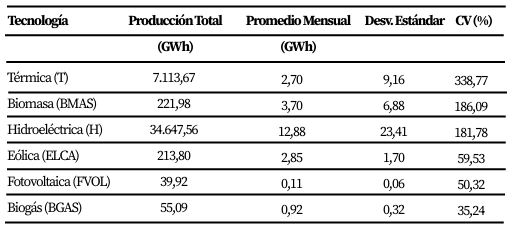
Ecuador's National Interconnected System has historically relied on hydroelectric generation, which accounts for 75% to 85% of total production, creating a structural vulnerability exposed during the 2023-2024 energy crisis, when the country implemented power rationing of up to eight hours per day. This research analyzes the variability of electric power production by generation technology type in the SNI using Big Data and Data Science techniques, based on official open data from CENACE for the period January 2025 – March 2026. A Python-based processing pipeline was applied, including cleaning, transformation, and statistical analysis of 5,886 monthly production records. Results show that thermal technology presents the highest coefficient of variation at 163%, followed by biomass at 163% and hydroelectric at 141%, while wind energy at 60% and biogas at 44% are the most stable technologies in the system. It is concluded that diversifying the energy matrix toward lower-variability technologies, particularly wind and biogas, is a priority strategy to reduce the vulnerability of Ecuador's electric system to adverse climate conditions.
Downloads
Metrics
Article Details

This work is licensed under a Creative Commons Attribution-NonCommercial-NoDerivatives 4.0 International License.