
From Construction 4.0 to Construction 5.0: A Sustainable Transition Framework for Ecuador
Article Sidebar
Main Article Content
Abstract
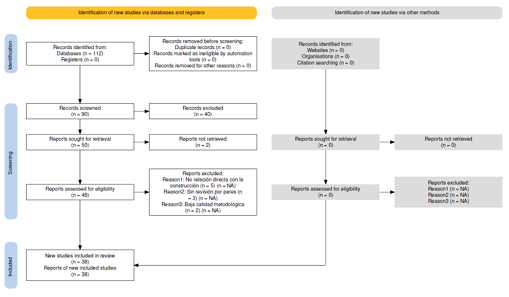
The digital transformation of the construction sector has given rise to two interconnected paradigms: Construction 4.0, driven by automation and cyber-physical technologies, and Construction 5.0, focused on sustainability and human-centered innovation. This study conducts a systematic narrative review with a comparative approach, following the PRISMA 2020 guidelines, based on a corpus of 38 studies published between 2015 and 2025. The findings reveal that Construction 4.0 has reached high technological maturity levels (TRL 7–9), achieving significant improvements in productivity, efficiency, and occupational safety, yet remaining limited in social and environmental integration. Conversely, Construction 5.0 is at an early stage (TRL 3–6), emphasizing human–machine collaboration, circular economy practices, and digital ethics. Building upon these insights, a transition framework toward Sustainable Construction 5.0 in Ecuador is proposed, structured around four interdependent dimensions: technological, human, environmental, and policy–institutional. The framework aims to guide public policies, innovation strategies, and digital adoption processes in the Latin American context, linking digital transformation with human well-being and environmental sustainability. The study contributes an integrative perspective to accelerate the sustainable digital transition of the construction sector in developing countries.
Downloads
Metrics
Article Details

This work is licensed under a Creative Commons Attribution-NonCommercial-NoDerivatives 4.0 International License.




References
McKinsey Global Institute., “Reinventing Construction: a Route To Higher Productivity,” 2017. [Online]. Available: https://www.mckinsey.com/~/media/mckinsey/business functions/operations/our insights/reinventing construction through a productivity revolution/mgi-reinventing-construction-a-route-to-higher-productivity-full-report.pdf.
A. Sawhney, M. Riley, and J. Irizarry, Construction 4.0: An Innovation Platform for the Built Environment. Routledge, Taylor & Francis Group, 2020.
R. Y. Zhong, X. Xu, E. Klotz, and S. T. Newman, “Intelligent Manufacturing in the Context of Industry 4.0: A Review,” Engineering, vol. 3, no. 5, pp. 616–630, 2017, doi: 10.1016/J.ENG.2017.05.015.
E. Forcael, I. Ferrari, and A. Opazo-vega, “Construction 4 . 0 : A Literature Review,” 2020.
T. D. Oesterreich and F. Teuteberg, “Understanding the implications of digitisation and automation in the context of Industry 4.0: A triangulation approach and elements of a research agenda for the construction industry,” Comput. Ind., vol. 83, no. January, pp. 121–139, 2016, doi: 10.1016/j.compind.2016.09.006.
B. Dave, A. Buda, A. Nurminen, and K. Främling, “A framework for integrating BIM and IoT through open standards,” Autom. Constr., vol. 95, no. August, pp. 35–45, 2018, doi: 10.1016/j.autcon.2018.07.022.
A. Qasem, A. H. M. Hamad, E. S. Gharaibeh, T. M. Abu-khait, Gharaibeh, and M. Falah, “Building Information Modelling (BIM) in Managing Construction Claims: Now and Beyond – A Review (Jordan Perspective),” Int. J. Innov. Technol. Explor. Eng., vol. 9, no. 7, pp. 1099–1115, 2020, doi: 10.35940/ijitee.a2551.059720.
O. Bongomin et al., “Industry 4.0 Disruption and Its Neologisms in Major Industrial Sectors: A State of the Art,” J. Eng. (United Kingdom), vol. 2020, 2020, doi: 10.1155/2020/8090521.
Nirmani I.A.P., “Barriers to digital participation in developing countries: Identifying technological, social, and cultural obstacles to community involvement,” GSC Adv. Res. Rev., vol. 23, no. 2, pp. 061–071, 2025, doi: 10.30574/gscarr.2025.23.2.0130.
G. Reischauer, “Industry 4.0 as policy-driven discourse to institutionalize innovation systems in manufacturing,” Technol. Forecast. Soc. Change, vol. 132, no. March, pp. 26–33, 2018, doi: 10.1016/j.techfore.2018.02.012.
European Commission, “Industry 5.0 – Towards a sustainable, human-centric and resilient European industry,” 2021. [Online]. Available: https://op.europa.eu/en/publication-detail/-/publication/468a892a-5097-11eb-b59f-01aa75ed71a1/.
S. Nahavandi, “Industry 5 . 0,” Sustainability, vol. 11, pp. 43–71, 2019.
U. K. Pal, C. Zhang, T. C. Haupt, H. Li, and L. Su, “The Evolution of Construction 5.0: Challenges and Opportunities for the Construction Industry,” Buildings, vol. 14, no. 12, pp. 1–18, 2024, doi: 10.3390/buildings14124010.
I. Yitmen, A. Almusaed, and S. Alizadehsalehi, “Investigating the Causal Relationships among Enablers of the Construction 5.0 Paradigm: Integration of Operator 5.0 and Society 5.0 with Human-Centricity, Sustainability, and Resilience,” Sustain., vol. 15, no. 11, 2023, doi: 10.3390/su15119105.
D. Pamela and C. Galvez, “Assessing Digital Technology Development in Latin American Countries : Challenges , Drivers , and Future Directions,” Digital, 2025, [Online]. Available: https://doi.org/10.3390/digital5020020.
N. R. Haddaway, M. J. Page, and L. A. Pritchard, C. C., McGuinness, “PRISMA2020: An R package and Shiny app for producing PRISMA 2020-compliant flow diagrams, with interactivity for optimised digital transparency and Open Synthesis.,” Campbell Syst. Rev., vol. 18, 2022, doi: https://doi.org/10.1002/cl2.1230.
Y. Liao, F. Deschamps, E. de F. R. Loures, and L. F. P. Ramos, “Past, present and future of Industry 4.0 - a systematic literature review and research agenda proposal,” Int. J. Prod. Res., vol. 55, no. 12, pp. 3609–3629, 2017, doi: 10.1080/00207543.2017.1308576.
Q. Li and J. Shi, “Dam construction 4.0,” Shuili Fadian Xuebao/Journal Hydroelectr. Eng., vol. 34, no. 8, pp. 1–6, 2015, doi: 10.11660/slfdxb.20150801.
J. Y. Kim et al., “Implementation of Integrated Smart Construction Monitoring System Based on Point Cloud Data and IoT Technique,” Sensors, vol. 25, no. 13, pp. 1–25, 2025, doi: 10.3390/s25133997.
A. Q. Gbadamosi et al., “Offsite construction: Developing a BIM-Based optimizer for assembly,” J. Clean. Prod., vol. 215, pp. 1180–1190, 2019, doi: 10.1016/j.jclepro.2019.01.113.
C. İ. Sarioğlu, “Industry 5.0, Digital Society, and Consumer 5.0,” Handb. Res. Perspect. Soc. Technol. Addict., no. June, pp. 11–33, 2023, doi: 10.4018/978-1-6684-8397-8.ch002.
M. Marinelli, “From Industry 4.0 to Construction 5.0: Exploring the Path towards Human–Robot Collaboration in Construction,” Systems, vol. 11, no. 3, pp. 1–23, 2023, doi: 10.3390/systems11030152.
K. A. Demir, G. Döven, and B. Sezen, “Industry 5.0 and Human-Robot Co-working,” Procedia Comput. Sci., vol. 158, pp. 688–695, 2019, doi: 10.1016/j.procs.2019.09.104.
R. Kurt, “Industry 4.0 in Terms of Industrial Relations and Its Impacts on Labour Life,” Procedia Comput. Sci., vol. 158, pp. 590–601, 2019, doi: 10.1016/j.procs.2019.09.093.
W. F. Cascio and R. Montealegre, “How Technology Is Changing Work and Organizations,” Annu. Rev. Organ. Psychol. Organ. Behav., vol. 3, pp. 349–375, 2016, doi: 10.1146/annurev-orgpsych-041015-062352.