
Using Death Certificates to Estimate Work-related Fatalities from Falls from Height in the Construction Industry in Ecuador, 2013–2023
Article Sidebar
Main Article Content
Abstract
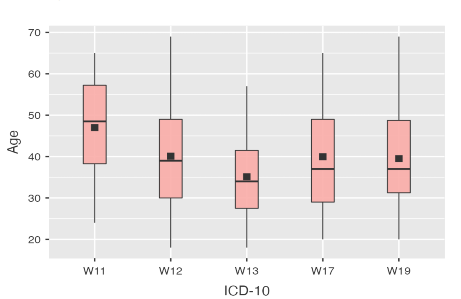
Falls from heights (FFH) are a major cause of occupational fatalities in the construction industry. In developing countries, underreporting in social security records limits accurate knowledge of work-related mortality. This observational and descriptive study examined FFH deaths in Ecuador’s construction sector from 2013 to 2023 using data from the Statistical Registry of General Deaths. Cases were identified through ICD-10 codes (W11, W12, W13, W17, W19) with the place of occurrence classified as construction (.6). Descriptive and inferential analyses were conducted (Kruskal–Wallis test, p < 0.05), and working years of potential life lost (WYPLLs) were estimated. Fatal FFH incidents increased until 2017 (14.0%), decreased during 2020–2021, and rose again in 2022–2023. Most deaths occurred in Pichincha (48.2%), primarily from falls from scaffolding (W12, 65.5%). The mean age was 39.6 years (95% CI: 38.3–40.9). Significant differences in age by cause were observed (χ² = 9.74; p = 0.045), especially between W11 and W13 (p = 0.040). A total of 8,221 WYPLLs were estimated, mostly from scaffolding and building falls. These findings highlight a substantial mortality burden and the urgent need to reinforce preventive strategies, strengthen compliance and inspection systems, and promote safety culture within Ecuador’s construction industry.
Downloads
Metrics
Article Details

This work is licensed under a Creative Commons Attribution-NonCommercial-NoDerivatives 4.0 International License.




References
C. M. Socias-Morales, C. K. Chaumont Menéndez, and S. M. Marsh, “Fatal work-related falls in the United States, 2003–2014,” American Journal of Industrial Medicine, vol. 61, no. 2, pp. 111–119, 2018, doi: 10.1002/ajim.22810.
[2] F. Li et al., “Work-related and non-work-related accident fatal falls in Shanghai and Wuhan, China,” Safety Science, vol. 117, pp. 43–48, 2019, doi: 10.1016/j.ssci.2019.04.001.
WHO/ILO, WHO/ILO Joint Estimates of the Work-related Burden of Disease and Injury, 2000–2016: Global Monitoring Report, Geneva: World Health Organization and International Labour Organization, 2021. [Online]. Available: https://www.ilo.org/sites/default/files/wcmsp5/groups/public/@ed_dialogue/@lab_admin/documents/publication/wcms_819788.pdf
E. A. Nadhim, C. Hon, B. Xia, I. Stewart, and D. Fang, “Falls from height in the construction industry: A critical review of the scientific literature,” International Journal of Environmental Research and Public Health, vol. 13, no. 7, p. 638, 2016, doi: 10.3390/ijerph13070638.
S. Konda, H. M. Tiesman, and A. A. Reichard, “Fatal traumatic brain injuries in the construction industry, 2003–2010,” American Journal of Industrial Medicine, vol. 59, no. 3, pp. 212–220, 2016, doi: 10.1002/ajim.22557.
Y. Halabi et al., “Causal factors and risk assessment of fall accidents in the U.S. construction industry: A comprehensive data analysis (2000–2020),” Safety Science, vol. 145, p. 105537, 2022, doi: 10.1016/j.ssci.2021.105537.
S. Jung et al., “Epidemiology of occupational injuries in construction workers between 2009 and 2018 in South Korea,” American Journal of Industrial Medicine, vol. 66, no. 2, pp. 155–166, 2022, doi: 10.1002/ajim.23448.
T. Nowobilski and B. Hoła, “Methodology based on causes of accidents for forecasting the effects of falls from scaffoldings using the construction industry in Poland as an example,” Safety Science, vol. 157, p. 105945, 2023, doi: 10.1016/j.ssci.2022.105945.
A. D. Rafindadi et al., “Data mining of the essential causes of different types of fatal construction accidents,” Heliyon, vol. 9, e13389, 2023, doi: 10.1016/j.heliyon.2023.e13389.
M. A. Camino López, D. O. Ritzel, I. Fontaneda González, and O. J. González Alcántara, “Occupational accidents with ladders in Spain: Risk factors,” Journal of Safety Research, vol. 42, no. 5, pp. 391–398, 2011, doi: 10.1016/j.jsr.2011.08.003.
M. Sawicki and M. Szóstak, “Quantitative assessment of the state of threat of working on construction scaffolding,” International Journal of Environmental Research and Public Health, vol. 17, no. 16, p. 5773, 2020, doi: 10.3390/ijerph17165773.
M. Fujii et al., “Factors influencing the injury severity score and the probability of survival in patients who fell from height,” Scientific Reports, vol. 11, no. 1, p. 15561, 2021, doi: 10.1038/s41598-021-95226-w.
C. Palacio et al., “Incidence of fall-from-height injuries and predictive factors for severity,” Journal of Osteopathic Medicine, vol. 125, no. 5, pp. 229–236, 2025, doi: 10.1515/jom-2024-0158.
A. A. Kiadaliri, B. E. Rosengren, and M. Englund, “Fall-related mortality in southern Sweden: A multiple cause of death analysis, 1998–2014,” Injury Prevention, vol. 25, no. 2, pp. 129–135, 2019, doi: 10.1136/injuryprev-2017-042425.
S. N. Min, M. Subramaniyam, S. J. Park, and K. S. Lee, “Development of the fall prevention index on the movable scaffold for construction workers,” Work, vol. 65, no. 1, pp. 167–173, 2020, doi: 10.3233/WOR-193070.
International Labour Organization (ILO), Safe and Healthy Working Environment: Principles and Implementation, Geneva: ILO, 2022. [Online]. Available: https://www.ilo.org/sites/default/files/wcmsp5/groups/public/%40ed_dialogue/%40lab_admin/documents/publication/wcms_851909.pdf
S. Abbaszadeh et al., “Risk assessment of probable human errors in the scaffold erection and dismantling procedure: A fuzzy approach,” International Journal of Occupational Safety and Ergonomics (JOSE), vol. 28, no. 3, pp. 1773–1778, 2022, doi: 10.1080/10803548.2021.1932110.
M. Abbasinia and I. Mohammadfam, “Identifying, evaluating and prioritizing the causes of occupational accidents in the construction industry using fuzzy AHP and fuzzy TOPSIS,” Work, vol. 72, no. 3, pp. 933–940, 2022, doi: 10.3233/WOR-210024.
Z. Ashuro et al., “Prevalence of work-related injury and its determinants among construction workers in Ethiopia: A systematic review and meta-analysis,” Journal of Environmental and Public Health, p. 9954084, 2021, doi: 10.1155/2021/9954084.
M. Kyung, S. J. Lee, C. Dancu, and O. Hong, “Underreporting of workers’ injuries or illnesses and contributing factors: A systematic review,” BMC Public Health, vol. 23, no. 1, p. 558, 2023, doi: 10.1186/s12889-023-15487-0.
J. Johansson et al., “Occupational safety in the construction industry,” Work, vol. 64, no. 1, pp. 21–32, 2019, doi: 10.3233/WOR-192976.
L. Ensslin, A. Gonçalves, S. R. Ensslin, and A. Dutra, “Bibliometric and systemic review of the state of the art of occupational risk management in the construction industry,” International Journal of Occupational Safety and Ergonomics (JOSE), vol. 29, no. 3, pp. 1107–1120, 2023, doi: 10.1080/10803548.2022.2111893.
A. R. Gómez-García, K. P. Córdova Falconí, P. Merino-Salazar, and J. García-Arroyo, “Fatal work accidents in Ecuador from 2014 to 2020: How the age of the deceased worker relates to the accidents’ temporal and geographical characteristics,” Archives of Environmental & Occupational Health, vol. 78, no. 5, pp. 305–311, 2023, doi: 10.1080/19338244.2023.2196051.
M. Paguay, J. D. Febres, and E. Valarezo, “Occupational accidents in Ecuador: An approach from the construction and manufacturing industries,” Sustainability, vol. 15, no. 16, p. 12661, 2023, doi: 10.3390/su151612661.
A. R. Gómez-García, R. Gutierrez-Álvarez, A. H. Chang-León, and J. A. García-Arroyo, “What activity is the most dangerous to work in? Estimation of the risk level of economic activities in Ecuador,” Safety and Health at Work, vol. 16, no. 2, pp. 172–179, 2025, doi: 10.1016/j.shaw.2025.03.004.
A. R. Gómez-García, “Commentary on the current situation of occupational injuries in the construction sector of Ecuador,” INGENIO, vol. 7, no. 1, pp. 1–3, 2024, doi: 10.29166/ingenio.v7i1.5787.
Ministerio del Trabajo, Acuerdo Ministerial Nro. MDT-2025-122. Reglamento de seguridad en el trabajo y prevención de riesgos laborales para la construcción y obras públicas y privadas, Quito: Gobierno del Ecuador, 2025. [Online]. Available: https://www.trabajo.gob.ec/wp-content/uploads/2025/09/Acuerdo-Ministerial-Nro.-MDT-2025-122-signed.pdf
K. J. Rauscher, C. W. Runyan, and D. Radisch, “Using death certificates and medical examiner records for adolescent occupational fatality surveillance and research: A case study,” Journal of Occupational and Environmental Hygiene, vol. 9, no. 10, pp. 609–615, 2012, doi: 10.1080/15459624.2012.713764.
R. Lilley et al., “Decade of fatal injuries in workers in New Zealand: Insights from a comprehensive national observational study,” Injury Prevention, vol. 27, no. 2, pp. 124–130, 2021, doi: 10.1136/injuryprev-2020-043643.
S. Massari et al., “Occupational mortality matrix: A tool for epidemiological assessment of work-related risk based on current data sources,” International Journal of Environmental Research and Public Health, vol. 19, no. 9, p. 5652, 2022, doi: 10.3390/ijerph19095652.
T. Kimura, M. Sasaki, and T. Hattori, “Estimation of the mortality rate of workers in Japan,” Journal of Occupational Medicine and Toxicology, vol. 17, no. 1, p. 24, 2022, doi: 10.1186/s12995-022-00365-z.
M. M. Richey et al., “Trends in fatal occupational injuries in Latino/a workers relative to other groups, North Carolina 2000–2017,” American Journal of Industrial Medicine, vol. 65, no. 4, pp. 242–247, 2022, doi: 10.1002/ajim.23331.
F. G. Benavides, A. Vives, M. Zimmerman, and M. Silva-Peñaherrera, “Exceso de mortalidad en población en edad de trabajar en nueve países de Latinoamérica, año 2020,” Revista Panamericana de Salud Pública, vol. 46, e75, 2022, doi: 10.26633/RPSP.2022.75.
Instituto Nacional de Estadística y Censos (INEC), Portal de Datos Abiertos del Ecuador, Gobierno del Ecuador, 2025. [Online]. Available: https://www.datosabiertos.gob.ec/dataset
R. Lilley et al., “Identifying opportunities to prevent work-related fatal injury in New Zealand using 40 years of coronial records: Protocol for a retrospective case review study,” Injury Epidemiology, vol. 6, p. 16, 2019, doi: 10.1186/s40621-019-0193-z.
International Labour Organization (ILO), Methodologies for the Collection and Analysis of Data on Occupational Accidents, Regional Office for Latin America and the Caribbean, 2021. [Online]. Available: https://vzf.ilo.org/wp-content/uploads/2021/06/wcms_794841.pdf
J. Rochon, M. Gondan, and M. Kieser, “To test or not to test: Preliminary assessment of normality when comparing two independent samples,” BMC Medical Research Methodology, vol. 12, p. 81, 2012, doi: 10.1186/1471-2288-12-81.
C. Fan and D. Zhang, “A note on power and sample size calculations for the Kruskal–Wallis test for ordered categorical data,” Journal of Biopharmaceutical Statistics, vol. 22, no. 6, pp. 1162–1173, 2012, doi: 10.1080/10543406.2011.578313.
The jamovi project, jamovi (Version 2.3.21.0) [Computer software], 2025. [Online]. Available: https://www.jamovi.org
Y. V. Chudasama et al., “Estimates of years of life lost depended on the method used: Tutorial and comparative investigation,” Journal of Clinical Epidemiology, vol. 150, pp. 42–50, 2022, doi: 10.1016/j.jclinepi.2022.06.012.
A. R. Gómez-García, C. H. Tsao Wu, E. N. Ruiz Barzola, and A. H. Hacay Chang, “Social burden and economic cost estimation of fatal injuries in workers affiliated to social security in Ecuador: A shared challenge in public and occupational health,” Revista de Investigación e Innovación en Ciencias de la Salud, vol. 7, no. 2, 2025, doi: 10.46634/riics.390.
M. Hollander, D. A. Wolfe, and E. Chicken, Nonparametric Statistical Methods, Wiley Series in Probability and Statistics, 2015, doi: 10.1002/9781119196037.
A. R. Gómez-García, M. L. Vega Chica, and J. A. García-Arroyo, “Relationship between the territorial distribution of labor inspectors and work accident injuries: Clustering Ecuadorian provinces into four management scenarios,” Safety Science, vol. 158, p. 105956, 2023, doi: 10.1016/j.ssci.2022.105956.