
Valorization of Sugarcane Bagasse into Nano-Silica: Optimized Route for Enhancing Strength and Sustainability in Cement Mortars
Article Sidebar
Main Article Content
Abstract
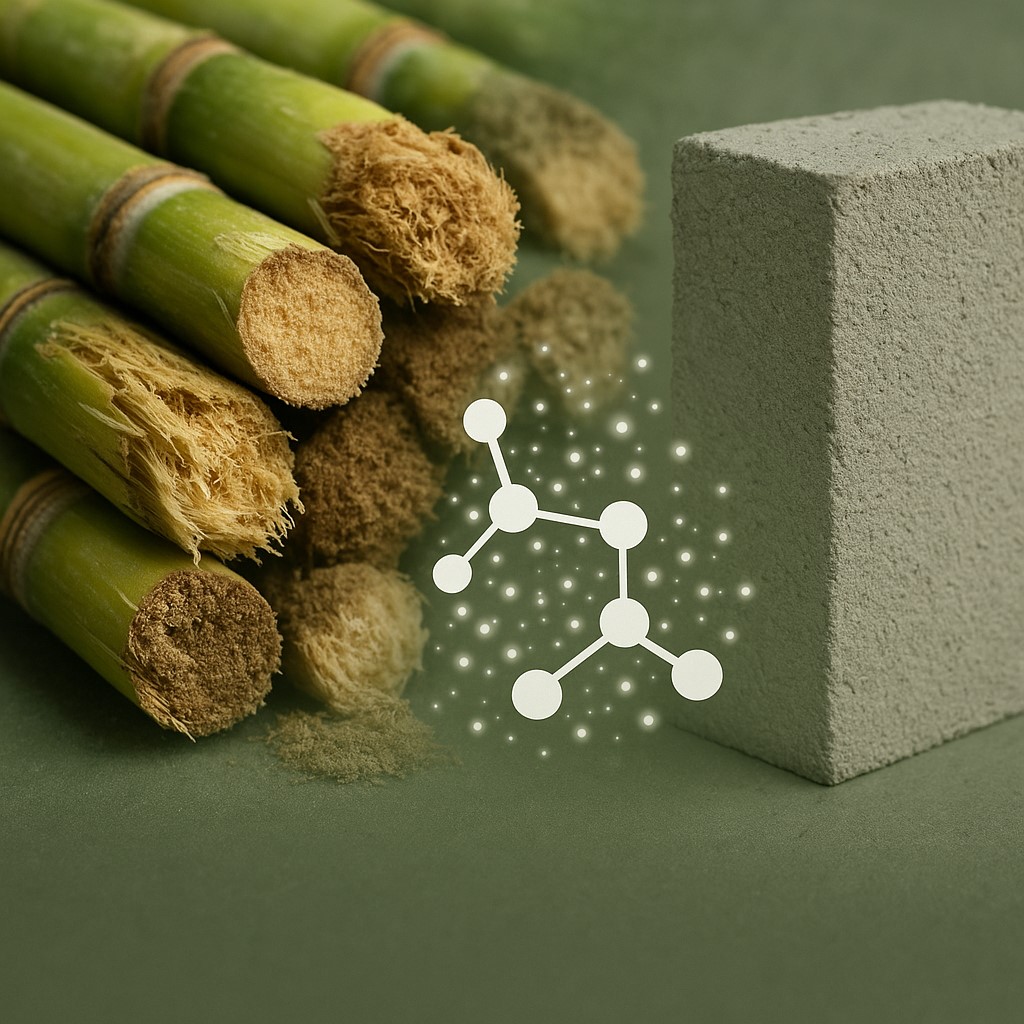
The present research aims to evaluate the influence of adding silica nanoparticles derived from sugarcane bagasse, synthesized in the laboratory using the sol-gel method, on the properties of cement mortar in both its fresh and hardened states. In the fresh state, the study examines workability, consistency, and flow, while in the hardened state, it evaluates compressive strength and hydrophobicity. Specimens were prepared using Type N and Type HS cement, with the addition of nano-silica particles at 0.25%, 0.50%, 0.75%, 1.00%, and 1.50% by weight as a replacement for cement in the control mortar. The results revealed that 0.25% nano-silica was the optimal addition percentage for both mortars. Moreover, it was found that both fresh and hardened properties were negatively affected as the percentage of nano-silica increased. The compressive strength increased by 9% at 28 days and 12% at 56 days for the Type N cement mortar, while for the Type HS cement mortar, the strength increase was 9% at 28 days, 10% at 56 days, and 5% at 90 days.
The contact angle test indicated that nano-silica particles reduce the permeability of the mortars, with specimens made with Type N cement exhibiting greater impermeability compared to those made with Type HS cement.
Downloads
Metrics
Article Details

This work is licensed under a Creative Commons Attribution-NonCommercial-NoDerivatives 4.0 International License.




References
M. Álvarez, J. Izquierdo y M. Rojas, «Uso de la ceniza de bagazo de caña (CBC) como reemplazo parcial del cemento Portland - Caso Colombia,» IBRACON, 2019.
Organización de las Naciones Unidas (ONU), «Las emisiones históricas del sector de la construcción, lo alejan de los objetivos de descarbonización,» 2022. [En línea]. Available: https://news.un.org/es/story/2022/11/1516722.
Organización de las Naciones Unidas para la Alimentación y la Agricultura (FAO), «OCDE-FAO Perspectivas agrícolas 2023-2032,» 2023.
L. W. Morales, M. Alvansazyazdi y e. al., «Prevención de la contaminación por la fabricación de hormigones con nanopartículas.,» Conference Paper, vol. ResearchGate, 2020.
M. Alvansazyazdi y J. Rosero, «The pathway of concrete improvement via nano-technology,» Revista Ingenio N°1, vol. 2, 2019.
M. Alvansazyazdi, A. Villalba, S. Saltos, J. Santamaria, A. Cadena, M. Leon, L. Leon, P. Bonilla, B. Heredia, J. Bucheli, A. Debut y M. Feizbahr, «Enhancing Sustainable Construction: An Evaluation of Nano-Graphene's Effectiveness in Mortar Composition,» International Journal of Engineering & Technology Sciences, 2024.
M. Alvansazyazdi, J. Fraga, E. Stalyn, R. Guevara, J. Santamaria, M. Leon, A. Cadena, P. Bonilla, B. Heredia, A. Debut y M. Feizbahr, «Comparative Analysis of a mortar for plastering with hydraulic cement type HS incorporating nano-iron vs cement-based mortar for masonry type N,» International Journal of Engineering & Technology Sciences, 2024.
Y. Du, I. Pundiene, J. Pranckeviciene, A. Zujevs y A. Korjakins, «Study on the Pore Structure of Lightweight Mortar with Nano-Additives,» MDPI, Nanomaterials 2023, 13, 2942, 2023.
M. Karakouzian, V. Farhangi, M. Farani, A. Joshaghani, M. Zadehmohamad y M. Ahmadzadeh, «Mechanical Characteristics of Cement Paste in the Presence of Carbon Nanotubes and Silica Oxide Nanoparticles: An Experimental Study,» MDPI, Materials 2021,14, 1347, 2021.
N. Salgado, J. Guaña, C. Escobar y M. Alvansazyazdi, «Result of the Methodology for Learning English Distance with the Use of TICs. Case Study: Central University of Ecuador.,» In Á. Rocha et al. (Eds.), vol. WorldCIST', nº 19, pp. 227-233, 2019.
M. Alvansazyazdi, N. Salgado, A. Borghei, S. Camino y M. Guzmán, «Web-Based Executive Dashboard Reports for Public Works Clients in Construction Industry.,» pp. 285-294, 2019.
M. Alvansazyazdi, H. Alvansaz, M. Hakakian, N. Salgado y A. Camino Solórzano, «An Investigation and Presentation of a Model for Factors Influencing the Agility of Human Resources: A Case Study of Yazd Electricity Distribution Company,» vol. In Á. Rocha et al. (Eds.), pp. 823-834, 2019.
L. Cajero, M. E. Nicho, U. León, M. R. Díaz, R. Salgado, E. García y E. Díaz, «Caracterización de SiO2 obtenido a partir de fuentes naturales,» Revista Politécnica de Aguascalientes, Vol 3, Año 3, 2024.
Agencia Iberoamericana para la difusión de la Ciencia y la Tecnología (DICYT), «Bagazo de caña, posible componente de concreto hidráulico,» 2014. [En línea]. Available: https://www.dicyt.com/noticias/bagazo-de-cana-posible-componente-de-concreto-hidraulico.
N. León, «Influencia de la adición de nano sílice en el hormigón autocompactante,» Universidad Politécnica de Madrid, 2012.
L. Morales, M. Alvansazyazdi, P. Landázuri y W. Vásconez, «Prevención de la contaminación por la fabricación de hormigones con nanopartículas,» Iberian Journal of Information Systems and Technologies, RISTI, N°E30, 06, pp. 297-312, 2020.
J. Puerto, Efecto de la nanosílice sobre las propiedades reológicas de la matriz cementante y su influencia en el estado endurecido del concreto hidráulico, Bogotá: Universidad Nacional de Colombia, 2019.
M. Alvansazyazdi, B. Claudio y R. Bagner, «Study of the Incorporation of nano-SiO2 in high-performance concrete (hpc),» Revista Ingenio 2022, vol. 5 (1), pp. 12-21, 2022.
L. Loaiza, E. Díaz y M. Rojas, «Nanosílice como aditivo para el concreto - caso Colombia,» IBRACON, 2019.
A. Khaloo, M. Mohammad y P. Hosseini, «Influence of different types of nano-SiO2 particles on properties of high performance concrete,» ELSERVIER, Construction and Building Materials 113 (2016) 188-201, 2016.
J. Tapia, M. Alvansazyazdi y A. Barrionuevo, «Study of an Environmentally Friendly High-Performance Concrete (HPC) Manufactured with the Incorporation of a Blend of Micro-Nano Silica,» Revista Científica de Arquitectura y Urbanismo, EÍDOS 24, pp. 95-110, 2024.
M. Mobini, A. Khaloo, P. Hosseini y A. Esrafili, «Mechanical properties of fiber-reinforced high-performance concrete incorporating pyrogenic nanosilica with different surface areas,» ELSEVIER, Construction and Building Materials 101 (2015) 130-140, 2015.
M. Alvansazyazdi, B. Arévalo y J. Arévalo, «Adoquines de hormigón ecoamigables fabricados con la incorporación de una mezcla de micro-nano sílice,» Revista Ingenio, vol. 5 (1), pp. 34-42, 2022.
G. Pérez, A. Guerrero, I. Jiménez y S. Abdul, «Estudio comparativo del efecto de dos tipos de nanosílice sobre las propiedades de pastas de cemento Portland y cemento belítico,» Instituto Ciencias de la Construcción "Eduardo Torroja", Madrid, 2012.
M. Dávila, D. D. Costa y D. Duarte, «Efecto de la adición de nanosílice en cementos y concretos,» Universidad Simón Bolívar, Caracas, 2013.
M. Alvansazyazdi, J. Figueroa, A. Paucar, G. Robles, M. Khorami, P. Bonilla, A. Debut y M. Feizbahr, «Nano-silica in Holcim General Use Cement Mortars: A Comparative Study with Traditional and Prefabricated Mortars,» 2024.
NTE INEN 2536, «Áridos para uso en morteros para mampostería. Requisitos.,» Quito - Ecuador, 2010.
Y. Ni’mah, Z. Muhaiminah y S. Suprapto, «Synthesis of Silica Nanoparticles from Sugarcane Bagasse by Sol-Gel Method,» Nanoparticle, 4(1):10, 2023.
A. Golsha, M. Rezazadeh Shirdar, S. Gohery y M. Alvansazyazdi, «Optimization of Pre-Treatment Parameters before Diamond Coating using Non-Dominated Sorting Genetic Algorithm (NSGA-II),» vol. Advanced Materials Research, nº 463-464, 399-405, 2012.
NTE INEN 1806, «Cemento para mampostería. Requisitos.,» Quito - Ecuador, 2015.
NTE INEN 2502, «Cemento hidráulico. Determinación del flujo en morteros,» Quito - Ecuador, 2009.
NTE INEN 488, «Cemento hidráulico. Determinación de la resistencia a la compresión de morteros en cubos de 50 mm de arista.,» Quito - Ecuador, 2009.
M. Alvansazyazdi, F. Alvarez-Rea, J. Pinto-Montoya, M. Khorami, P. M. Bonilla-Valladares, A. Debut y M. Feizbahr, «Evaluating the Influence of Hydrophobic Nano-Silica on Cement Mixtures for Corrosion-Resistant Concrete in Green Building and Sustainable Urban Development,» Sustainability, vol. 15, nº 21, p. 15311, 2023.
M. Alvansazyazdi, F. Alvarez, J. Pinto, M. Khorami, P. Bonilla, A. Debut y M. Faizbahr, «Evaluating the Influence of Hydrophobic Nano-Silica on Cement Mixtures for Corrosion-Resistant Concrete in Green Building and Sustainable Urban Development,» MDPI, Sustainability 2023, 15, 15311, 2023.
M. Alvansazyazdi, D. Farinango, J. Yaucan, A. Cadena, J. Santamaria, P. Bonilla, M. León, A. Debut, M. Feizbahr, L. León y B. Ayala, «Exploring Crack Reduction in High-Performance Concrete: The Impact of Nano-Silica, Polypropylene, and 4D Metallic Fibers,» International Journal of Engineering & Technology Sciences, 2024.
M. Alvansazyazdi, J. Figueroa, A. Paucar, G. Robles, M. Khorami, P. M. Bonilla-Valladares, A. Debut y M. Feizbahr, «Nano-silica in Holcim General Use Cement Mortars: A Comparative Study with Traditional and Prefabricated Mortars.,» Advances in Concrete Construction, vol. 17, nº 3, pp. 135-150, 2024.