SciELO
2022-09-13
Estamos en la base SciELO Ecuador
http://scielo.senescyt.gob.ec/scielo.php?script=sci_serial&pid=2602-8484&lng=es&nrm=iso

The journal FIGEMPA: Investigación y Desarrollo is published at Universidad Central del Ecuador in Quito (Ecuador) by Facultad de Ingeniería en Geología, Minas, Petróleos y Ambiental (FIGEMPA). It is dedicated to the dissemination of research results and technical studies conducted by professors, professionals, and undergraduate and postgraduate students of the University, as well as national and international experts in areas related to Engineering Sciences, Exact and Natural Sciences, Energy, Geology, Mining Engineering, Petroleum Engineering, Environmental Engineering, Technology, Earth Sciences, Research, Safety, and the Sustainable and Sustainable Utilization of Non-Renewable Natural Resources. It is an interdisciplinary space for discussion on both theoretical and applied aspects in the indicated areas. Its publication is semi-annual and in continuous flow.
FIGEMPA: Investigación y Desarrollo.
ISSN e: 2602-8484
Printed ISSN: 1390-7042 (up to 2020)
DOI: 10.29166/revfig
Indexings: SciELO, AURA, ACTUALIDAD IBEROAMERICANA, BASE - UNIVERSITAT BIELEFELD, CROSSREF, DOAJ, ERIHPLUS, EUROPUB, GOOGLE SCHOLAR, LATINDEX 2.0, MIAR, REDIB, ROAD, AMELICA, ADVANCED SCIENCES INDEX, COPERNICUS, DIALNET.
URL: https://revistadigital.uce.edu.ec/index.php/RevFIG
Authors should not pay any charge for the submission of articles or for their processing or publication (Article Processing Charge - Non-APC does not apply).
FIGEMPA: Investigación y Desarrollo is an Open Access journal that follows a not-for-profit publishing model, thus preserving the scholarly and open nature of scientific communication. This approach is known as Diamond Open Access.
2022-09-13
Estamos en la base SciELO Ecuador
http://scielo.senescyt.gob.ec/scielo.php?script=sci_serial&pid=2602-8484&lng=es&nrm=iso
2021-08-20
Find us on the largest social network for scientists and researchers Researchgate
2021-08-20
The journal has been approved for inclusion in ERIH PLUS. The ERIH PLUS listing of the journal is available at
https://dbh.nsd.uib.no/publiseringskanaler/erihplus/periodical/info?id=502082
2021-01-09
Después de examinar la publicación y comprobar que cumplimos todos los criterios, la REVISTA FIGEMPA: Investigación y Desarrollo ha sido aceptada en REDIB (Red Iberoamericana de Innovación y Conocimiento Científico).
https://www.redib.org/recursos/Record/oai_revista5021-figempa

2019-10-17
The articles published in the journal FIGEMPA: Research and Development have their respective DOI.

2019-10-17
Figempa: research and development is indexed on ROAD
https://portal.issn.org/resource/ISSN/2602-8484#

Vol. 22 No. 2 (2026): Energy Frontiers
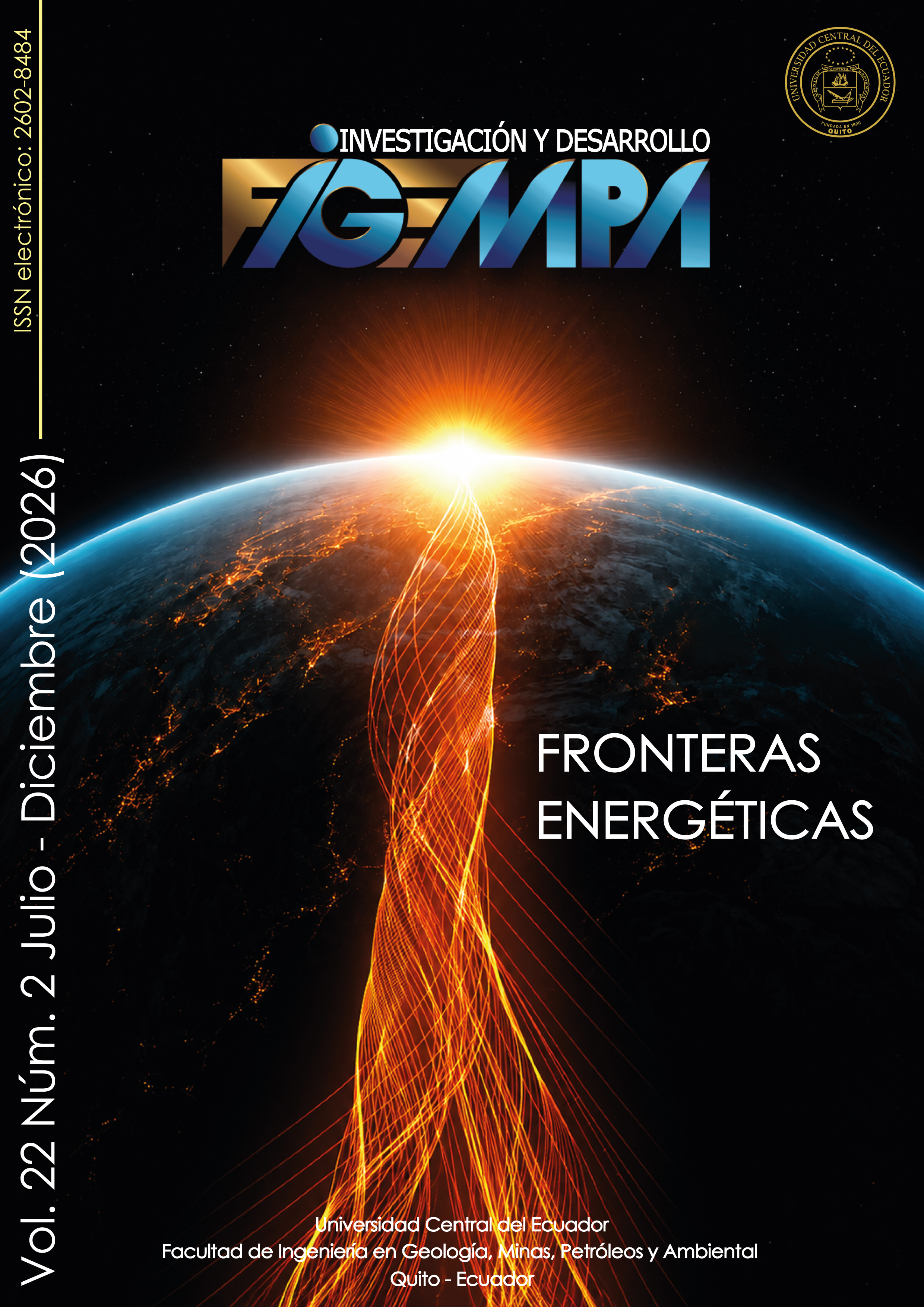
Energy Frontiers represent the space where science, innovation, and sustainability converge to address the challenges of a constantly evolving world. This approach integrates disciplines such as geology, mining, petroleum engineering, environmental sciences, and energy studies, recognizing that the future of energy depends on a comprehensive understanding of natural resources, the development of more efficient technologies, and the responsible management of land and resources. From subsurface exploration to the integration of emerging energy sources, these frontiers foster new perspectives to strengthen energy security, advance the transition toward more sustainable energy systems, and generate scientific knowledge aimed at enhancing societal well-being and supporting national development.
Published: 2026-07-01