
Reducción de la severidad de Fusarium oxysporum f. sp. cubense raza 1 en banano Gros Michel mediante microorganismos con diferentes mecanismos de antagonismo
Barra lateral del artículo
Contenido principal del artículo
Resumen
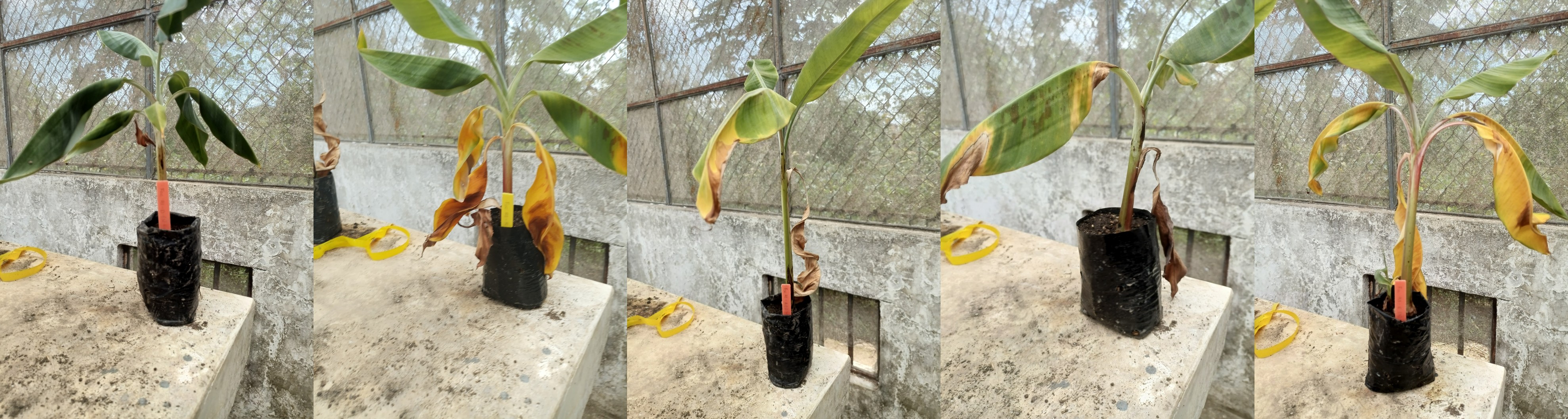
La marchitez vascular por Fusarium de las musáceas, causada por cepas de Fusarium oxysporum f. sp. cubense [Foc], sólo se han manejado eficazmente con el uso de variedades con niveles de resistencia genética. Además de la resistencia genética, el uso de estrategias de manejo del cultivo enfocadas en la salud del suelo y aquellas que contribuyan a mantener duradera la resistencia disponible también son una opción con impacto en la reducción de intensidad de epidemia. Este estudio se realizó con el objetivo de evaluar el efecto de la aplicación de agentes de control biológico con diferente mecanismo de antagonismo en los componentes de la epidemia de Fusarium de las musáceas en condiciones de invernadero, utilizando como modelo el patosistema Foc raza 1 [R1]-banano Gros Michel. Los experimentos en condiciones controladas mostraron que la aplicación de agentes de control biológico en plantas de banano Gros Michel, antes y después de la inoculación de Fusarium, genera diferentes niveles de intensidad de daño del patógeno en la planta. Cuando se aplicaron agentes de control biológico a un suelo contaminado antes de la siembra de las plantas, la aparición de síntomas se retrasó, así como la severidad de daño causada por el patógeno debido a la competencia y antibiosis. Ningún tratamiento impidió la infección del patógeno, pero si retrasaron el tiempo de aparición de síntomas y la intensidad del daño, por tanto, el efecto de microorganismos puede ser potencial para disminuir la severidad de la enfermedad en condiciones de manejo óptimas, pero es necesario realizar evaluaciones en campo.
Descargas
Métricas
Detalles del artículo

Esta obra está bajo una licencia internacional Creative Commons Atribución-NoComercial 4.0.
Los autores que publican en Siembra conocen y aceptan las siguientes condiciones:
- Los autores retienen los derechos de copia (copyright) y ceden a Siembra el derecho de primera publicación del trabajo, bajo licencia Creative Commons Attribution License, que permite a terceros utilizar lo publicado siempre que hagan referencia al autor o autores del trabajo y a su publicación en esta revista.
 Esta obra está bajo una Licencia Creative Commons Reconocimiento-NoComercial 4.0 Internacional (CC BY-NC 4.0).
- Los autores conservan los derechos de autor y garantizan a Siembra el derecho de publicar el manuscrito a través de los canales que considere adecuados.
- Los autores pueden establecer por su cuenta acuerdos adicionales para la distribución no exclusiva de la versión de la obra publicada en Siembra, haciendo reconocimiento de su publicación inicial en la misma, como por ejemplo en repositorios institucionales.
Se autoriza a los autores a difundir sus trabajos electrónicamente una vez sea aceptado el manuscrito para su publicación.




Citas
Avis, T. J., Gravel, V., Antoun, H., y Tweddell, R. J. (2008). Multifaceted beneficial effects of rhizosphere microorganisms on plant health and productivity. Soil Biology and Biochemistry, 40(7), 1733–1740. https://doi.org/10.1016/j.soilbio.2008.02.013 DOI: https://doi.org/10.1016/j.soilbio.2008.02.013
Bubici, G., Kaushal, M., Prigigallo, M. I., Gómez-Lama Cabanás, C., y Mercado-Blanco, J. (2019). Biological control agents against Fusarium wilt of banana. Frontiers in Microbiology, 10, 616 https://doi.org/10.3389/fmicb.2019.00616 DOI: https://doi.org/10.3389/fmicb.2019.00616
Castillo, A., Puig, C., y Cumagun, C. (2019). Non-synergistic effect of Trichoderma harzianum and Glomus spp. in reducing infection of Fusarium wilt in banana. Pathogens, 8(2), 43. https://doi.org/10.3390/pathogens8020043 DOI: https://doi.org/10.3390/pathogens8020043
Chaves, N. P., Staver, C., & Dita, M. A. (2016). Potential of Trichoderma asperellum for biocontrol of Fusarium wilt in banana. Acta Horticulturae, 1114, 261–266. https://doi.org/10.17660/ActaHortic.2016.1114.35 DOI: https://doi.org/10.17660/ActaHortic.2016.1114.35
Dadrasnia, A., Usman, M. M., Omar, R., Ismail, S., y Abdullah, R. (2020). Potential use of Bacillus genus to control of bananas diseases: Approaches toward high yield production and sustainable management. Journal of King Saud University - Science, 32(4), 2336–2342. https://doi.org/10.1016/j.jksus.2020.03.011 DOI: https://doi.org/10.1016/j.jksus.2020.03.011
Delgado-Baquerizo, M., Oliverio, A. M., Brewer, T. E., Benavent-González, A., Eldridge, D. J., Bardgett, R. D., Maestre, F. T., Singh, B. K., y Fierer, N. (2018). A global atlas of the dominant bacteria found in soil. Science, 359(6373), 320–325. https://doi.org/10.1126/science.aap9516 DOI: https://doi.org/10.1126/science.aap9516
Dita, M., Barquero, M., Heck, D., Mizubuti, E. S. G., y Staver, C. P. (2018). Fusarium wilt of banana: current knowledge on epidemiology and research needs toward sustainable disease management. Frontiers in Plant Science, 9, 1468. https://doi.org/10.3389/fpls.2018.01468 DOI: https://doi.org/10.3389/fpls.2018.01468
Drenth, A., y Kema, G. (2021). The vulnerability of bananas to globally emerging disease threats. Phytopathology, 111(12), 2146–2161. https://doi.org/10.1094/PHYTO-07-20-0311-RVW DOI: https://doi.org/10.1094/PHYTO-07-20-0311-RVW
García-Bastidas, F. A., van der Veen, A. J. T., Nakasato-Tagami, G., Meijer, H. J. G., Arango-Isaza, R. E., y Kema, G. H. J. (2019). An improved phenotyping protocol for panama disease in banana. Frontiers in Plant Science, 10, 1006. https://doi.org/10.3389/fpls.2019.01006 DOI: https://doi.org/10.3389/fpls.2019.01006
García-Bastidas, F. (2022). Fusarium oxysporum f.sp. cubense tropical race 4 (Foc TR4). CABI Compendium, 59074053. https://doi.org/10.1079/cabicompendium.59074053 DOI: https://doi.org/10.1079/cabicompendium.59074053
García-Bastidas, F., Drenth, A., y Kema, G. H. J. (2024). The past, present and future of Fusarium wilt of banana caused by Tropical Race 4. En A. Drenth y G. H. J. Kema (eds.), Achieving sustainable cultivation of bananas Volume 3: Diseases and Pests (pp. 113–144). Burleigh Dodds Science Publishing. https://doi.org/10.19103/AS.2022.0108.05 DOI: https://doi.org/10.19103/AS.2022.0108.05
Ghanbarzadeh, B., Safaie, N., y Goltapeh, E. M. (2014). Antagonistic activity and hyphal interactions of Trichoderma spp. against Fusarium proliferatum and F. oxysporum in vitro. Archives of Phytopathology and Plant Protection, 47(16), 1979–1987. https://doi.org/10.1080/03235408.2013.864506 DOI: https://doi.org/10.1080/03235408.2013.864506
Gomes, E. N., Elsherbiny, E. A., Aleem, B., y Bennett, J. W. (2020). Beyond classical biocontrol: new perspectives on Trichoderma. En A. E.-L.Hesham, R. S. Upadhyay, G. D.Sharma, C. Manoharachary, y V. K. Gupta (eds.), Fungal Biotechnology and Bioengineering. Fungal Biology (pp. 437–455). Springer Cham. https://doi.org/10.1007/978-3-030-41870-0_19 DOI: https://doi.org/10.1007/978-3-030-41870-0_19
Guzmán-Guzmán, P., Porras-Troncoso, M. D., Olmedo-Monfil, V., y Herrera-Estrella, A. (2019). Trichoderma Species: Versatile plant symbionts. Phytopathology, 109(1), 6–16. https://doi.org/10.1094/PHYTO-07-18-0218-RVW DOI: https://doi.org/10.1094/PHYTO-07-18-0218-RVW
Hernández-Melchor, D. J., Guerrero-Chávez, A. C., Ferrera-Rodríguez, M. R., Ferrera-Cerrato, R., Larsen, J., y Alarcón, A. (2023). Cellulase and chitinase activities and antagonism against Fusarium oxysporum f.sp. cubense race 1 of six Trichoderma strains isolated from Mexican maize cropping. Biotechnology Letters, 45(3), 387–400. https://doi.org/10.1007/s10529-022-03343-x DOI: https://doi.org/10.1007/s10529-022-03343-x
Huang, J., Pang, Y., Zhang, F., Huang, Q., Zhang, M., Tang, S., Fu, H., y Li, P. (2019). Suppression of Fusarium wilt of banana by combining acid soil ameliorant with biofertilizer made from Bacillus velezensis H-6. European Journal of Plant Pathology, 154(3), 585–596. https://doi.org/10.1007/s10658-019-01683-5 DOI: https://doi.org/10.1007/s10658-019-01683-5
Izquierdo-García, L. F., Carmona-Gutiérrez, S. L., Moreno-Velandia, C. A., Villarreal-Navarrete, A. del P., Burbano-David, D. M., Quiroga-Mateus, R. Y., Gómez-Marroquín, M. R., Rodríguez-Yzquierdo, G. A., y Betancourt-Vásquez, M. (2024). Microbial-based biofungicides mitigate the damage caused by Fusarium oxysporum f. sp. cubense race 1 and improve the physiological performance in banana. Journal of Fungi, 10(6), 419. https://doi.org/10.3390/jof10060419 DOI: https://doi.org/10.3390/jof10060419
Keswani, C., Mishra, S., Sarma, B. K., Singh, S. P., y Singh, H. B. (2014). Unraveling the efficient applications of secondary metabolites of various Trichoderma spp. Applied Microbiology and Biotechnology, 98(2), 533–544. https://doi.org/10.1007/s00253-013-5344-5 DOI: https://doi.org/10.1007/s00253-013-5344-5
Mayorga Morejón, K. R., Solis Hidalgo, Z. K., Terrero Yepez, P. I., y Hoyos Montesdeoca, M. A. (2024). Interacciones antagónicas entre Trichoderma spp. y Fusarium oxysporum f. sp. cubense R1: Un estudio in vitro sobre competencia y antibiosis. Pro Sciences: Revista de Producción, Ciencias e Investigación, 8(54), 12–23. https://doi.org/10.29018/issn.2588-1000vol8iss54.2024pp12-23
Mon, Y. Y., Bidabadi, S. S., Oo, K. S., y Zheng, S.-J. (2021). The antagonistic mechanism of rhizosphere microbes and endophytes on the interaction between banana and Fusarium oxysporum f. sp. cubense. Physiological and Molecular Plant Pathology, 116, 101733. https://doi.org/10.1016/j.pmpp.2021.101733 DOI: https://doi.org/10.1016/j.pmpp.2021.101733
Munhoz, T., Vargas, J., Teixeira, L., Staver, C., y Dita, M. (2024). Fusarium Tropical Race 4 in Latin America and the Caribbean: status and global research advances towards disease management. Frontiers in Plant Science, 15, 1397617 https://doi.org/10.3389/fpls.2024.1397617 DOI: https://doi.org/10.3389/fpls.2024.1397617
Nandhini, M., Udayashankar, A. C., Jogaiah, S., y Prakash, H. S. (2020). Unraveling the Potentials of Endophytes and Its Applications. En A. E.-L.Hesham, R. S. Upadhyay, G. D.Sharma, C. Manoharachary, y V. K. Gupta (eds.), Fungal Biotechnology and Bioengineering. Fungal Biology (pp. 331–348). Springer Cham. https://doi.org/10.1007/978-3-030-41870-0_14 DOI: https://doi.org/10.1007/978-3-030-41870-0_14
Nel, B., Steinberg, C., Labuschagne, N., y Viljoen, A. (2006). The potential of nonpathogenic Fusarium oxysporum and other biological control organisms for suppressing Fusarium wilt of banana. Plant Pathology, 55(2), 217–223. https://doi.org/10.1111/j.1365-3059.2006.01344.x DOI: https://doi.org/10.1111/j.1365-3059.2006.01344.x
Parlevliet, J. E. (1993). What is Durable resistance, A general outline. En Th. Jacobs, y J. E. Parlevliet (eds.), Durability of disease resistance (pp. 23–39). Springer Netherland. https://doi.org/10.1007/978-94-011-2004-3_3 DOI: https://doi.org/10.1007/978-94-011-2004-3_3
Rajeswari, P. (2019). Combination of Trichoderma viride and Pseudomonas fluorescens for the enhanced control of Fusarium wilt disease caused by Fusarium oxysporum infecting Arachis hypogaea L. Journal of Applied and Natural Science, 11(1), 138–143. https://doi.org/10.31018/jans.v11i1.1985 DOI: https://doi.org/10.31018/jans.v11i1.1985
Rashad, Y. M., y Abdel-Azeem, A. M. (2020). Recent progress on Trichoderma secondary metabolites. En A. E.-L.Hesham, R. S. Upadhyay, G. D.Sharma, C. Manoharachary, y V. K. Gupta (eds.), Fungal Biotechnology and Bioengineering. Fungal Biology (pp. 281–303). Springer Cham. https://doi.org/10.1007/978-3-030-41870-0_12 DOI: https://doi.org/10.1007/978-3-030-41870-0_12
Ren, X., Zhou, Z., Liu, M., Shen, Z., Wang, B., Jousset, A., Geisen, S., Ravanbakhsh, M., Kowalchuk, G. A., Li, R., Shen, Q., y Xiong, W. (2024). Intercropping with Trifolium repens contributes disease suppression of banana Fusarium wilt by reshaping soil protistan communities. Agriculture, Ecosystems & Environment, 361, 108797. https://doi.org/10.1016/j.agee.2023.108797 DOI: https://doi.org/10.1016/j.agee.2023.108797
Román Jeri, C. H. (2012). Consideraciones epidemiológicas para el manejo de la marchitez por Fusarium (Fusarium oxysporum f. sp. cubense) del banano en la región central del Perú. Centro Agronómico Tropical de Investigación y Enseñanza [CATIE]. https://repositorio.catie.ac.cr/handle/11554/926
Shen, Z., Xue, C., Penton, C. R., Thomashow, L. S., Zhang, N., Wang, B., Ruan, Y., Li, R., y Shen, Q. (2019). Suppression of banana Panama disease induced by soil microbiome reconstruction through an integrated agricultural strategy. Soil Biology and Biochemistry, 128, 164–174. https://doi.org/10.1016/j.soilbio.2018.10.016 DOI: https://doi.org/10.1016/j.soilbio.2018.10.016
Solórzano, R., Ramírez Maguiña, H. A., Johnson, L., Ureta Sierra, C., y Cruz, J. (2025). Current progress in microbial biocontrol of banana Fusarium wilt: A systematic review. Agronomy, 15(3), 619. https://doi.org/10.3390/agronomy15030619 DOI: https://doi.org/10.3390/agronomy15030619
Vieira, L. C. S., Costa, S. N., Borges, C. V., Gonçalves, Z. S., y Haddad, F. (2020). Fusarium oxysporum f. sp. cubense biocontrol mediated by Bacillus spp. in Prata-Anã banana. Revista Brasileira de Ciências Agrárias - Brazilian Journal of Agricultural Sciences, 15(3), 1–7. https://doi.org/10.5039/agraria.v15i3a8030 DOI: https://doi.org/10.5039/agraria.v15i3a8030
Vijayasanthi, S., Akila, R., Ayyandurai, M., y Kannan, R. (2022). Survey, identification and management of Fusarium wilt of banana in Tamirabarani tract of Southern districts of Tamil Nadu. Journal of Biological Control, 36(1), 64–70. https://doi.org/10.18311/jbc/2022/30449 DOI: https://doi.org/10.18311/jbc/2022/30449
Villavicencio-Vásquez, M., Espinoza-Lozano, F., Espinoza-Lozano, L., y Coronel-León, J. (2025). Biological control agents: mechanisms of action, selection, formulation and challenges in agriculture. Frontiers in Agronomy, 7,.1578915. https://doi.org/10.3389/fagro.2025.1578915 DOI: https://doi.org/10.3389/fagro.2025.1578915
Viljoen, A., Mostert, D., Chiconela, T., Beukes, I., Fraser, C., Dwyer, J., Murray, H., Amisse, J., Matabuana, E. L., Tazan, G., Amugoli, O. M., Mondjana, A., Vaz, A., Pretorius, A., Bothma, S., Rose, L. J., Beed, F., Dusunceli, F., Chao, C.-P., y Molina, A. (2020). Occurrence and spread of the banana fungus Fusarium oxysporum f. sp. cubense TR4 in Mozambique. South African Journal of Science, 116(11/12), 8608. https://doi.org/10.17159/sajs.2020/8608 DOI: https://doi.org/10.17159/sajs.2020/8608
Vinale, F., Sivasithamparam, K., Ghisalberti, E. L., Marra, R., Barbetti, M. J., Li, H., Woo, S. L., y Lorito, M. (2008). A novel role for Trichoderma secondary metabolites in the interactions with plants. Physiological and Molecular Plant Pathology, 72(1–3), 80–86. https://doi.org/10.1016/j.pmpp.2008.05.005 DOI: https://doi.org/10.1016/j.pmpp.2008.05.005
Vinale, F., y Sivasithamparam, K. (2020). Beneficial effects of Trichoderma secondary metabolites on crops. Phytotherapy Research, 34(11), 2835–2842. https://doi.org/10.1002/ptr.6728 DOI: https://doi.org/10.1002/ptr.6728
Watanabe, T. (2002). Pictorial atlas of soil and seed fungi. CRC Press. https://doi.org/10.1201/9781420040821 DOI: https://doi.org/10.1201/9781420040821
Yadav, K., Damodaran, T., Dutt, K., Singh, A., Muthukumar, M., Rajan, S., Gopal, R., y Sharma, P. C. (2021). Effective biocontrol of banana Fusarium wilt tropical race 4 by a Bacillus rhizobacteria strain with antagonistic secondary metabolites. Rhizosphere, 18, 100341. https://doi.org/10.1016/j.rhisph.2021.100341 DOI: https://doi.org/10.1016/j.rhisph.2021.100341
Zadoks, J. C. (1993). The partial past: Comments on the history of thinking about resistance of plants against insects, nematodes, fungi, and other harmful agents. En Th. Jacobs, y J. E. Parlevliet (eds.), Durability of disease resistance (pp. 11–22). Springer Netherlands. https://doi.org/10.1007/978-94-011-2004-3_2 DOI: https://doi.org/10.1007/978-94-011-2004-3_2
Zheng, S.-J., Hu, H., Li, Y., Chen, J., Li, X., y Bai, T. (2024). Editorial: Microbial interaction with banana: mechanisms, symbiosis, and integrated diseases control. Frontiers in Microbiology, 15, 1390969.https://doi.org/10.3389/fmicb.2024.1390969 DOI: https://doi.org/10.3389/fmicb.2024.1390969