
Public policies and technical plot irrigation in Ecuador. A case study of the Píllaro Irrigation System- north branch
Article Sidebar
Main Article Content
Abstract
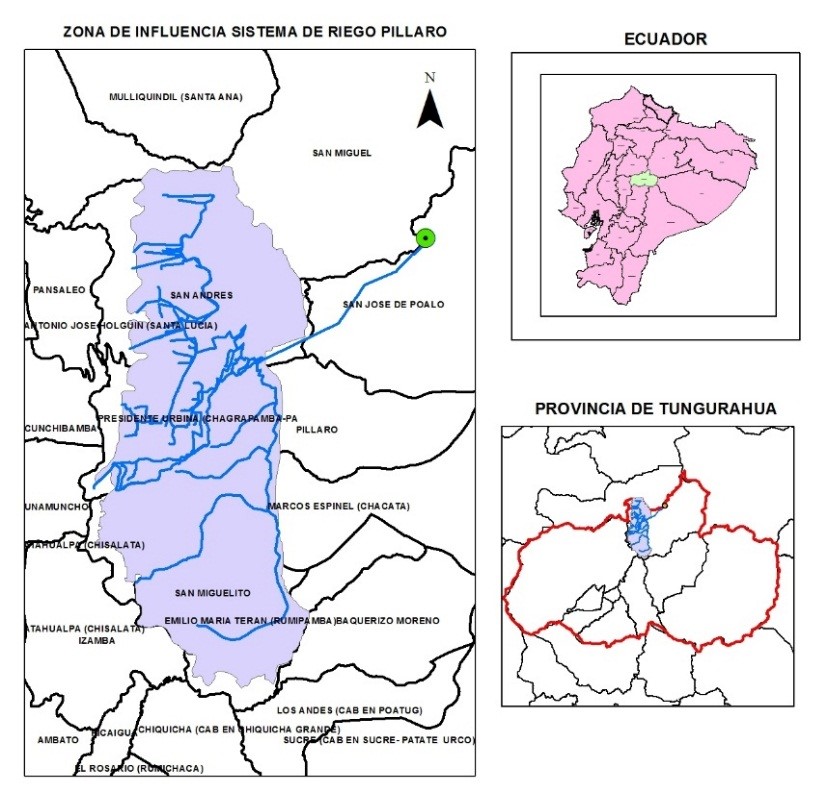
The framework of public policies for management of water resources, proposes arguments for the efficient use of water, where technical plot irrigation projects are born, as is the case of the Píllaro-north branch irrigation system, considered one of the most representative experiences of massive and collective pressurized irrigation in the country in the last 20 years. This system currently has more than 5,000 beneficiaries, distributed in 115 irrigation modules, across 3,359 hectares, and 7,700 smallholding lots, with an assigned flow of 1,265 l s-1, and an allocation of 0.39 l s-1 ha-1per hectare. This experience of collective modernization is the result of co-management between users, the state and development agencies. This technification process, which has been carried out for 20 years, has brought with it transformations in the territory, making it a precise scenario for evaluating and analyzing the reasons for its success. This technification experience considered key concepts such as the social construction of technology, where four aspects are closely related: infrastructure and civil work, normative, social and institutional components, at national, provincial and local scales. It is also evidenced that the technification of irrigation is seen in an integral and comprehensive perspective, where a “reproduction of technology” is carried out as an endogenous process, allowing a strong interdependence and unity between infrastructure, regulations and the reagents organization.
Downloads
Metrics
Article Details

This work is licensed under a Creative Commons Attribution-NonCommercial 4.0 International License.
The authors who publish in Siembra know and accept the following conditions:
- Authors retain the copyright and grant Siembra the right of first publication of the work, under the Creative Commons Attribution License. Third parties are allowed to use what has been published as long as they refer to the author or authors of the work and its publication in this journal.
 This content is licensed under a Creative Commons Attribution-Noncommercial 4.0 International (CC BY-NC 4.0).
- Authors maintain the copyright and guarantee Siembra the right to publish the manuscript through the channels it considers appropriate.
- Authors may establish on their own additional agreements for the non-exclusive distribution of the version of the work published in Siembra, acknowledging their initial publication in the same, such as in institutional repositories.
- Authors are authorized to disseminate their work electronically once the manuscript is accepted for publication.




References
Acuerdo Ministerial N° 2022-096. Que oficializa la actualización del Plan Nacional de Riego y Drenaje 2012–2026 publicado en el Registro Oficial, edición especial, No. 401 de 25 de febrero de 2014, correspondiente al periodo 2021–2026. Ministerio de Ambiente, Agua y Transición Ecológica. Registro Oficial, Segundo Suplemento, Nº 253. 17 febrero 2023 (Ecuador). https://www.ambiente.gob.ec/wp-content/uploads/downloads/2023/01/Acuerdo-Ministerial-Nro.-MAATE-2022-096.pdf
Acuerdo Ministerial N°. 2012-342. Que aprueba el Plan Nacional de Riego y Drenaje 2012-2026. Ministerio de Agricultura, Ganadería, Acuacultura y Pesca. Registro Oficial, edición especial, No. 401. 25 de febrero de 2014 (Ecuador) http://servicios.agricultura.gob.ec/mag01/pdfs/aministerial/2012/2012_0342.pdf
Banco Central del Ecuador. (2021). Informe de la evolución de la economía ecuatoriana en el año 2021 y perspectivas del año 2022. Banco Central del Ecuador. https://contenido.bce.fin.ec/documentos/Administracion/EvolEconEcu_2021persp2022.pdf
Boelens, R., Hoogesteger, J., Swyngedouw, E., Vos, J., y Wester, P. (2016). Hydrosocial territories: a political ecology perspective. Water International, 41(1), 1-14. https://doi.org/10.1080/02508060.2016.1134898 DOI: https://doi.org/10.1080/02508060.2016.1134898
Central Ecuatoriana de Servicios Agrícolas. [CESA]. (2014). Una experiencia exitosa de cogestión (público-comunitaria y privada) del Sistema de Riego Píllaro, Ramal Norte y de tecnificación del riego parcelario [Documento inédito]. CESA.
Consorcio de Capacitación para el Manejo de los Recursos Naturales Renovables [CAMAREN]. (2024). Organizaciones sociales del Ecuador presentan propuesta de Ley intercultural del agua y sus usos. Noticias CAMAREN. https://camaren.org/organizaciones-sociales-del-ecuador-presentan-propuesta-de-ley-intercultural-del-agua-y-sus-usos/
Damonte Valencia, G. H. (2015). Redefiniendo territorios hidrosociales: control hídrico en el valle de Ica, Perú (1993-2013). Cuadernos de Desarrollo Rural, 12(76), 109-133. https://doi.org/10.11144/Javeriana.cdr12-76.rthc DOI: https://doi.org/10.11144/Javeriana.cdr12-76.rthc
Decreto Ejecutivo Nº 206, Que transfiere a la Secretaría del Agua las competencias, atribuciones, responsabilidades, funciones, delegaciones, representaciones, proyectos y programas en materia de riego y drenaje que ejerce el Ministerio de Agricultura y Ganadería. Registro Oficial Nº 124 Suplemento. 21 de noviembre de 2017 (Ecuador). https://esacc.corteconstitucional.gob.ec/storage/api/v1/10_DWL_FL/eyJjYXJwZXRhIjoicm8iLCJ1dWlkIjoiMTMwNmI5OGQtNGIzNy00OTRmLWE4OTMtNDEwNmE1YWYwMDNlLnBkZiJ9
Decreto Ejecutivo Nº 6, Que escinde del Ministerio de Agricultura, Ganadería, Acuacultura y Pesca, el Viceministerio de Acuacultura y Pesca y créese el Ministerio de Acuacultura y Pesca, como organismo de derecho público, con personería jurídica, patrimonio y régimen administrativo y financiero propios, con sede en la ciudad de Quito. Registro Oficial Nº 16 Segundo Suplemento. 16 de junio de 2017 (Ecuador). https://esacc.corteconstitucional.gob.ec/storage/api/v1/10_DWL_FL/eyJjYXJwZXRhIjoicm8iLCJ1dWlkIjoiZGJkNzExOGMtMDIxNS00ZDIwLWE4NjItODNmMTNiOTEzNTU3LnBkZiJ9
Decreto Ejecutivo Nº 989, Que reorganiza la competencia de riego y drenaje, y transfiere a la Secretaría del Agua las competencias, atribuciones, responsabilidades, funciones, delegaciones, representaciones, proyectos y programas en materia de riego y drenaje que ejerce el Ministerio de Agricultura y Ganadería. Registro Oficial Nº 152 Suplemento. 2 de marzo de 2020 (Ecuador). https://esacc.corteconstitucional.gob.ec/storage/api/v1/10_DWL_FL/eyJjYXJwZXRhIjogInJvIiwgInV1aWQiOiAiY2JjMjk2MTEtZTJhMi00MzRmLWI1MmEtZTA4MTRiODYwNTQ2LnBkZiJ9
Gaybor Secaira, A. (2008). El despojo del agua y la necesidad de una transformación urgente. En E. Isch (ed.), Memorias del V Encuentro del Foro Nacional de los Recursos Hídricos (pp. 45-106). Consorcio CAMAREN. https://drive.google.com/file/d/1xUtMygvzRlcTtsySLp98L61RE3N-Nhch/view
Jiménez Chaves, V. E. (2012). El estudio de caso y su implementación en la investigación. Revista Internacional de Investigación en Ciencias Sociales, 8(1), 141-150. https://revistacientifica.uaa.edu.py/index.php/riics/article/view/18
Ministerio de Agricultura, Ganadería, Acuacultura y Pesca [MAGAP]. (2012). Plan Nacional de riego y drenaje. MAGAP.
Ministerio del Ambiente, Agua y Transición Ecológica [MAATE]. (2021). Plan Nacional de riego y drenaje 2021-2026. MAATE. https://www.ambiente.gob.ec/wp-content/uploads/downloads/2022/12/PLAN-NACIONAL-DE-RIEGO-Y-DRENAJE-2021-2026-PARA-PUBLICAR.pdf
Recalt, C. (2010). El proyecto Píllaro ¿Iniciado por la voluntad del Estado, deseado por la de las comunidades rurales, terminado en favor de quién? En E. Isch, y A. Zapata (eds.), Tierra y agua: interrelaciones de un acceso inequitativo (pp. 187-216). Corporación Sistema de Investigación sobre la Problemática Agraria en el Ecuador. https://horizon.documentation.ird.fr/exl-doc/pleins_textes/divers17-07/010055327.pdf
Resolución No. 0008-CNC-2011. Consejo Nacional de Competencias. 14 de julio de 2011 (Ecuador). https://www.competencias.gob.ec/wp-content/uploads/2015/10/resolucion-008-2011.pdf
Resolución No. 0012-CNC-2011. Consejo Nacional de Competencias. 8 de diciembre de 2011 (Ecuador). https://www.competencias.gob.ec/wp-content/uploads/2021/04/0012-11-Resolucio%CC%81n-reformatoria-de-008.pdf
Resolución No. 010-CNC-2012. Consejo Nacional de Competencias. 24 de septiembre de 2012 (Ecuador). https://www.competencias.gob.ec/wp-content/uploads/2015/10/010-12-cnc.pdf
Rogers, P., y Hall, A. W. (2003). Gobernabilidad Efectiva del Agua. Tec background papers N° 7. Global Water Partnership. https://www.gwp.org/globalassets/global/toolbox/publications/background-papers/07-effective-water-governance-2003-spanish.pdf
Secretaría Nacional del Agua [SENAGUA]. (2017). Base de datos del Banco Nacional de autorizaciones de uso del agua. Sistema Único de Información Ambiental [SUIA]. https://suia.ambiente.gob.ec/?page_id=467
Vargas, D., y Soares, S. (2008). El debate actual del agua: entre la economía, el derecho humano y la sustentabilidad. En D. Soares, S. Vargas, y M. R. Nuño (eds.), La gestión de los recursos hídricos: Realidades y perspectivas. Tomo I (pp. 87-117). Instituto Mexicano de Tecnología del Agua, Universidad de Guadalajara. http://hdl.handle.net/20.500.12013/1160
Vegas Meléndez, H. (2017). Políticas públicas y gobernanza Articulación para una gestión pública local autónoma. Polis (Santiago), 16(48), 155-172. https://doi.org/10.4067/S0718-65682017000300155 DOI: https://doi.org/10.4067/S0718-65682017000300155