
Environment-society relations in Ecuador's tourist beaches: application of “Silver and Gold” criteria in Paraíso and Puerto Engabao
Article Sidebar
Main Article Content
Abstract
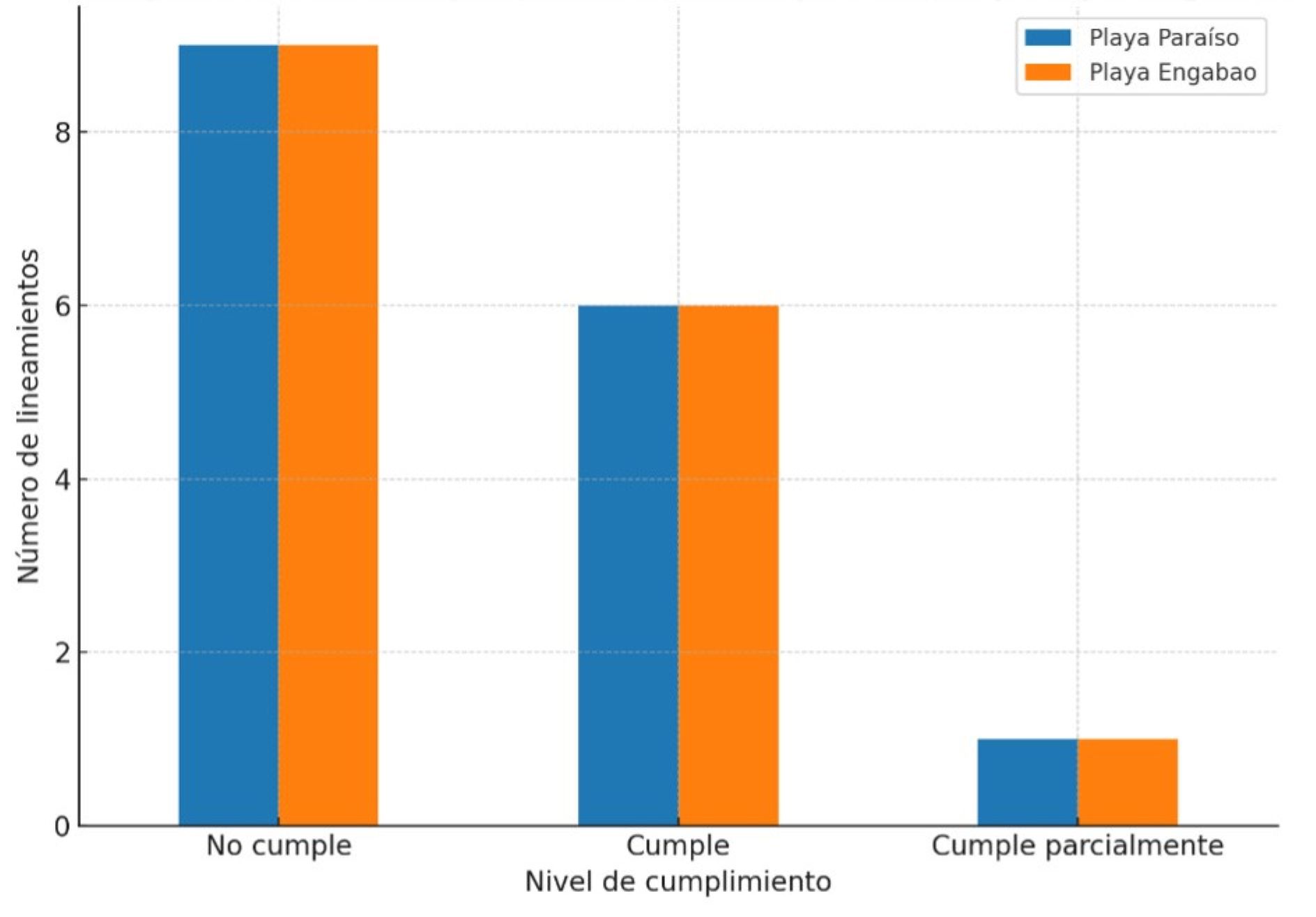
Beaches are key resources for coastal tourism in Ecuador; however, they currently face significant challenges, such as pollution, the impacts of climate change, and inadequate land-use planning. These challenges compromise their sustainability and reduce their competitiveness. This study evaluated compliance with Ministerial Agreement No. 2022-030, which establishes the requirements and procedures for achieving “Sustainable Tourist Beach – Ecuador” status, as well as the specific requirements for earning “Silver” and “Gold” Sustainable Tourist Beach recognition in Playa Paraíso and Playa Engabao, located in the canton Playas, Ecuador. We used a descriptive–comparative approach to collect information through field visits, direct observations, and document analysis. The evaluated criteria were safety, tourist services, environmental management, and coastal management. The results indicate that Playa Paraíso has better safety and basic infrastructure conditions, whereas Puerto Engabao exhibits deficiencies in environmental management and land use planning. Neither beach achieved the “Gold” certification level. These findings underscore the need for strengthening environmental, tourism, and social management to promote sustainable coastal development.
Downloads
Metrics
Article Details

This work is licensed under a Creative Commons Attribution-NonCommercial 4.0 International License.
The authors who publish in Siembra know and accept the following conditions:
- Authors retain the copyright and grant Siembra the right of first publication of the work, under the Creative Commons Attribution License. Third parties are allowed to use what has been published as long as they refer to the author or authors of the work and its publication in this journal.
 This content is licensed under a Creative Commons Attribution-Noncommercial 4.0 International (CC BY-NC 4.0).
- Authors maintain the copyright and guarantee Siembra the right to publish the manuscript through the channels it considers appropriate.
- Authors may establish on their own additional agreements for the non-exclusive distribution of the version of the work published in Siembra, acknowledging their initial publication in the same, such as in institutional repositories.
- Authors are authorized to disseminate their work electronically once the manuscript is accepted for publication.




References
Acuerdo Ministerial No. 2022 030. Para el reconocimiento de “Playa Turística Sostenible - Ecuador”. Registro Oficial No. 212 14. 19 de diciembre de 2022 (Ecuador). https://www.gob.ec/sites/default/files/regulations/2022-12/RO%20Playas%20tur%C3%ADsticas%20sostenibles_compressed.pdf
Allen, C., Malekpour, S., y Mintrom, M. (2023). Cross‐scale, cross‐level and multi‐actor governance of transformations toward the Sustainable Development Goals: A review of common challenges and solutions. Sustainable Development, 31(3), 1250–1267. https://doi.org/10.1002/sd.2495 DOI: https://doi.org/10.1002/sd.2495
Ansell, C., y Gash, A. (2008). Collaborative governance in theory and practice. Journal of Public Administration Research and Theory, 18(4), 543–571. https://doi.org/10.1093/jopart/mum032 DOI: https://doi.org/10.1093/jopart/mum032
Basurto-Cedeno, E., Penington-Gray, L., y Basurto, X. (2025). Developing a comprehensive index for beaches to enhance sustainability and visitor experience through holistic monitoring. Sustainability, 17(7), 3049. https://doi.org/10.3390/su17073049 DOI: https://doi.org/10.3390/su17073049
Berkes, F., y Folke, C. (1998). Linking social and ecological systems: Management practices and social mechanisms for building resilience. Cambridge University Press. https://assets.cambridge.org/97805217/85624/excerpt/9780521785624_excerpt.pdf
Bramwell, B., y Lane, B. (2011). Critical research on the governance of tourism and sustainability. Journal of Sustainable Tourism, 19(4–5), 411–421. https://doi.org/10.1080/09669582.2011.580586 DOI: https://doi.org/10.1080/09669582.2011.580586
Cicin-Sain, B., y Knecht, R. W. (1998). Integrated coastal and ocean management: Concepts and practices. Island Press. https://islandpress.org/books/integrated-coastal-and-ocean-management#desc
Er-Ramy, N., Nachite, D., Anfuso, G., y Azaaouaj, S. (2023). The Sector Analysis as a coastal management tool for sustainable tourism development on the Mediterranean Coast of Morocco. Sustainability, 15(16), 12581. https://doi.org/10.3390/su151612581 DOI: https://doi.org/10.3390/su151612581
Global Sustainable Tourism Council [GSTC]. (2020). GSTC criteria for destinations. GSTC. https://www.gstcouncil.org
Halliday, E., y Gast, R. J. (2011). Bacteria in beach sands: An emerging challenge in protecting coastal water quality and bather health. Environmental Science & Technology, 45(2), 370–379. https://doi.org/10.1021/es102747s DOI: https://doi.org/10.1021/es102747s
Iturralde, G., y Samaniego, J. (2021). Marine spatial planning in Ecuador: Current situation and the challenges we face. Revista Costas, 6(Esp. 2), 293–314. https://doi.org/10.26359/costas.e1421 DOI: https://doi.org/10.26359/costas.e1421
Jones, A., y Phillips, M. (eds.). (2018). Global climate change and coastal tourism: recognizing problems, managing solutions and future expectations. CABI. https://doi.org/10.1079/9781780648439.0000 DOI: https://doi.org/10.1079/9781780648439.0000
Kozak, M., Crotts, J. C., y Law, R. (2007). The impact of the perception of risk on international travellers. International Journal of Tourism Research, 9(4), 233–242. https://doi.org/10.1002/jtr.607 DOI: https://doi.org/10.1002/jtr.607
Lastra-Bravo, X., y Cabanilla V., E. (2020). Impacto del turismo en el desarrollo del Ecuador: Reflexiones desde la academia – IV CONGRETUR. Estudios y Perspectivas en Turismo, 29(4), 1272–1289. https://www.redalyc.org/journal/1807/180766099014/html/
Marchese, L., Botero, C. M., Zielinski, S., Anfuso, G., Polette, M., y Correa, I. C. S. (2021). Beach certification schemes in Latin America: Are they applicable to the Brazilian context? Sustainability, 13(2), 934. https://doi.org/10.3390/su13020934 DOI: https://doi.org/10.3390/su13020934
Mcleod, E., Chmura, G. L., Bouillon, S., Salm, R., Björk, M., Duarte, C. M., Lovelock, C. E., Schlesinger, W. H., y Silliman, B. R. (2011). A blueprint for blue carbon: toward an improved understanding of the role of vegetated coastal habitats in sequestering CO2. Frontiers in Ecology and the Environment, 9(10), 552–560. https://doi.org/10.1890/110004 DOI: https://doi.org/10.1890/110004
Mora Méndez, F. M., García Castro, S. R., y Chiriboga Cisneros, E. F. (2020). Certificación turística como herramienta de diferenciación clave para las playas: Caso Playa Chipipe. Salinas- Ecuador. INNOVA Research Journal, 5(3), 233–244. https://doi.org/10.33890/innova.v5.n3.2020.1386 DOI: https://doi.org/10.33890/innova.v5.n3.2020.1386
Ocean Panel. (2022). Opportunities for transforming coastal and marine tourism: Towards sustainability, regeneration and resilience. Ocean Panel. https://oceanpanel.org/wp-content/uploads/2022/06/Sustainable-Tourism-Full-Report.pdf
Ostrom, E. (1990). Governing the commons: The evolution of institutions for collective action. Cambridge University Press. https://www.actu-environnement.com/media/pdf/ostrom_1990.pdf DOI: https://doi.org/10.1017/CBO9780511807763
Pine, B. J., y Gilmore, J. H. (2013). The experience economy: past, present and future. En J. Sundbo y F. Sørensen (eds.), Handbook on the Experience Economy (pp. 21-44). Edward Elgar Publishing. https://doi.org/10.4337/9781781004227.00007 DOI: https://doi.org/10.4337/9781781004227.00007
Rhodes, R. A. W. (1996). The New Governance: Governing without Government. Political Studies, 44(4), 652–667. https://doi.org/10.1111/j.1467-9248.1996.tb01747.x DOI: https://doi.org/10.1111/j.1467-9248.1996.tb01747.x
Roca, E., y Villares, M. (2008). Public perceptions for evaluating beach quality in urban and semi-natural environments. Ocean & Coastal Management, 51(4), 314–329. https://doi.org/10.1016/j.ocecoaman.2007.09.001 DOI: https://doi.org/10.1016/j.ocecoaman.2007.09.001
Senthilkumar, R. (2021). Sustainable coastal tourism – An overview. Sustainability, Agri, Food and Environmental Research, 10(1), 1–12. https://doi.org/10.7770/safer-V10N1-art2497 DOI: https://doi.org/10.7770/safer-V10N1-art2497
Sharpley, R. (2020). Tourism, sustainable development and the theoretical divide: 20 years on. Journal of Sustainable Tourism, 28(11), 1932–1946. https://doi.org/10.1080/09669582.2020.1779732 DOI: https://doi.org/10.1080/09669582.2020.1779732
Slovic, P. (1987). Perception of Risk. Science, 236(4799), 280–285. https://doi.org/10.1126/science.3563507 DOI: https://doi.org/10.1126/science.3563507
United Nations Environment Programme [UNEP]. (2013). Review of ecosystem-based indicators and indices on the state of the Regional Seas. UNEP (DEPI)/VW.1/INF.1. UNEP. https://www.unep.org/resources/report/review-ecosystem-based-indicators-and-indices-state-regional-seas-0
Whitman, R. L., Harwood, V. J., Edge, T. A., Nevers, M. B., Byappanahalli, M., Vijayavel, K., Brandão, J., Sadowsky, M. J., Alm, E. W., Crowe, A., Ferguson, D., Ge, Z., Halliday, E., Kinzelman, J., Kleinheinz, G., Przybyla-Kelly, K., Staley, C., Staley, Z., y Solo-Gabriele, H. M. (2014). Microbes in beach sands: integrating environment, ecology and public health. Reviews in Environmental Science and Bio/Technology, 13(3), 329–368. https://doi.org/10.1007/s11157-014-9340-8 DOI: https://doi.org/10.1007/s11157-014-9340-8
World Health Organization. (2021). Guidelines on recreational water quality: Volume 1 – Coastal and fresh waters. Geneva: World Health Organization. https://www.who.int/publications/i/item/9789240031302
Zielinski, S., y Botero, C. (2015). Are eco-labels sustainable? Beach certification schemes in Latin America and the Caribbean. Journal of Sustainable Tourism, 23(10), 1550–1572. https://doi.org/10.1080/09669582.2015.1047376 DOI: https://doi.org/10.1080/09669582.2015.1047376