Incidencia del software GeoGebra en el proceso de enseñanza-aprendizaje de la derivada en el segundo año de Bachillerato General Unificado
DOI:
https://doi.org/10.29166/catedra.v9i1.7849Palabras clave:
Matemática, derivadas, software, GeoGebra, rendimiento académicoResumen
Este artículo presenta el estudio sobre el uso del software libre denominado GeoGebra, en el proceso de enseñanza-aprendizaje de la Matemática, centralizada en el campo de la derivación, con la finalidad de evidenciar la incidencia de la misma en los estudiantes del segundo año de Bachillerato General Unificado del colegio municipal “Juan Wisneth”, puesto que, en Ecuador existe una metodología tradicional y mínimamente orientada al ámbito digital dentro de la educación. Para esto, el estudiantado fue dividido en dos grupos: el primero fue incluido al programa mediante una guía didáctica, mientras que el segundo continuó con el pénsum académico establecido y otorgado por la institución. La investigación es de tipo cuasiexperimental con enfoque cuantitativo. De igual manera, para la recolección de datos se emplearon tres instrumentos: evaluación diagnóstica (antes de la intervención), evaluación formativa (durante); y, evaluación sumativa (final). Asimismo, la modalidad de investigación forma parte de un proyecto socioeducativo con un nivel de profundidad descriptiva. Este hallazgo evidencia que la utilización de GeoGebra favorece en la enseñanza-aprendizaje de los estudiantes al mostrar calificaciones más altas en aquellos que utilizaron el software. Por consecuente, la implicación de la era digital en la Matemática, específicamente al tratar el tema de la derivada, favorece a las instituciones el uso de software libres para un mejor aprendizaje.
Descargas
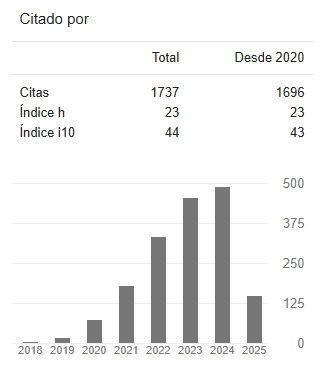
Citas
Álvarez, J., García, D., Erazo, C., y Erazo, J. (2020). GeoGebra como estrategia de enseñanza de la matemática. Episteme Koinonía, 3(6), 213–226. https://doi.org/10.35381/e.k.v3i6.827 DOI: https://doi.org/10.35381/e.k.v3i6.827
Arias, J., y Covinos, M. (2021). Diseño y metodología de la investigación. Enfoques Consulting E.I.R.L.
Ayil, J. (2018). Entorno virtual de aprendizaje: Una herramienta de apoyo para la enseñanza de las matemáticas. Revista de Investigación en Tecnologías de la Información (RITI), 6(11), 34–39. https://dialnet.unirioja.es/servlet/articulo?codigo=7107366 DOI: https://doi.org/10.36825/RITI.06.11.006
Blázquez, S., Ortega, T., Gatica, S., y Benegas, J. (2006). Una conceptualización de límite para el aprendizaje inicial de análisis matemático en la universidad. Revista Latinoamericana de Investigación en Matemática Educativa, 9(2), 189–209. https://www.redalyc.org/articulo.oa?id=33590202
Guevara, G., Verdesoto, A., y Castro, N. (2020). Metodologías de investigación educativa (descriptivas, experimentales, participativas y de investigación-acción). Recimundo, 4(3), 163–173. https://recimundo.com/index.php/es/article/view/860 DOI: https://doi.org/10.26820/recimundo/4.(3).julio.2020.163-173
Hernández, R., Fernández, C., y Baptista, M. (2014). Metodología de la investigación (6.ª ed.). McGraw-Hill Education.
Hernández, R., y Mendoza, C. (2018). Metodología de la investigación: Las rutas cuantitativa, cualitativa y mixta. McGraw-Hill Education.
Holguín, F., Holguín, E., y García, N. (2020). Gamificación en la enseñanza de las matemáticas: Una revisión sistemática. Telos: Revista de Estudios Interdisciplinarios en Ciencias Sociales, 22(1), 62–75. https://doi.org/10.36390/telos221.05 DOI: https://doi.org/10.36390/telos221.05
Mejía, E. (2005). Técnicas e instrumentos de investigación. Universidad Nacional Mayor de San Marcos.
Mellado, P., Sánchez, P., y Blanco, M. (2021). Tendencias de la evaluación formativa y sumativa del alumnado en Web of Science. Alteridad, 16(2), 170–185. https://scielo.senescyt.gob.ec/pdf/alteridad/v16n2/1390-325X-alt-16-02-00170.pdf DOI: https://doi.org/10.17163/alt.v16n2.2021.01
Muñoz, R. (2015). Cómo elaborar y asesorar una investigación de tesis. Pearson.
Olivo, J., y Corrales, J. (2020). De los entornos virtuales de aprendizaje: Hacia una nueva praxis en la enseñanza de la matemática. Revista Andina de Educación, 3(1), 8–19. https://doi.org/10.32719/26312816.2020.3.1.2 DOI: https://doi.org/10.32719/26312816.2020.3.1.2
Parra, L., y Vázquez, M. (2017). Muestreo probabilístico y no probabilístico. Gestiopolis. https://www.gestiopolis.com/wp-content/uploads/2017/02/muestreo-probabilistico-no-probabilistico-guadalupe.pdf
Revelo, J., Lozano, E., y Bastidas, P. (2019). La competencia digital docente y su impacto en el proceso de enseñanza–aprendizaje de la matemática. Espirales, 3(28), 156–175. https://dialnet.unirioja.es/servlet/articulo?codigo=8466473 DOI: https://doi.org/10.31876/er.v3i28.630
Vera, F. (2020, agosto). La importancia del proceso de enseñanza-aprendizaje y la evaluación diagnóstica. Atlante: Cuadernos de Educación y Desarrollo. https://www.eumed.net/rev/atlante/2020/08/evaluacion-diagnostica.html