
Understanding the effect of cropping system on soil health at the Northwestern Ontario Agricultural Research Station in Canada
Article Sidebar
Main Article Content
Abstract
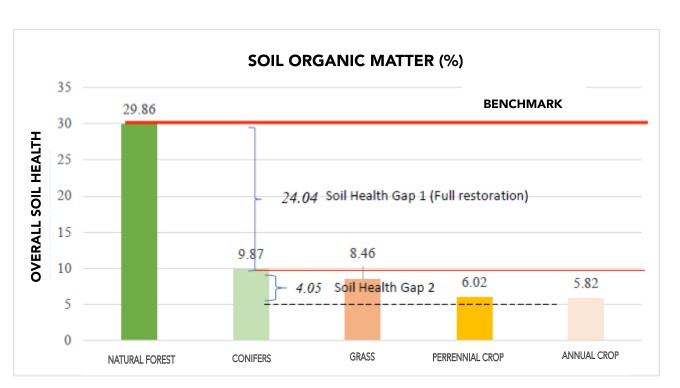
Anthropogenic activities impact soil in varying degrees, from preserving natural landscapes to intensive agriculture which among the farm practices that impact the soil are the cropping systems. Information on cropping systems and soil impacts in northern territories is still missing. This study assesses the effect of different cropping systems on soil health -physical, chemical and biological soil properties and indicators of soil health - at the Lakehead Agricultural Research Station [LUARS] in northern Ontario, Canada. The study compares three cropping systems (perennial crops-pasture, grass, and annual crops -wheat, barley, corn, soybeans) and two forest areas (conifer plantation and naturally regenerating mixed wood forest) at LUARS. Soil samples were collected at different depths and analyzed for various indicators using the Cornell Soil Health Assessment framework. The results showed the soil health scores varied among cropping systems, with natural forest and perennial crops-pasture having higher scores compared to annual crops -wheat, barley, corn, soybeans. Soil organic matter was found to be lowest in annual crops -wheat, barley, corn, soybeans, while aggregate stability was highest in natural forests. The study also identifies the soil health gap, which represents the difference between the health of a particular cropping system and a benchmark. The soil health gap analysis can help farmers implement practices to improve soil health and increase the resilience and sustainability of agroecosystems. Overall, this study emphasizes the importance of understanding the effect of cropping systems on soil health and provides insights into potential strategies for improving farm practices.
Downloads
Metrics
Article Details

This work is licensed under a Creative Commons Attribution-NonCommercial 4.0 International License.
The authors who publish in Siembra know and accept the following conditions:
- Authors retain the copyright and grant Siembra the right of first publication of the work, under the Creative Commons Attribution License. Third parties are allowed to use what has been published as long as they refer to the author or authors of the work and its publication in this journal.
 This content is licensed under a Creative Commons Attribution-Noncommercial 4.0 International (CC BY-NC 4.0).
- Authors maintain the copyright and guarantee Siembra the right to publish the manuscript through the channels it considers appropriate.
- Authors may establish on their own additional agreements for the non-exclusive distribution of the version of the work published in Siembra, acknowledging their initial publication in the same, such as in institutional repositories.
- Authors are authorized to disseminate their work electronically once the manuscript is accepted for publication.




References
Acton, D. F., & Gregorich, L. J. (eds.). (1995). The health of our soils: toward sustainable agriculture in Canada. Agriculture and Agri-Food Canada. https://doi.org/10.5962/bhl.title.58906
Afzalinia, S., & Zabihi, J. (2014). Soil compaction variation during corn growing season under conservation tillage. Soil and Tillage Research, 137, 1–6. https://doi.org/10.1016/j.still.2013.11.003
Agomoh, I. v., Drury, C. F., Phillips, L. A., Reynolds, W. D., & Yang, X. (2020). Increasing crop diversity in wheat rotations increases yields but decreases soil health. Soil Science Society of America Journal, 84(1), 170–181. https://doi.org/10.1002/saj2.20000
Baldwin, D. J., Desloges, J. R., & Band, L. E. (2000). Physical geography of Ontario. In A. H. Perera, D. L. Euler, & I. D. Thompson, Ecology of a Managed Terrestrial Landscape: Patterns and Processes of Forest Landscapes in Ontario (pp. 12-29). University of British Columbia Press. https://www.ubcpress.ca/asset/12524/1/9780774807494.pdf
Benalcazar, P., Seuradge, B., Diochon, A. C., Kolka, R. K., & Phillips, L. A. (2024). Conversion of boreal forests to agricultural systems: soil microbial responses along a land-conversion chronosequence. Environmental Microbiome, 19(1), 32. https://doi.org/10.1186/s40793-024-00576-3
Carpenter, S. R., Caraco, N. F., Correll, D. L., Howarth, R. W., Sharpley, A. N., & Smith, V. H. (1998). Nonpoint pollution of surface waters with phosphorus and nitrogen. Ecological Applications, 8(3), 559-568. https://doi.org/10.1890/1051-0761(1998)008[0559:NPOSWW]2.0.CO;2
Cheng, Y., Wang, J., Mary, B., Zhang, J., Cai, Z., & Chang, S. X. (2013). Soil pH has contrasting effects on gross and net nitrogen mineralizations in adjacent forest and grassland soils in central Alberta, Canada. Soil Biology and Biochemistry, 57, 848-857. https://doi.org/10.1016/j.soilbio.2012.08.021
Congreves, K. A., Hayes, A., Verhallen, E. A., & van Eerd, L. L. (2015). Long-term impact of tillage and crop rotation on soil health at four temperate agroecosystems. Soil and Tillage Research, 152, 17-28. https://doi.org/10.1016/j.still.2015.03.012
Das, B., Chakraborty, D., Singh, V. K., Aggarwal, P., Singh, R., Dwivedi, B. S., & Mishra, R. P. (2014). Effect of integrated nutrient management practice on soil aggregate properties, its stability and aggregate-associated carbon content in an intensive rice–wheat system. Soil and Tillage Research, 136, 9–18. https://doi.org/10.1016/j.still.2013.09.009
de Clercq, T., Heiling, M., Dercon, G., Resch, C., Aigner, M., Mayer, L., Mao, Y., Elsen, A., Steier, P., Leifeld, J., & Merckx, R. (2015). Predicting soil organic matter stability in agricultural fields through carbon and nitrogen stable isotopes. Soil Biology and Biochemistry, 88, 29-38. https://doi.org/10.1016/j.soilbio.2015.05.011
DeFries, R. S., Foley, J. A., & Asner, G. P. (2004). Land-use choices: Balancing human needs and ecosystem function. Frontiers in Ecology and the Environment, 2(5), 249-257. https://doi.org/10.1890/1540-9295(2004)002[0249:LCBHNA]2.0.CO;2
Doran, J. W., & Parkin, T. B. (1994). Defining and Assessing Soil Quality. In W. Doran, D. C. Coleman, D. F. Bezdicek, & B. A. Stewart (eds.), Defining Soil Quality for a Sustainable Environment (pp. 1-21). SSSA Special Publications. https://doi.org/10.2136/sssaspecpub35.c1
Environment Canada. (1991). The state of Canada’s environment. Government of Canada. https://publications.gc.ca/pub?id=9.881528&sl=0
Karlen, D. L., Veum, K. S., Sudduth, K. A., Obrycki, J. F., & Nunes, M. R. (2019). Soil health assessment: Past accomplishments, current activities, and future opportunities. Soil and Tillage Research, 195, 104365. https://doi.org/10.1016/j.still.2019.104365
Lal, R. (2011). Soil Health and Climate Change: An Overview. In B. P. Singh, A. L. Cowie, & K. Y. Chan (eds.), Soil Health and Climate Change (pp. 3-24). Springer Berlin Heidelberg. https://doi.org/10.1007/978-3-642-20256-8_1
Magdoff, F. (2007). Ecological agriculture: Principles, practices, and constraints. Renewable Agriculture and Food Systems, 22(2), 109-117. https://doi.org/10.1017/S1742170507001846
Magdoff, F., & Es, H. van. (2000). Building soils for better crops (2nd ed.). Sustainable Agriculture Network. https://soilwealth.com.au/wp-content/uploads/2023/08/030218bettersoils.pdf
Magdoff, F., & Weil, R. R. (eds.). (2004). Soil organic matter in sustainable agriculture. CRC press. https://doi.org/10.1201/9780203496374
Maharjan, B., Das, S., & Acharya, B. S. (2020). Soil Health Gap: A concept to establish a benchmark for soil health management. Global Ecology and Conservation, 23, e01116. https://doi.org/10.1016/j.gecco.2020.e01116
Moebius-Clune, B. N., Moebius-Clune, D. J., Gugino, B. K., Idowu, O. J., Schindelbeck, R. R., Ristow, A. J., Es, H. M. van, Thies, J. E., Shayler, H. A., McBride, M. B., Kurtz, K. S. M., Wolfe, D. W., & Abawi, G. S. (2016). Comprehensive Assessment of Soil Health – The Cornell Framework (3.2 ed.). Cornell University. http://www.css.cornell.edu/extension/soil-health/manual.pdf
Oregon State University. (2017). Small Farms Workshops. College of Agricultural Sciences, Oregon State University. https://agsci.oregonstate.edu/academics/available-projects/small-farms-workshops
Reicosky, D. (ed.). (2018). Managing soil health for sustainable agriculture Volume 1. Burleigh Dodds Science Publishing. https://doi.org/10.1201/9781351114530
Sahota, T. S., & Malhi, S. S. (2012). Intercropping barley with pea for agronomic and economic considerations in northern Ontario. Agricultural Sciences, 03(07), 889-895. https://doi.org/10.4236/as.2012.37107
Tilman, D., Cassman, K. G., Matson, P. A., Naylor, R., & Polasky, S. (2002). Agricultural sustainability and intensive production practices. Nature, 418(6898), 671-677. https://doi.org/10.1038/nature01014
Torstensson, G., Aronsson, H., & Bergström, L. (2006). Nutrient use efficiencies and leaching of organic and conventional cropping systems in Sweden. Agronomy Journal, 98(3), 603-615. https://doi.org/10.2134/agronj2005.0224
Wei, X., Shao, M., Gale, W., & Li, L. (2014). Global pattern of soil carbon losses due to the conversion of forests to agricultural land. Scientific Reports, 4(1), 4062. https://doi.org/10.1038/srep04062
Wiesmeier, M., Urbanski, L., Hobley, E., Lang, B., von Lützow, M., Marin-Spiotta, E., van Wesemael, B., Rabot, E., Ließ, M., Garcia-Franco, N., Wollschläger, U., Vogel, H.-J., & Kögel-Knabner, I. (2019). Soil organic carbon storage as a key function of soils - A review of drivers and indicators at various scales. Geoderma, 333, 149-162. https://doi.org/10.1016/j.geoderma.2018.07.026
Yang, Q., Peng, J., Ni, S., Zhang, C., Wang, J., & Cai, C. (2024). Soil erosion-induced decline in aggregate stability and soil organic carbon reduces aggregate-associated microbial diversity and multifunctionality of agricultural slope in the Mollisol region. Land Degradation & Development, 35(11), 3714-3726. https://doi.org/10.1002/ldr.5163
Yang, T., Siddique, K. H. M., & Liu, K. (2020). Cropping systems in agriculture and their impact on soil health-A review. Global Ecology and Conservation, 23, e01118. https://doi.org/10.1016/j.gecco.2020.e01118