
Physiological acclimatization strategies to water deficit in Solanum phureja Juz. et. Buk
Article Sidebar
Main Article Content
Abstract
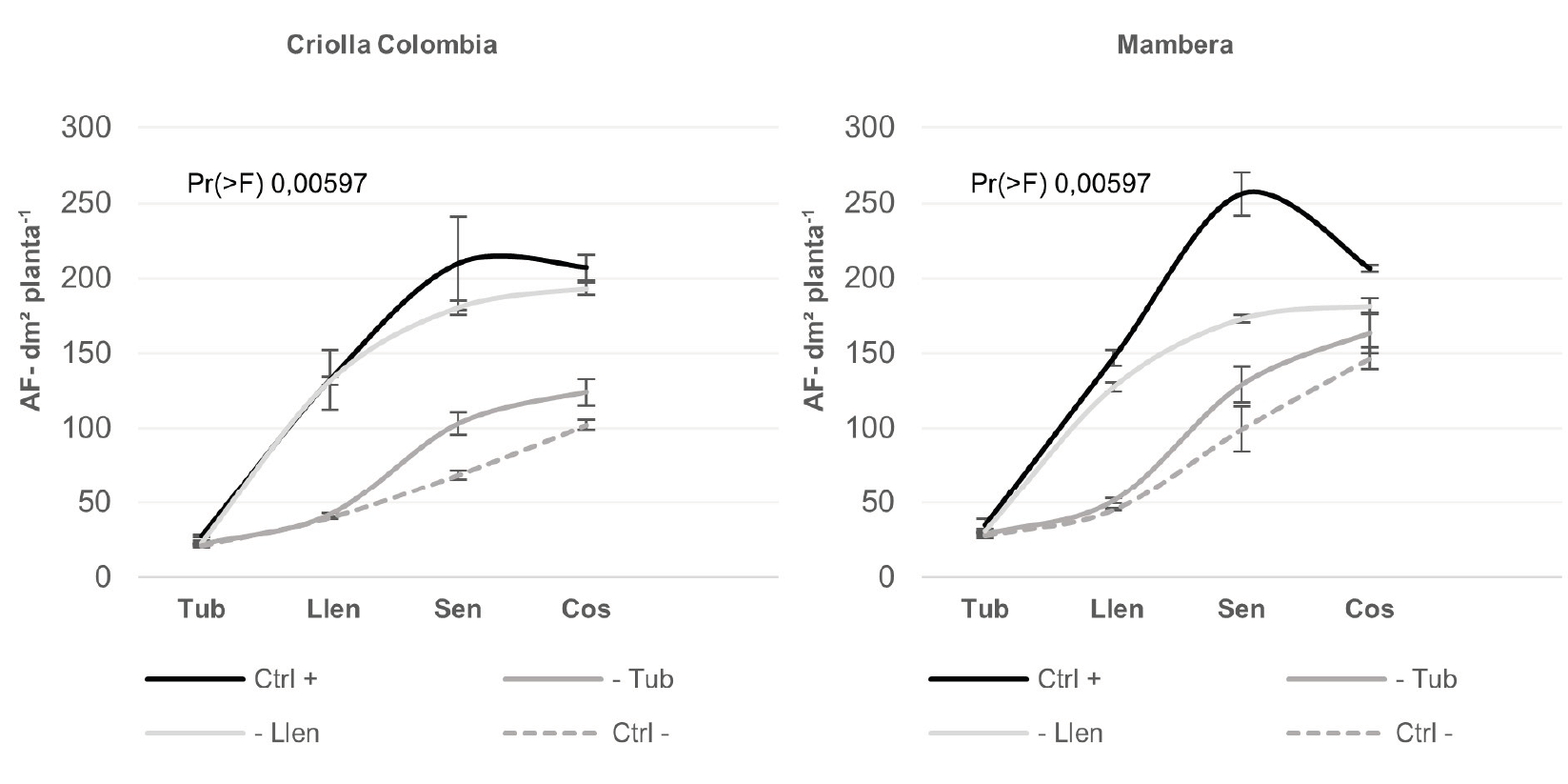
Potatoes are an important crop for global food security. Solanum phureja is a highly diverse group of cultivars that are economically and culturally significant. Climate change has affected potato yields, and water deficits are a determining factor. This study aimed to identify the physiological strategies of S. phureja for acclimatizing to water deficit stress. Tubers from two S. phureja cultivars (Criolla Colombia and Mambera) were planted in a greenhouse and exposed to a water deficit by maintaining soil volumetric moisture levels between 10% and 15% during periods of stress, according to the crop’s phenological stage. Water potential, gas exchange, water use efficiency, chlorophyll content, dry mass accumulation, and yield were evaluated. Results showed decreases in leaf water potential (-1.28 Ψ), stomatal conductance (0.047 mol m-2 s-1), and photosynthesis rate (µmol 3.6 mol m-2 s-1), as well as decreases in leaf area. There were also increases in chlorophyll concentration (566.77 mg m-2) and water use efficiency (119 µmol CO₂/mmol H₂O) in treatments under hydric stress. Higher levels of stress were reported during the filling stage, as well as high recovery and adaptation to stress during tuberization. Additionally, we found differences between the cultivars related to their phenology, yield, and dry matter distribution. These results highlight a chain of physiological responses beginning with a reduction in water potential and gas exchange and ending with changes in organ growth. These results contribute to identifying tolerant cultivars, improving agronomic management, optimizing irrigation, and crop zoning.
Downloads
Metrics
Article Details

This work is licensed under a Creative Commons Attribution-NonCommercial 4.0 International License.
The authors who publish in Siembra know and accept the following conditions:
- Authors retain the copyright and grant Siembra the right of first publication of the work, under the Creative Commons Attribution License. Third parties are allowed to use what has been published as long as they refer to the author or authors of the work and its publication in this journal.
 This content is licensed under a Creative Commons Attribution-Noncommercial 4.0 International (CC BY-NC 4.0).
- Authors maintain the copyright and guarantee Siembra the right to publish the manuscript through the channels it considers appropriate.
- Authors may establish on their own additional agreements for the non-exclusive distribution of the version of the work published in Siembra, acknowledging their initial publication in the same, such as in institutional repositories.
- Authors are authorized to disseminate their work electronically once the manuscript is accepted for publication.




References
Abaunza González, C. A., Sánchez Vivas, D. F., Cerón Lasso, M. del S., y Echeverry Prieto, L. C. (2022). Análisis del riesgo por cambio climático en el cultivo de papa diploide (Solanum phureja Juz. et Buk.) en municipios productores del Departamento de Cundinamarca. En Papa nativa diploide: en busca de fortalecer el sistema productivo de Colombia (pp. 67-85). Editorial Grupo Compás. http://hdl.handle.net/20.500.12324/38029
Alhoshan, M., Zahedi, M., Ramin, A. A., y Sabzalian, M. R. (2019). Effect of soil drought on biomass production, physiological attributes and antioxidant enzymes activities of potato cultivars. Russian Journal of Plant Physiology, 66(2), 265–277. https://doi.org/10.1134/S1021443719020031 DOI: https://doi.org/10.1134/S1021443719020031
Araus, J. L., Slafer, G. A., Reynolds, M. P., y Royo, C. (2002). Plant breeding and drought in C3 cereals: What should we breed for? Annals of Botany, 89(7), 925-940. https://doi.org/10.1093/AOB/MCF049 DOI: https://doi.org/10.1093/aob/mcf049
Ariza, W., Rodríguez, L. E., Moreno-Echeverry, D., Guerrero, C. A., y Moreno, L. P. (2020). Effect of water deficit on some physiological and biochemical responses of the yellow diploid potato (Solanum tuberosum L. Group Phureja). Agronomía Colombiana, 38(1), 36–44. https://doi.org/10.15446/agron.colomb.v38n1.78982 DOI: https://doi.org/10.15446/agron.colomb.v38n1.78982
Blum, A. (2009). Effective use of water (EUW) and not water-use efficiency (WUE) is the target of crop yield improvement under drought stress. Field Crops Research, 112(2–3), 119–123. https://doi.org/10.1016/j.fcr.2009.03.009 DOI: https://doi.org/10.1016/j.fcr.2009.03.009
Deblonde, P. M. K., y Ledent, J. F. (2001). Effects of moderate drought conditions on green leaf number, stem height, leaf length and tuber yield of potato cultivars. European Journal of Agronomy, 14(1), 31–41. https://doi.org/10.1016/S1161-0301(00)00081-2 DOI: https://doi.org/10.1016/S1161-0301(00)00081-2
Díaz Valencia, P. A. (2016). Evaluación de la tolerancia al estrés hídrico en genotipos de papa criolla (Solanum phureja Juz et Buk). Universidad Nacional de Colombia. https://repositorio.unal.edu.co/handle/unal/55602
Fang, Y. J., y Xiong, L. Z. (2015). General mechanisms of drought response and their application in drought resistance improvement in plants. Cellular & Molecular Life Sciences Cmls, 72(4), 673–689. https://doi.org/10.1007/s00018-014-1767-0 DOI: https://doi.org/10.1007/s00018-014-1767-0
Federación Colombiana de Productores de Papa [Fedepapa]. (2023). Boletín Regional Nacional Papa Volumen 7 2023. Federación Colombiana de Productores de Papa. https://fedepapa.com/wp-content/uploads/2024/04/Regional-Nacional.pdf
Food and Agriculture Organization of the United Nations [FAO] (2025). FAOSTAT: Potato production – Crops and livestock products. https://www.fao.org/faostat/en/#data
Gerhards, M., Rock, G., Schlerf, M., y Udelhoven, T. (2016). Water stress detection in potato plants using leaf temperature, emissivity, and reflectance. International Journal of Applied Earth Observation and Geoinformation, 53, 27–39. https://doi.org/10.1016/j.jag.2016.08.004 DOI: https://doi.org/10.1016/j.jag.2016.08.004
Gervais, T., Creelman, A., Li, X.-Q., Bizimungu, B., de Koeyer, D., y Dahal, K. (2021). Potato response to drought stress: physiological and growth basis. Frontiers in Plant Science, 12, e698060. https://doi.org/10.3389/fpls.2021.698060 DOI: https://doi.org/10.3389/fpls.2021.698060
Gómez, T. M., López, J. B., Pineda, R., Galindo, L. F., Arango, R., y Morales, J. G. (2012). Caracterización citogenética de cinco genotipos de papa criolla, Solanum phureja (Juz. et Buk.). Revista Facultad Nacional de Agronomía Medellín 65(1), 6379–6387. https://www.redalyc.org/articulo.oa?id=179924340008.
Graça, J. P. da, Rodrigues, F. A., Farias, J. R. B., Oliveira, M. C. N. de, Hoffmann-Campo, C. B., y Zingaretti, S. M. (2010). Physiological parameters in sugarcane cultivars submitted to water deficit. Brazilian Journal of Plant Physiology, 22(3), 189–197. https://doi.org/10.1590/S1677-04202010000300006 DOI: https://doi.org/10.1590/S1677-04202010000300006
Hill, D., Nelson, D., Hammond, J., y Bell, L. (2021). Morphophysiology of potato (Solanum tuberosum) in response to drought stress: Paving the way forward. Frontiers in Plant Science, 11, 597554. https://doi.org/10.3389/fpls.2020.597554 DOI: https://doi.org/10.3389/fpls.2020.597554
Hörtensteiner, S. (2009). Stay-green regulates chlorophyll and chlorophyll-binding protein degradation during senescence. Trends in Plant Science, 14(3), 155–162. https://doi.org/10.1016/j.tplants.2009.01.002 DOI: https://doi.org/10.1016/j.tplants.2009.01.002
Kim, Y.-U., Seo, B.-S., Choi, D.-H., Ban, H.-Y., y Lee, B.-W. (2017). Impact of high temperatures on the marketable tuber yield and related traits of potato. European Journal of Agronomy, 89, 46–52. https://doi.org/10.1016/j.eja.2017.06.005 DOI: https://doi.org/10.1016/j.eja.2017.06.005
López-Rendón, J. F., Rodríguez-Hernández, P., Meneses Buitrago, D. H., y Lopez-Peñafiel, H.-V. (2024). Respuesta fisiológica de Solanum phureja bajo déficit hídrico. Agronomía Mesoamericana, 35, 55692. https://doi.org/10.15517/am.2024.55692 DOI: https://doi.org/10.15517/am.2024.55692
Mahmud, A. al, Hossain, M., Kadian, M. S., y Hoque, Md. A. (2015). Physiological and biochemical changes in potato under water stress condition. Indian Journal of Plant Physiology, 20(4), 297–303. https://doi.org/10.1007/s40502-015-0173-4 DOI: https://doi.org/10.1007/s40502-015-0173-4
Marmolejo, D., y Ruiz, J. (2018). Tolerancia de papas nativas (Solanum spp.) a heladas en el contexto de cambio climático. Scientia Agropecuaria, 9(3), 393–400. https://doi.org/10.17268/sci.agropecu.2018.03.10 DOI: https://doi.org/10.17268/sci.agropecu.2018.03.10
Medrano Gil, H., Bota Salort, J., Cifre Llompart, J., Flexas Sans, J., Ribas Carbó, M., y Gulías León, J. (2007). Eficiencia en el uso del agua por las plantas. Investigaciones Geográficas, (43), 63-84. https://doi.org/10.14198/INGEO2007.43.04 DOI: https://doi.org/10.14198/INGEO2007.43.04
Molina Cita, Y., Caez Ramirez, G. R., Cerón Lasso, M. S., y Garnica Holguín, A. M. (2015). Contenido de antioxidantes en papas criollas nativas (Solanum tuberosum L. grupo Phureja) en proceso de precocción y congelación. Alimentos Hoy, 23(36) 31–41. https://alimentoshoy.acta.org.co/index.php/hoy/article/view/341
Moradi, R., Koocheki, A., Nassiri Mahallati, M., y Mansoori, H. (2013). Adaptation strategies for maize cultivation under climate change in Iran: irrigation and planting date management. Mitigation and Adaptation Strategies for Global Change, 18(2), 265–284. https://doi.org/10.1007/s11027-012-9410-6 DOI: https://doi.org/10.1007/s11027-012-9410-6
Ñústez López, C. E., y Rodríguez Molano, L. E. (2024). Papa criolla (Solanum tuberosum L. Grupo Phureja): manual de recomendaciones técnicas para su cultivo en Cundinamarca. Universidad Nacional de Colombia. https://repositorio.unal.edu.co/handle/unal/86779
Paul, S., Farooq, M., y Gogoi, N. (2016). Influence of high temperature on carbon assimilation, enzymatic antioxidants and tuber yield of different potato cultivars. Russian Journal of Plant Physiology, 63(3), 319–325. https://doi.org/10.1134/S1021443716030109 DOI: https://doi.org/10.1134/S1021443716030109
Pieczynski, M., Wyrzykowska, A., Milanowska, K., Boguszewska‐Mankowska, D., Zagdanska, B., Karlowski, W., Jarmolowski, A., y Szweykowska‐Kulinska, Z. (2018). Genomewide identification of genes involved in the potato response to drought indicates functional evolutionary conservation with Arabidopsis plants. Plant Biotechnology Journal, 16(2), 603–614. https://doi.org/10.1111/pbi.12800 DOI: https://doi.org/10.1111/pbi.12800
Pino, M.T, Park E. J., Chen, H. H. T., Ramírez, D. A., Monneveux, P., Quiroz, R., González, S., Gutiérrez, R., Aguayo, F., Salazar, C., Romero, P., y Antúnez, A. (2016). Estrés hídrico y térmico en papas avances y protocolos. Boletin no.331. Instituto de Investigaciones Agropecuarias [INIA]. https://www.researchgate.net/publication/305222881_Estres_hidrico_y_termico_en_papas_avances_y_protocolos_Boletin_INIA_N_331_148p
R Core Team. (2020). R: A Language and Environment for Statistical Computing. R Foundation for Statistical Computing. https://www.r-project.org/
Ramírez, D. A., Yactayo, W., Gutiérrez, R., Mares, V., de Mendiburu, F., Posadas, A., y Quiroz, R. (2014). Chlorophyll concentration in leaves is an indicator of potato tuber yield in water-shortage conditions. Scientia Horticulturae, 168, 202–209. https://doi.org/10.1016/j.scienta.2014.01.036 DOI: https://doi.org/10.1016/j.scienta.2014.01.036
Red de información y comunicación del sector Agropecuario Colombiano [Agronet] (2024). Reporte: Área, Producción y Rendimiento Nacional por Cultivo. https://www.agronet.gov.co/estadistica/Paginas/home.aspx?cod=1
Rodríguez-Pérez, L., Ñústez López, C. E., y Moreno, L.P. (2017). El estrés por sequía afecta los parámetros fisiológicos, pero no el rendimiento de los tubérculos en tres cultivares de papa andina (Solanum tuberosum L.). Agronomía Colombiana, 35(2), 158-170. https://doi.org/10.15446/agron.colomb.v35n2.65901 DOI: https://doi.org/10.15446/agron.colomb.v35n2.65901
Rolando, J. L., Ramírez, D. A., Yactayo, W., Monneveux, P., y Quiroz, R. (2015). Leaf greenness as a drought tolerance related trait in potato (Solanum tuberosum L.). Environmental and Experimental Botany, 110, 27–35. https://doi.org/10.1016/j.envexpbot.2014.09.006 DOI: https://doi.org/10.1016/j.envexpbot.2014.09.006
Rowland, D. L., Faircloth, W. H., Payton, P., Tissue, D. T., Ferrell, J. A., Sorensen, R. B., y Butts, C. L. (2012). Primed acclimation of cultivated peanut (Arachis hypogaea L.) through the use of deficit irrigation timed to crop developmental periods. Agricultural Water Management, 113, 85–95. https://doi.org/10.1016/j.agwat.2012.06.023 DOI: https://doi.org/10.1016/j.agwat.2012.06.023
Rudack, K., Seddig, S., Sprenger, H., Köhl, K., Uptmoor, R., y Ordon, F. (2017). Drought stress‐induced changes in starch yield and physiological traits in potato. Journal of Agronomy and Crop Science, 203(6), 494–505. https://doi.org/10.1111/jac.12224 DOI: https://doi.org/10.1111/jac.12224
Sánchez-Rodríguez, E., Rubio-Wilhelmi, M., Cervilla, L. M., Blasco, B., Rios, J. J., Rosales, M. A., Romero, L., y Ruiz, J. M. (2010). Genotypic differences in some physiological parameters symptomatic for oxidative stress under moderate drought in tomato plants. Plant Science, 178(1), 30–40. https://doi.org/10.1016/j.plantsci.2009.10.001 DOI: https://doi.org/10.1016/j.plantsci.2009.10.001
Sierra Herrera, J., P. (2019). Cambio climático y producción de papa en Zona papera de Boyacá 1986-2017. Universidad Pedagógica y Tecnológica de Colombia. http://repositorio.uptc.edu.co/handle/001/3676
Singh, B., Kukreja, S., y Goutam, U. (2020). Impact of heat stress on potato (Solanum tuberosum L.): present scenario and future opportunities. The Journal of Horticultural Science and Biotechnology, 95(4), 407–424. https://doi.org/10.1080/14620316.2019.1700173 DOI: https://doi.org/10.1080/14620316.2019.1700173
Tardieu, F. (2013). Plant response to environmental conditions: assessing potential production, water demand, and negative effects of water deficit. Frontiers in Physiology, 4. 1-11 https://doi.org/10.3389/fphys.2013.00017 DOI: https://doi.org/10.3389/fphys.2013.00017
Thomas, H., y Howarth, C. J. (2000). Five ways to stay green. Journal of Experimental Botany, 51(suppl_1), 329–337. https://doi.org/10.1093/jexbot/51.suppl_1.329 DOI: https://doi.org/10.1093/jexbot/51.suppl_1.329
Vila, H. F. (2011). Regulación de la hidratación y la turgencia foliares por mecanismos evitadores del estrés, y resistencia a déficit hídrico en vid. Universidad Nacional de Cuyo. https://bdigital.uncu.edu.ar/objetos_digitales/4367/vila-regulacionhidratacion.pdf
Wang, C., Shi, X., Liu, J., Zhao, J., Bo, X., Chen, F., y Chu, Q. (2021). Interdecadal variation of potato climate suitability in China. Agriculture, Ecosystems & Environment, 310, 107293. https://doi.org/10.1016/j.agee.2020.107293 DOI: https://doi.org/10.1016/j.agee.2020.107293
Wei, J., Zhang, N., Deng, Y., Liu, S., Yang, L., Wang, X., Wen, R., y Si, H. (2025). Functional analysis of the StERF79 gene in response to drought stress in potato (Solanum tuberosum L.). BMC Plant Biology, 25(1), 387. https://doi.org/10.1186/s12870-025-06417-w DOI: https://doi.org/10.1186/s12870-025-06417-w
Zapata Murillo, P., Ospina-Parra, C. E., Rodriguez Borray, G. A., y Tapasco, J. (2023). Modelo de evaluación de tecnologías frente al cambio climático en el trópico alto de Nariño, Colombia. Revista de Investigación e Innovación Agropecuaria y de Recursos Naturales, 10(1), 66–79. https://doi.org/10.53287/mrqm3628nk15k DOI: https://doi.org/10.53287/mrqm3628nk15k
Zhang, N., Liu, B., Ma, C., Zhang, G., Chang, J., Si, H., y Wang, D. (2014). Transcriptome characterization and sequencing-based identification of drought-responsive genes in potato. Molecular Biology Reports, 41(1), 505–517. https://doi.org/10.1007/s11033-013-2886-7 DOI: https://doi.org/10.1007/s11033-013-2886-7