
Dossier: Native Maize in Latin America: A biocultural legacy between agronomy, economy, and politics
Article Sidebar
Main Article Content
Abstract
Mesoamerica is widely regarded as the geographical region of origin and domestication of maize (Zea mays). This sociocultural region, as proposed by Kirchhoff (2019), encompasses western, central and southern Mexico, and includes several Central American countries—Belize, Guatemala, Honduras, El Salvador, Nicaragua, and Costa Rica. This region was home to a variety of pre-Hispanic Indigenous civilizations, including the Olmecs, Maya, Zapotecs, Mixtecs, Toltecs, Mexica, Teotihuacanos, and Purépecha. These cultures shared a common element: maize, which was a fundamental component of their diets and cosmogonies.
But what is the origin of maize? This question has generated multiple theories. It is currently widely accepted that the annual teosinte from the Balsas River Basin (Zea mays ssp. parviglumis) is the direct ancestor of the domesticated maize (Bonavia, 2013). Both archaeological and genetic evidence suggest that maize was domesticated approximately 9,000 years ago in the Balsas River region in southern Mexico. The process of maize domestication was a biological phenomenon that occurred through the application of artificial selection, a method employed by early farmers, who played a pivotal role in this process. These early agriculturalists played an active role in a selection process that favored teosinte plants with traits that gradually gave rise to the maize that we know today.
Following the establishment of the biological and cultural processes of maize domestication in the Balsas Basin, the dissemination of this crop to other regions of the world occurred through a variety of terrestrial and maritime routes (Bedoya et al., 2017), as human groups settled in new territories. By land, maize spread from southern Mexico into Central America, crossing the Isthmus of Panama and moving into the northern coast of South America—routes that connected Mesoamerica with the Andean and Caribbean regions. The dissemination of maize across the Caribbean islands, and potentially to the coasts of Venezuela and northeastern South America, was facilitated by maritime routes. This maritime corridor may have functioned as a secondary pathway, facilitating its propagation into coastal areas and the interior of the Amazon rainforest.
The broad geographic dispersal of maize, along with its remarkable capacity for adaptation to diverse agroecological conditions, has contributed to the emergence of substantial genetic diversity. Across Latin America, between 220 and 300 maize races have been recorded, primarily in Bolivia (77), Peru (66), Mexico (59), Argentina (47), Brazil (44), Guatemala (33), and Ecuador (31) (Serratos Hernández, 2009). Following this initial dissemination, maize spread further through the Columbian Exchange, moving from Latin America to Europe and, subsequently, to other continents, including Africa and Asia (Vargas Guadarrama, 2014).
Today, maize is one of the most widely cultivated grains in the world. Within the global agri-food system, it occupies two contrasting spheres. On one hand, it is a biocultural, dietary, and spiritual pillar for rural and Indigenous communities. Conversely, it functions as a commodity with applications in high-yield agricultural practices and industrial processes.
It is imperative to pause and deliberate in the industrial context. The logic of large-scale capital suggests that control over maize production leads to the accumulation of political and economic power. The fact that the United States and China account for more than 50% of global maize production is not merely a coincidence. The maize they produce sustains the international ultra-processed food industry, including industrial-scale livestock production—cattle, pigs, and poultry. The maize that fuels this industry consists of hybrid and genetically modified varieties, which are derived from native races that have undergone agronomic improvement to increase yields.
In contrast to this industrial vision, native maize remains a defining element of the identity, agriculture, and diet of millions of smallholder families in Latin America. Its biocultural value, however, cannot be reduced to the economic valuations produced under the paradigm of capitalist logic. Maize is the foundation of rural food systems; it is consumed in a variety of dishes, including humitas (or tamales), chulpi, arepas, sanku, pupusas, chicha, pozol, tortillas, and numerous others. In Mexico alone, at least 600 distinct forms of maize preparations have been documented. Consequently, preserving the extensive biodiversity of maize in Latin America is imperative for ensuring the food security of rural communities. The efficacy of this conservation strategy hinges on the incorporation of indigenous knowledge and agricultural practices, which are meticulously executed by farmers. This task is carried out through the local knowledge and practices of farmers, who maintain in situ diversity during each agricultural cycle..
Furthermore, maize constitutes a fundamental component of the cosmogony of Latin American peoples. Many Indigenous cultures attribute sacred qualities to maize. In Inca culture, maize played an ideological and religious role. Mama Sara or Sara Mama (Mother of Maize) was the wak’a, or sacred manifestation, associated with maize harvests and responsible for the growth, fertility, and abundance of maize fields (Ortiz Luna, 2022). In Maya culture, maize is believed to be the very substance of humanity: “maize is the flesh and life of human beings.” This belief is rooted in the Popol Vuh, the sacred book of the K’iche’ Maya.
Despite agricultural modernization, native maize continues to symbolize cultural identity transmitted across generations. The defense of native races symbolizes resistance, perseverance, and campesino struggle—an effort to restore harmony between humans and nature and to challenge global homogenization.
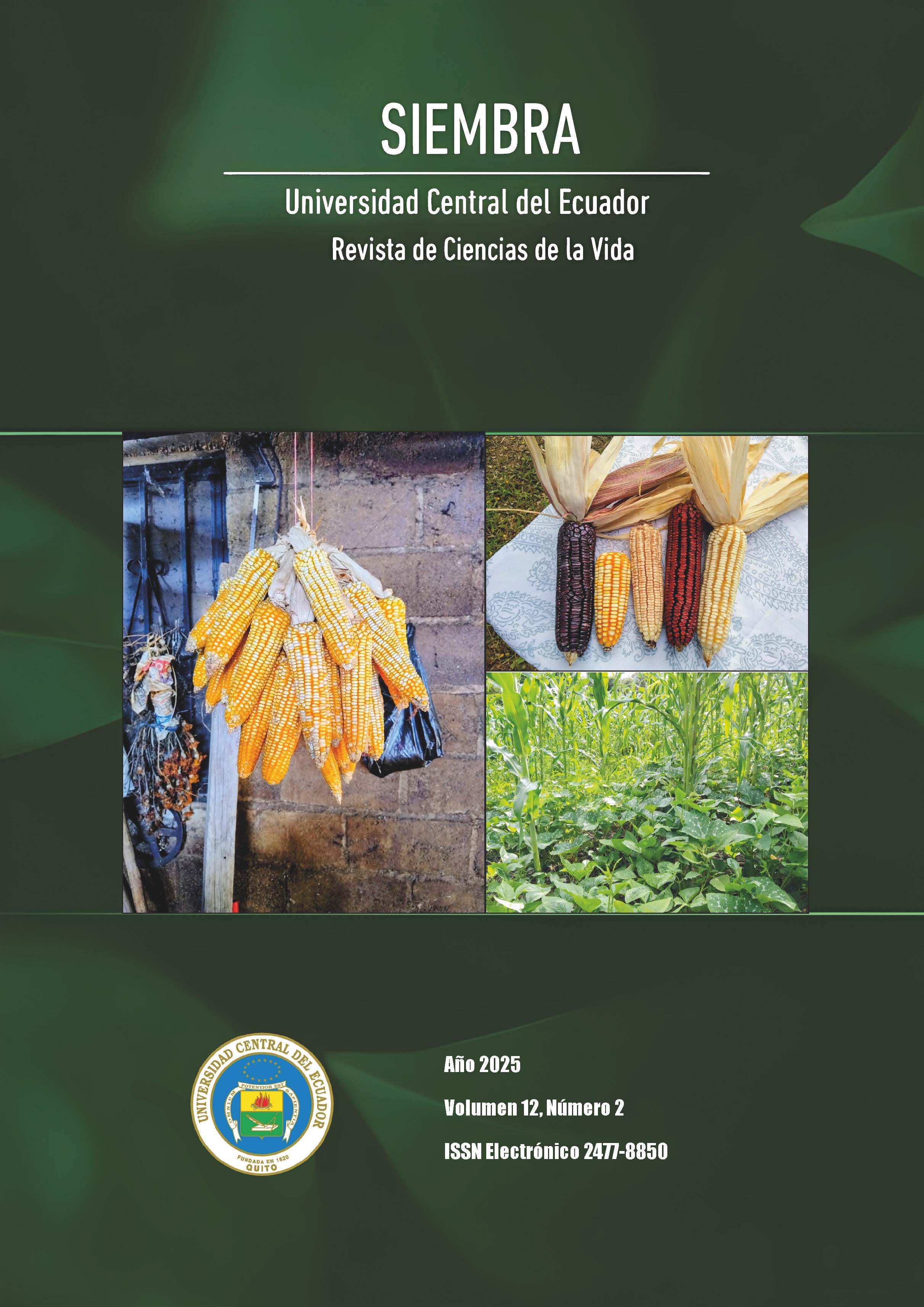
This dossier contains articles that shed light on the persistence of native maize cultivation within various agricultural systems—such as tornamil—and within the Mesoamerican milpa under shifting cultivation systems. It also documents traditional practices grounded in ancestral knowledge that support agroecological management and the exchange of native seeds. Additionally, it emphasizes the agronomic merits of native maize, including its resilience to drought and pests, as well as its cultural and culinary significance.
Juan Carlos Caballero Salinas, Hugo Adrián Pizaña Vidal, Alma Amalia González Cabañas, Francisco Guevara Hernández
Guest editors
Downloads
Metrics
Article Details

This work is licensed under a Creative Commons Attribution-NonCommercial 4.0 International License.
The authors who publish in Siembra know and accept the following conditions:
- Authors retain the copyright and grant Siembra the right of first publication of the work, under the Creative Commons Attribution License. Third parties are allowed to use what has been published as long as they refer to the author or authors of the work and its publication in this journal.
 This content is licensed under a Creative Commons Attribution-Noncommercial 4.0 International (CC BY-NC 4.0).
- Authors maintain the copyright and guarantee Siembra the right to publish the manuscript through the channels it considers appropriate.
- Authors may establish on their own additional agreements for the non-exclusive distribution of the version of the work published in Siembra, acknowledging their initial publication in the same, such as in institutional repositories.
- Authors are authorized to disseminate their work electronically once the manuscript is accepted for publication.




References
Bedoya, C. A., Dreisigacker, S., Hearne, S., Franco, J., Mir, C., Prasanna, B. M., Taba, S., Charcosset, A., y Warburton, M. L. (2017). Genetic diversity and population structure of native maize populations in Latin America and the Caribbean. PLOS ONE, 12(4), e0173488. https://doi.org/10.1371/journal.pone.0173488 DOI: https://doi.org/10.1371/journal.pone.0173488
Bonavia, D. (2013). Maize: Origin, Domestication and its role in the development of culture. Cambridge University Press. https://doi.org/10.1017/CBO9781139149433 DOI: https://doi.org/10.1017/CBO9781139149433
Kirchhoff, P. (2019). Mesoamérica. Sus límites geográficos, composición étnica y caracteres culturales. Instituto Nacional de Antropología e Historia. http://bdjc.iia.unam.mx/items/show/772
Ortiz Luna, A. J. (2022). Mamasara o saramama, la madre del maíz: Reflexiones sobre agencia de objetos agrícolas mágico-religiosos en el antiguo Perú. ISHRA, Revista Del Instituto Seminario de Historia Rural Andina, 9, 101–124. https://doi.org/10.15381/ishra.n9.22861 DOI: https://doi.org/10.15381/ishra.n9.22861
Serratos Hernández, J. A. (2009). El origen y la diversidad del maíz en el continente americano. Greenpeace. https://esant.mx/bach/perfil/hm/docs/hm-en1.8.pdf
Vargas Guadarrama, L. A. (2014). El maíz, viajero sin equipaje. Anales de Antropología, 48(1), 123–137. https://doi.org/10.1016/S0185-1225(14)70492-8 DOI: https://doi.org/10.1016/S0185-1225(14)70492-8