
Floristic and structural characterization of the mangrove formations of the Tachina and Camarones parishes, Esmeraldas – Ecuador
Article Sidebar
Main Article Content
Abstract
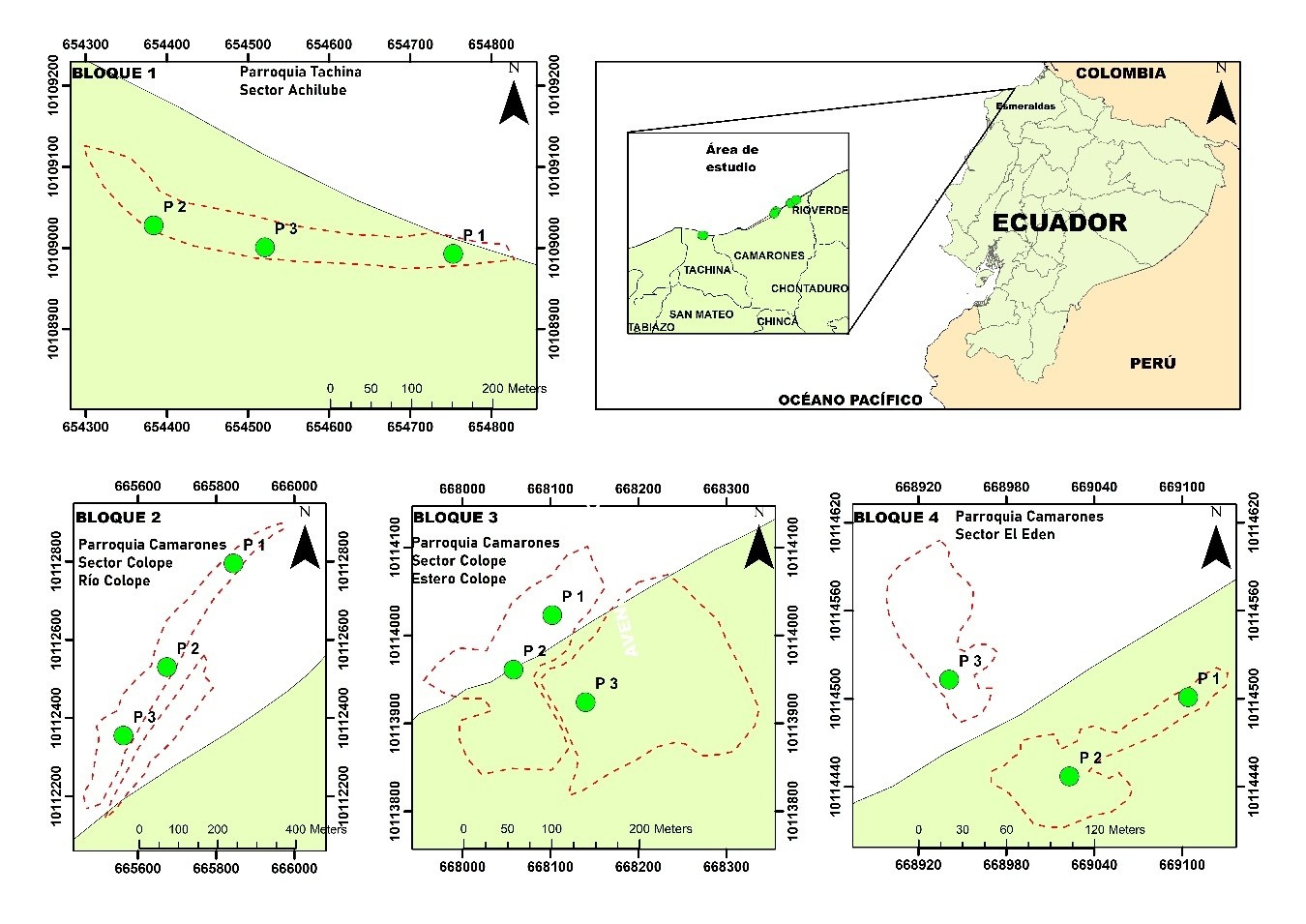
Mangroves are coastal ecosystems that provide multiple goods and services and depend on salinity, temperature, and nutrients. The study was carried out in the coastal area of Esmeraldas Canton, with the objective of floristically and structurally characterizing the mangrove formations of the Tachina and Camarones parishes, analyzing the physicochemical parameters of soil and water. Four permanent monitoring blocks (PMBs) were established, with the first (B1) located in the Achilube sector, the second and third (B2 and B3) in the Colope sector, and the fourth (B4) in the El Edén sector. Three circular plots of 500 m² were established in each PMB to record the data, and soil and water samples were collected. A total of 2,360 mangrove individuals were recorded, comprising four species: Rhizophora harrisonii, Laguncularia racemosa, Avicennia germinans, and Conocarpus erectus. B2 showed greater floristic richness, recording four species. The species with the greatest distribution was Avicennia germinans, present in three study blocks. The findings classified B1 as primary succession with predominance of seedlings, B2 and B3 as secondary succession with predominance of juvenile trees, and B4 as being in a high state of vulnerability. Soil analysis showed low levels of organic matter, nitrogen, and phosphorus in most PMBs. The correlations revealed the relationship of Laguncularia racemosa with zinc and the relationship of Rhizophora harrisonii with N, Ca, Mn, and organic matter. Electrical conductivity indicated the influence of salinity on species distribution.
Downloads
Metrics
Article Details

This work is licensed under a Creative Commons Attribution-NonCommercial 4.0 International License.
The authors who publish in Siembra know and accept the following conditions:
- Authors retain the copyright and grant Siembra the right of first publication of the work, under the Creative Commons Attribution License. Third parties are allowed to use what has been published as long as they refer to the author or authors of the work and its publication in this journal.
 This content is licensed under a Creative Commons Attribution-Noncommercial 4.0 International (CC BY-NC 4.0).
- Authors maintain the copyright and guarantee Siembra the right to publish the manuscript through the channels it considers appropriate.
- Authors may establish on their own additional agreements for the non-exclusive distribution of the version of the work published in Siembra, acknowledging their initial publication in the same, such as in institutional repositories.
- Authors are authorized to disseminate their work electronically once the manuscript is accepted for publication.




References
Adams, J. B., y Rajkaran, A. (2020). Changes in mangroves at their southernmost African distribution limit. Estuarine, Coastal and Shelf Science, 247, 106862. https://doi.org/10.1016/j.ecss.2020.106862 DOI: https://doi.org/10.1016/j.ecss.2020.106862
Alongi, D. (2021). Macro- and micronutrient cycling and crucial linkages to geochemical processes in mangrove ecosystems. Journal of Marine Science and Engineering, 9(5), 456. https://doi.org/10.3390/jmse9050456 DOI: https://doi.org/10.3390/jmse9050456
Amel, A. L. K., Minsaris, L. O. A., y Lestari, D. A. (2023). Mapping the distribution of mangroves in serang regency using remote sensing (case study of Pulau Panjang). Jurnal Teknologi Informasi Dan Komunikasi, 14(1), 153-158. https://doi.org/10.51903/jtikp.v14i1.535 DOI: https://doi.org/10.51903/jtikp.v14i1.535
Andrade Chica, R. A. (2019). Estructura y composición florística (de los manglares) del refugio de vida silvestre manglares estuario río esmeraldas. Pontificia Universidad Católica del Ecuador. https://repositorio.puce.edu.ec/handle/123456789/37656
Asif, M., Saqib, M., Yousaf, B., Adnan, M., Yousaf, A., Ali, A. y Sabir, D. (2014). Growth and ionic composition of buttonwood (Conocarpus erectus L.) in response to soil salinity and water stress. Advances in Life Science and Technology, 19, 42–51. https://www.iiste.org/Journals/index.php/ALST/article/view/12116/12469
Avellán Jiménez, A. (2018). Manglares del Parque Histórico Guayaquil: Establecimiento de Sitios Para Monitoreo Fenológico y Crecimiento. Universidad de Especialidades Espíritu Santo. http://201.159.223.2/handle/123456789/2108
Barrantes Leiva, R. M., y Cerdas Salas, A. (2016). Spatial distribution of mangrove species and their association with the substrate sediment types, estuarine sector Térraba-Sierpe National Wetlands, Costa Rica. Revista de Biología Tropical, 63 (1), 47–60. https://doi.org/10.15517/rbt.v63i1.23094 DOI: https://doi.org/10.15517/rbt.v63i1.23094
Beitl, C. M., Chávez Páez, W., Vanegas Redondo, W. F., Carvajal Cañarte, E. L., Zambrano Mohauad, G. A., Alfonso Ramírez, K. R., Jama López, J. A., y Gortaire Díaz, D. E. (2020). Cambios socio-ambientales, alimentación y sustento en una comunidad rural del Manglar. Investigatio, 13(13), 89–102. https://doi.org/10.31095/investigatio.2020.13.9 DOI: https://doi.org/10.31095/investigatio.2020.13.9
Bodero, A., y Robadue, D. (1995). Estrategia para el Manejo del Ecosistema de Manglar, Ecuador. https://www.crc.uri.edu/download/8YearsSpanish_7_Manglares.pdf
Bruno Waibel, K. E. (2019). Evaluación del potencial de captura de carbono por la especie (rhizophora mangle) mediante ecuaciones alométricas en el refugio de vida silvestre manglares del estuario río esmeraldas trabajo no experimental. Universidad Agraria del Ecuador. https://cia.uagraria.edu.ec/Archivos/BRUNO%20WAIBEL%20KEVIN%20ERNESTO.pdf
Budiadi, B., Widiyatno, W., Nurjanto, H. H., Hasani, H., y Jihad, A. N. (2022). Seedling growth and quality of Avicennia marina (Forssk.) Vierh. under growth media composition and controlled salinity in an ex situ nursery. Forests, 13(5), 684. https://doi.org/10.3390/f13050684 DOI: https://doi.org/10.3390/f13050684
Carrera, F., Vernaza, L., Quiroz, F., Solís, K., y Vicente da Silva, E. (2017). Situación de la agricultura familiar y el extractivismo en el Ecuador caso de estudio en las parroquias rurales del cantón Muisne. Dominio de las ciencias, 3 (1), 689-713. http://dx.doi.org/10.23857/dom.cien.pocaip.2017.3.mono1.ago.689-713
Carrera, F., y Vicente da Silva, E. (2019). Percepción ambiental de habitantes de comunidades que viven aledañas al ecosistema manglar. El caso de la comunidad de Bunche, en Muisne, Ecuador. Espacio Abierto, 28 (4), 36 - 56. https://www.produccioncientificaluz.org/index.php/espacio/article/view/30673
Centro de Levantamientos Integrados de Recursos por Sensores Remotos [CLIRSEN]. (1990). Estudio multitemporal de los manglares, camaroneras y áreas salinas de la costa ecuatoriana, mediante información de sensores remotos. Serie Estudios3. CLIRSEN. https://www.crc.uri.edu/download/CLIRSEN_1987s.pdf
Cerón‐Souza, I., Barreto, M. B., Barreto‐Pittol, E., Silva, A., Feliner, G. N., y Medina, E. (2021). Rhizophora zonation, salinity, and nutrients in the western atlantic. Biotropica, 53(2), 384–396. https://doi.org/10.1111/btp.12924 DOI: https://doi.org/10.1111/btp.12924
Cuevas-Díaz, M. del C., Hernandez-Romero, Á. H., Vázquez-Luna, D., Lara-Rodríguez, D. A., Guzmán-López, O., González-Arvizu, J. E., y Ontiveros-José, J. I. (2020). Effect of anthropogenic activities on mangrove coverage in the lower Coatzacoalcos river basin. Ecosistemas, 29(3), 1954. https://doi.org/10.7818/ECOS.1954 DOI: https://doi.org/10.7818/ECOS.1954
Dewiyanti, I., Rifki, M., Octavina, C., Ulfa, M., Damora, A., y Nurfadillah, N. (2023). Important value index (IVI) and diversity of mangrove vegetation in Aceh Tamiang, Aceh Province. Depik, 12(2), 190-197.https://doi.org/10.13170/depik.12.2.31130 DOI: https://doi.org/10.13170/depik.12.2.31130
Díaz, J. (2011). Una revisión sobre los manglares: características, problemáticas y su marco jurídico. Importancia de los manglares, el daño de los efectos antropogénicos y su marco jurídico: caso sistema lagunar de Topolobampo. Ra Ximhai, 7(3), 355-369. https://doi.org/10.35197/rx.07.03.2011.05.jd DOI: https://doi.org/10.35197/rx.07.03.2011.05.jd
Diyah Retnosari, F., Andriyono, S., y Nurmalia Dewi, N. (2024). Bioaccumulation of heavy metals lead, copper, and zinc in mangrove roots Avicennia marina, water, and sediment in Panceng Waters, Gresik, Jawa Timur. Journal of Marine and Coastal Science, 13(2), 78–92. https://doi.org/10.20473/jmcs.v13i2.52524 DOI: https://doi.org/10.20473/jmcs.v13i2.52524
Drouet Yánez, A. M. (2019). Evaluación del estado actual de la regeneración natural del bosque del manglar del Refugio de Vida Silvestre Manglares Estuario Río Esmeraldas. Pontificia Universidad Católica del Ecuador. https://repositorio.puce.edu.ec/handle/123456789/37636
Echeverría-Ávila, S., Pérez-Ceballos, R., Zaldívar-Jímenez, M., Canales-Delgadillo, J., Brito-Pérez, R., Merino-Ibarra, M., y Vovides, A. (2019). Regeneración natural de sitios de manglar degradado en respuesta a la restauración hidrológica. Madera y Bosques, 25(1). https://doi.org/10.21829/myb.2019.2511754 DOI: https://doi.org/10.21829/myb.2019.2511754
El Ashmawy, A., Masoud, M., Yoshimura, C., Dilini, K., y Abdel-Halim, A. M. (2021). Accumulation of heavy metals by Avicennia marina in the highly saline Red Sea coast. Environmental science and pollution research international, 28(44), 62703–62715. https://doi.org/10.1007/s11356-021-15205-6 DOI: https://doi.org/10.1007/s11356-021-15205-6
Gobierno Autónomo Descentralizado Parroquial Rural Camarones. (2020). Plan de desarrollo y ordenamiento territorial parroquia rural Camarones 2020 -2023. https://www.gadcamarones.gob.ec/media/gadcamarones/pdot_archivos/PDyOT_CAMARONES_02082021_1.pdf
Gobierno Autónomo Descentralizado Parroquial Rural Tachina. (2019). Plan de desarrollo y de ordenamiento territorial de la parroquia Tachina 2019 -2023. https://www.prefecturadeesmeraldas.gob.ec/web/assets/pdot-tachina.pdf
González-Hernández, L., Sol-Sánchez, A., Pérez-Vázquez, A., y Obrador-Olan, J. J. (2017). Sobrevivencia y crecimiento de mangle negro (Avicennia germinans L.) en plantaciones reforestadas y regeneración natural. Revista Mexicana de Ciencias Agrícolas, (14), 2769–2782. https://doi.org/10.29312/remexca.v0i14.445 DOI: https://doi.org/10.29312/remexca.v0i14.445
Guadamuz, N., y Sean-Bloomfield, M. (2019). Composición florística y estructura del manglar de los Cayo Miskitos a 10 años después del huracán Félix. Revista Universitaria Del Caribe, 22(1), 88-93. http://ri.uagro.mx/handle/uagro/621 DOI: https://doi.org/10.5377/ruc.v1i22.8422
Hossain, M., Othman, S., Bujang, J. S., y Kusnan, M. (2003). Macronutrients content in different parts of seedling, sapling and tree of Bruguiera parviflora of kuala selangor nature park mangrove forest in Malaysia. Khulna University Studies, 15–20. https://doi.org/10.53808/KUS.2003.5.1.0348-L DOI: https://doi.org/10.53808/KUS.2003.5.1.0348-L
Iqbal, U., Azam, A., Ahmad, K. S., Mumtaz, S., Mehmood, A., Naz, N., Usman, Z., Abbas, H., y Akram, M. (2024). Unveiling the ecological dominance of button mangrove (Conocarpus erectus L.) through microstructural and functional traits modifications across heterogenic environmental conditions. Botanical Studies, 65(1), 36. https://doi.org/10.1186/s40529-024-00440-0 DOI: https://doi.org/10.1186/s40529-024-00440-0
Ismail, Sulistiono, Hariyadi, S., y Madduppa, H. (2021). Diversity, density, and importance value index of mangroves in the Segara Anakan lagoon and its surrounding area, Cilacap Regency, Indonesia. IOP Conference Series: Earth and Environmental Science, 744(1), 012034. https://doi.org/10.1088/1755-1315/744/1/012034 DOI: https://doi.org/10.1088/1755-1315/744/1/012034
Kallushettihalli Mallappa, V. K., y Kumara, V. (2020). Physico-Chemical Analysis of Mangrove Soil, Kundapura, Karnataka, India. Current World Environment, 15(3), 624–631. https://doi.org/10.12944/CWE.15.3.27 DOI: https://doi.org/10.12944/CWE.15.3.27
Kathiresan, K., y Bingham, B. (2001). Biology of mangroves and mangrove ecosystems. Advances in Marine Biology, 40(1), 81-251. https://doi.org/10.1016/S0065-2881(01)40003-4 DOI: https://doi.org/10.1016/S0065-2881(01)40003-4
Kusmana, C. (1991). Soil as a factor influencing the mangrove forest communities in Talidendang Besar, Riau. Biotropia, 4(1), 9-18. https://journal.biotrop.org/index.php/biotropia/article/view/207/176
Kusmana, C. (2014). Distribution and current status of mangrove forests in Indonesia. In Mangrove Ecosystems of Asia (pp. 37–60). Springer New York. https://doi.org/10.1007/978-1-4614-8582-7_3 DOI: https://doi.org/10.1007/978-1-4614-8582-7_3
Limmon, G., Waardenburg, E., Lengkeek, W., Vodegel, P., y Krisye, Noya Y. (2023). Restoration of mangrove ecosystem on biodegradable media on the coast of Waai Village. Mestaka: Jurnal Pengabdian Kepada Masyarakat, 2(2), 99–103. https://doi.org/10.58184/mestaka.v2i2.39 DOI: https://doi.org/10.58184/mestaka.v2i2.39
López Rodríguez, F. (2020). Definición de un modelo de gestión para las áreas de custodia de manglar bajo manejo comunitario los acuerdos de uso sustentable y custodia de manglar en Ecuador. Universidad de Cádiz. https://rodin.uca.es/handle/10498/29080
Macías Vargas, S. E. (2022). Distribución espacial, sistema ecológico y caracterización florística de la Reserva Ecológica Manglares Cayapas Mataje. Pontificia Universidad Católica del Ecuador. https://repositorio.puce.edu.ec/handle/123456789/37719
Malik, A., Mertz, O., y Fensholt, R. (2017). Mangrove forest decline: consequences for livelihoods and environment in South Sulawesi. Regional Environmental Change, 17(1), 157–169. https://doi.org/10.1007/s10113-016-0989-0 DOI: https://doi.org/10.1007/s10113-016-0989-0
Mama, A., Chougong, D., Dingong, G., Bessa, A., Dicka, E., Ajonina, G., y Ndam, J. (2024). Dendrometrical structure and physicochemical analysis of mangrove sediments from the Nyong River Estuary (Cameroon, Atlantic Coast). Journal of Water Resources and Ocean Science, 13(2), 23–41. https://doi.org/10.11648/j.wros.20241302.11 DOI: https://doi.org/10.11648/j.wros.20241302.11
Mejía, L., Molina, M., Sanjuan, A., Grijalba, M., y Niño, L. (2014). Bosque de manglar, un ecosistema que debemos cuidar. https://observatorio.epacartagena.gov.co/wp-content/uploads/2017/12/bosque-de-manglar-un-ecosistema-que-debemos-cuidar.pdf
Melo Cruz, O., y Vargas Ríos, R. (2003). Evaluación ecológica y silvicultural de ecosistemas boscosos. Universidad del Tolima. https://www.yumpu.com/es/document/view/14197807/evaluacion-ecologica-y-silvicultural
Ministerio del Ambiente, Agua y Transición Ecológica [MAATE] y Organización de las Naciones Unidas para la Alimentación y la Agricultura [FAO]. (2014). Árboles y arbustos de los manglares del Ecuador. https://biblio.flacsoandes.edu.ec/catalog/resGet.php?resId=55818
Ministerio del ambiente, agua y transición ecológica [MAATE]. (2015). Plan de manejo refugio de vida silvestre manglares estuario Río Esmeraldas. https://www.scribd.com/document/374490675/PM-Manglares-Estuario-Rio-Esmeraldas-2015
Mira, J. D., Urrego, L. E., y Monsalve, K. (2019). Natural and anthrophic deteminants of distribution, structure and floristic composition of mangroves in the Natural Sanguaré Reserve, Colombia. Revista De Biología Tropical, 67(4), 810–824. https://doi.org/10.15517/rbt.v67i4.30833 DOI: https://doi.org/10.15517/rbt.v67i4.30833
Morancy, J., Albuquerque, H., y Cavalcanti da Cunha, A. (2021). Effects of anthropic activity dynamics on mangrove ecosystems’ degradation in Caracol County – Haiti. Research Square. https://doi.org/10.21203/rs.3.rs-979434/v1 DOI: https://doi.org/10.21203/rs.3.rs-979434/v1
Moreira Estrella, H. R. (2020). Estado de las poblaciones del mangle blanco Laguncularia racemosa var. glabriflora (Combretaceae) en el Golfo de Guayaquil, Ecuador. Revista Científica Ciencias Naturales y Ambientales, 14(2), 190-200. https://doi.org/10.53591/cna.v14i2.1306 DOI: https://doi.org/10.53591/cna.v14i2.1306
Morocho, R., González, I., Ferreira, T. O., y Otero, X. L. (2022). Mangrove Forests in Ecuador: A Two-Decade Analysis. Forests, 13(5), 656. https://doi.org/10.3390/f13050656 DOI: https://doi.org/10.3390/f13050656
Numbere, A., y Obanye, C. (2023). Impacto ambiental de la quema de arbustos en la fisicoquímica del suelo de los manglares en Eagle Island, Delta del Níger, Nigeria. Revista Americana de Ciencias de las Plantas, 14(02), 191-201. https://doi.org/10.4236/ajps.2023.142015 DOI: https://doi.org/10.4236/ajps.2023.142015
Pimentel Victório, C., Silva dos Santos, M., Cordeiro Dias, A., Silvério Pena Bento, J. P., dos Santos Ferreira, B. H., da Costa Souza, M., Kato Simas, N., y do Carmo de Oliveira Arruda, R. (2023). Laguncularia racemosa leaves indicate the presence of potentially toxic elements in mangroves. Scientific Reports, 13(1), 4845. https://doi.org/10.1038/s41598-023-31986-x DOI: https://doi.org/10.1038/s41598-023-31986-x
Quispe, A., Quiñonez, M., Nazareno, I., y Quiñónez, L. (2021). Sistemas de información geográfica y economías de subsistencias en la comunidad rural de San-Antonio, Esmeraldas-Ecuador. Revista Ibérica de Sistemas e Tecnologias de Informação, 44, 79-90. https://www.risti.xyz/issues/ristie44.
Reef, R., Schmitz, N., Rogers, B.., Ball, M., y Lovelock, C. (2012). Differential responses of the mangrove Avicennia marina to salinity and abscisic acid. Functional Plant Biology 39, 1038-1046. https://doi.org/10.1071/FP12178 DOI: https://doi.org/10.1071/FP12178
Reef, R., Winter, K., Morales, J., Adame, M., Reef, D., y Lovelock, C. (2015). The effect of atmospheric carbon dioxide concentrations on the performance of the mangrove Avicennia germinans over a range of salinities. Physiologia plantarum, 154(3), 358-68. https://doi.org/10.1111/ppl.12289 DOI: https://doi.org/10.1111/ppl.12289
Riaz, A., Tariq, U., Qasim, M., Shaheen, M.R., Iqbal, A., y Younis, A. (2016). Effect of water stress on growth and dry matter partitioning of Conocarpus erectus. Acta Hortic. 1112, 163-172. https://doi.org/10.17660/ActaHortic.2016.1112.23 DOI: https://doi.org/10.17660/ActaHortic.2016.1112.23
Rodríguez, F. V. L. (2022). Mangroves of Ecuador. En Mangroves: Biodiversity, Livelihoods and Conservation (pp. 489–519). Springer Nature Singapore. https://doi.org/10.1007/978-981-19-0519-3_19 DOI: https://doi.org/10.1007/978-981-19-0519-3_19
Rodríguez Villón, G. F. (2015). Determinación de la estructura, diversidad y abundancia de la vegetación del manglar de Palmar provincia de Santa Elena durante Octubre 2014 / Marzo 2015. Universidad Estatal Península de Santa Elena. http://repositorio.upse.edu.ec/handle/46000/2204
Rodríguez Reales, R. (2022). Evaluación de la influencia de parámetros fisicoquímicos del agua y el suelo en la estructura, composición y almacenamiento de carbono de la comunidad de mangles en la Ciénaga de Mallorquín, Barranquilla, Colombia. Universidad del Norte. https://manglar.uninorte.edu.co/bitstream/handle/10584/10973/1045717701.pdf?sequence=1&isAllowed=y
Sánchez Montes, D. L. (2007). Diseño de estrategias participativas de manejo dirigidas hacia una administración ambiental local a partir del diagnóstico socio-biológico de los manglares en isla fuerte caribe colombiano. Universidad Tecnológica de Pereira. https://hdl.handle.net/11059/798
Sierra, S. (2018). Influencia de los impactos antrópicos en la estructura del manglar en la ensenada de Virudó, Bajo Baudó, Chocó, Colombia (parte I). Sabia Revista Científica, 4(1), 59-93. https://doi.org/10.47366/sabia.v4n1a5 DOI: https://doi.org/10.47366/sabia.v4n1a5
Suárez, L. (2016). Plan de acción regional para la conservación de los manglares en el Pacífico Sudeste. UNESCO. https://unesdoc.unesco.org/ark:/48223/pf0000246476
Tomlinson, P. (2016). The Botany of Mangroves (2nd ed.). Cambridge: Cambridge University Press. https://doi.org/10.1017/CBO9781139946575 DOI: https://doi.org/10.1017/CBO9781139946575
Torán Figueroa, R. G. (2020). Estructura y composición florística en relación con los parámetros físicos y bióticos del bosque del manglar del Refugio de Vida Silvestre Manglares Estuario Río Muisne (RVSMERM). Pontificia Universidad Católica del Ecuador. https://repositorio.puce.edu.ec/handle/123456789/37500
Torres, V., Infante, D., Sánchez, A., Espinoza, A., y Barba, E. (2018). Degradación de hojarasca y aporte de nutrientes del manglar en la Laguna Mecoacán, Golfo de México. Revista De Biología Tropical, 66(2), 892–907. https://doi.org/10.15517/rbt.v66i2.33421 DOI: https://doi.org/10.15517/rbt.v66i2.33421
Valle Estrada, A. G. (2007). Estructura del bosque de manglar y algunos aspectos sobre la fauna asociada a las raíces de Rhizophora mangle (L., 1773) en la Ciénaga de Cholón, Isla de Barú, municipio de Cartagena, Caribe Colombiano. Universidad de Bogotá Jorge Tadeo Lozano. https://hdl.handle.net/20.500.12010/1189
Valle, A., Osorno, A., y Gil, D. (2016). Estructura y regeneración del bosque de manglar de la Ciénaga de Cholón, Isla Barú, parque nacional natural Corales del Rosario y San Bernardo, Caribe Colombiano. Boletín de Investigaciones Marinas y Costeras, 40(1) 115-130. https://doi.org/10.25268/bimc.invemar.2011.40.1.105 DOI: https://doi.org/10.25268/bimc.invemar.2011.40.1.105
Van Hespen, R., Hu, Z., Peng, Y., Zhu, Z., Ysebaert, T., y Bouma, T. J. (2022). Identifying trait‐based tolerance to sediment dynamics during seedling establishment across eight mangrove species. Limnology and Oceanography, 67(10), 2281–2295. https://doi.org/10.1002/lno.12202 DOI: https://doi.org/10.1002/lno.12202
Velázquez-Pérez, C., Tovilla-Hernández, C., Romero-Berny, E. I., y de Jesús-Navarrete, A. (2019). Estructura del manglar y su influencia en el almacén de carbono en la reserva La Encrucijada, Chiapas, México. Madera y Bosques, 25(3). https://doi.org/10.21829/myb.2019.2531885 DOI: https://doi.org/10.21829/myb.2019.2531885
Vences, J., Sampedro, M., Castillo, B., Olmos, E., Juárez, A., Reyes, M., Amaya, I., y Ciprino, J. (2016). Afectación del manglar por actividades antrópicas en la subcuenca de Nuxco, Guerrero, Mexico. Revista Mexicana de Agroecosistemas, 3 (2), 163-174. http://ri.uagro.mx/handle/uagro/621
Wang, W., Li, X., y Wang, M. (2019). Propagule dispersal determines mangrove zonation at intertidal and estuarine scales. Forests, 10(3), 245. https://doi.org/10.3390/f10030245 DOI: https://doi.org/10.3390/f10030245
Yates, E., Ashwath, N.,y Midmore, D. (2002). Responses to nitrogen, phosphorus, potassium and sodium chloride by three mangrove species in pot culture. Trees, 16, 120-125. https://doi.org/10.1007/s00468-001-0145-3 DOI: https://doi.org/10.1007/s00468-001-0145-3
Yépez Rendón, E. (2021). Análisis del estado de conservación de la Reserva Ecológica Manglares Cayapas Mataje (REMACAM). Pontificia Universidad Católica del Ecuador. https://repositorio.puce.edu.ec/handle/123456789/37529