
Characterization and typification of Canna edulis L. agroindustrial systems in Colombia’s main producing areas
Article Sidebar
Main Article Content
Abstract
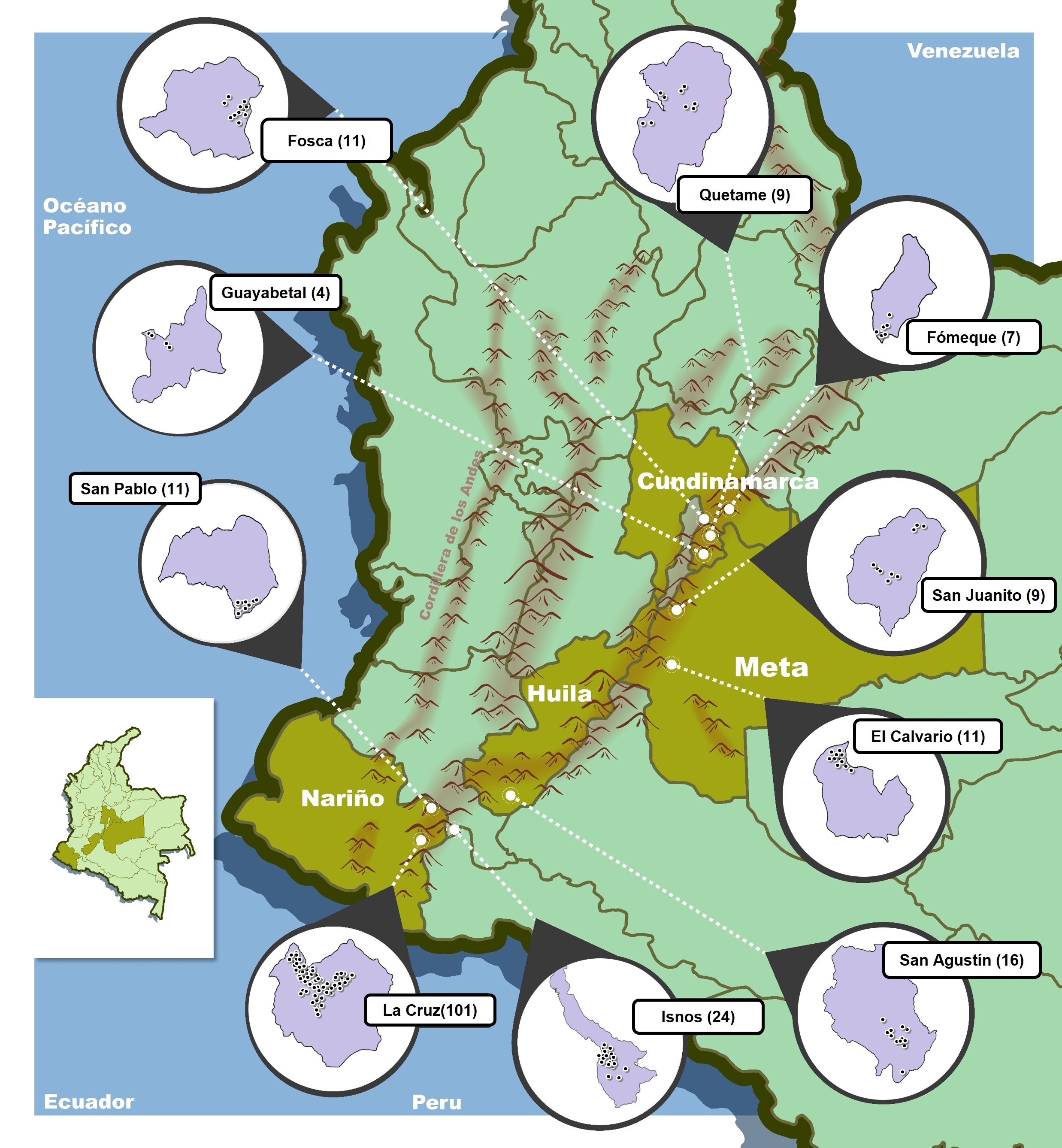
Edible canna (Canna edulis Ker-Gawler) agro-industrial system is of economic and cultural importance for more than 3,000 Colombian farming families due to the deep-rooted tradition of production, processing, and consumption of processed starch. The detailed knowledge of production dynamics allows the establishment of technological strategies aimed at improving the conditions of this productive line. With the objective of characterizing this agro-industrial system and identifying typologies of productive units to maximize the impact of technological generation and innovation processes in Colombia, 203 surveys were carried out in the main producing municipalities of the country. Information on 120 socioeconomic and technical variables was registered, of which 19 were selected for typification with multifactorial analysis by principal components where groupings of productive units were constructed. It was determined that the agro-industrial system is of the family-type, with conventional production technology and heterogeneity in the regions studied. Three typologies were identified per region, differentiated by lower, intermediate, and higher technological levels. The predominance of family farming within the regional typologies identified allows establishing the need to develop cultivation technologies that are easy to implement and use resources external to the farms, the rescue of sustainable family cultural practices, and the adaptation of processing technologies which allow a more efficient water use, improve starch quality, obtain economies of scale, and achieve greater bargaining power for producers under associative schemes.
Downloads
Metrics
Article Details

This work is licensed under a Creative Commons Attribution-NonCommercial 4.0 International License.
The authors who publish in Siembra know and accept the following conditions:
- Authors retain the copyright and grant Siembra the right of first publication of the work, under the Creative Commons Attribution License. Third parties are allowed to use what has been published as long as they refer to the author or authors of the work and its publication in this journal.
 This content is licensed under a Creative Commons Attribution-Noncommercial 4.0 International (CC BY-NC 4.0).
- Authors maintain the copyright and guarantee Siembra the right to publish the manuscript through the channels it considers appropriate.
- Authors may establish on their own additional agreements for the non-exclusive distribution of the version of the work published in Siembra, acknowledging their initial publication in the same, such as in institutional repositories.
- Authors are authorized to disseminate their work electronically once the manuscript is accepted for publication.




References
Acevedo Osorio, Á., y Martínez Collazos, J. (comps.). (2016). La agricultura familiar en Colombia. Estudios de caso desde la multifuncionalidad y su aporte a la paz. Ediciones Universidad Cooperativa de Colombia - Corporación Universitaria Minuto de Dios - Agrosolidaria https://doi.org/10.16925/9789587600476 DOI: https://doi.org/10.16925/9789587600476
Algar, A. F. C., Umali, A. B., y Tayobong, R. R. P. (2019). Physicochemical and functional properties of starch from Philippine edible canna (Canna indica L.) rhizomes. Journal of Microbiology, Biotechnology and Food Sciences, 9(1), 34-37. https://doi.org/10.15414/jmbfs.2019.9.1.34-37 DOI: https://doi.org/10.15414/jmbfs.2019.9.1.34-37
Amadu, F. O., McNamara, P. E., y Miller, D. C. (2020). Understanding the adoption of climate-smart agriculture: A farm-level typology with empirical evidence from southern Malawi. World Development, 126, 104692. https://doi.org/10.1016/j.worlddev.2019.104692 DOI: https://doi.org/10.1016/j.worlddev.2019.104692
Berre, D., Baudron, F., Kassie, M., Craufurd, P., y Lopez-Ridaura, S. (2019). Different ways to cut a cake: Comparing expert-based and statistical typologies to target sustainable intensification technologies, a case-study in Southern Ethiopia. Experimental Agriculture, 55(S1), 191-207. https://doi.org/10.1017/S0014479716000727 DOI: https://doi.org/10.1017/S0014479716000727
Caicedo Diaz, G. E., Rozo Wilches, L. S., y Rengifo Benítez, G. (2003). La achira: Alternativa agroindustrial para áreas de economía campesina. Corporación Colombiana de Investigación Agropecuaria [AGROSAVIA]. http://hdl.handle.net/20.500.12324/13024
Carrera, J. (2006). Cultivando la achira. Revista Allpa La Voz de La Tierra, (2), 13-16. https://www.rapaluruguay.org/sitio_1/organicos/articulos/Cultivando_Achira.pdf
Collier, D., LaPorte, J., y Seawright, J. (2012). Putting typologies to work: Concept formation, measurement, and analytic rigor. Political Research Quarterly, 65(1), 207-232. https://doi.org/10.1177/1065912912437162 DOI: https://doi.org/10.1177/1065912912437162
Díaz del Castillo, J. F. C. (2013). La intermediación como un impedimento al desarrollo del pequeño productor de Medellín. Ciencia & Tecnología Agropecuaria, 14(1), 27-32. https://doi.org/10.21930/rcta.vol14_num1_art:264 DOI: https://doi.org/10.21930/rcta.vol14_num1_art:264
Forero Álvarez, J. (2002). Elementos conceptuales para el estudio integrado de sistemas de producción familiares rurales. En N. A. Castillo Rodríguez, y D. C. Hernández Cruz (eds.), Sistemas de producción rurales en la Región Andina colombiana : análisis de su viabilidad económica, ambiental y cultural (pp. 23-55). Pontificia Universidad Javeriana, Colciencias.
Furnaro, A., Ramírez, E., Eguillor, P., Laval, E., Acuña, D., Sotomayor, N., Jiménez, J., Namdar-Irani, M., Peñailillo, L., Vidal, J., Guido Acuña, J., Pérez, S., Danessi, R., Saa, C., Gajardo, I., Miranda, M., Baracatt, K., y Urzúa, Á. (2015). Cómo vender en circuitos cortos. Desafíos y oportunidades para la agricultura familiar campesina. Serie Manuales y Cursos, N°4. Rimisp. http://rimisp.org/wp-content/files_mf/1448285606manual_circuitos_cortos.pdf
Hermann, M., Quynh, N. K., y Peters, D. (1999). Reappraisal of Edible canna as a high-value starch crop in Vietnam. En Impact on a changing world. Program Report 1997-1998 (pp. 415-424). International Potato Center. https://hdl.handle.net/10568/109460
Imai, K. (2011). Edible canna - A valuable plant resource from the Andean region. Japanese Journal of Crop Science, 80(2), 145-156. https://doi.org/10.1626/jcs.80.145 DOI: https://doi.org/10.1626/jcs.80.145
Instituto Geográfico Agustín Codazzi [IGAC]. (2012). Atlas de la distribución de la propiedad rural en Colombia. IGAC.
Kaur, J., Prusty, A. K., Ravisankar, N., Panwar, A. S., Shamim, M., Walia, S. S., Chatterjee, S., Pasha, M. L., Babu, S., Jat, M. L., López-Ridaura, S., Groot, J. C. J., Toorop, R. A., Barba-Escoto, L., Noopur, K., y Kashyap, P. (2021). Farm typology for planning targeted farming systems interventions for smallholders in Indo-Gangetic Plains of India. Scientific Reports, 11, 20978 . https://doi.org/10.1038/s41598-021-00372-w DOI: https://doi.org/10.1038/s41598-021-00372-w
Kumar, S., Craufurd, P., Haileslassie, A., Ramilan, T., Rathore, A., y Whitbread, A. (2019). Farm typology analysis and technology assessment: An application in an arid region of South Asia. Land Use Policy, 88, 104149. https://doi.org/10.1016/j.landusepol.2019.104149 DOI: https://doi.org/10.1016/j.landusepol.2019.104149
Lambert, D. M., English, B. C., Harper, D. C., Larkin, S. L., Larson, J. A., Mooney, D. F., Roberts, R. K., Velandia, M., y Reeves, J. M. (2014). Adoption and frequency of precision soil testing in cotton production. Journal of Agricultural and Resource Economics, 39(1), 106-123. https://jareonline.org/articles/adoption-and-frequency-of-precision-soil-testing-in-cotton-production/
López-Roldán, P., y Fachelli, S. (2015). Metodología de la investigación social cuantitativa. Universitat Autònoma de Barcelona. http://ddd.uab.cat/record/129382
Martín, T., Penagos, A. M., Ramírez, J. M., Bateman, A., Díaz, Y., Satizábal, S., y Espinoza, A. (2018). Tipología de Subregiones Funcionales para Colombia partir de la OCDE: metodología y resultados. Centro Latinoamericano para el Desarrollo Rural [RIMISP]. https://rimisp.org/tipologia-de-subregiones-funcionales-para-colombia-partir-de-la-ocde-metodologia-y-resultados/
Ministerio de Agricultura y Desarrollo Rural [MADR]. (2019). Evaluaciones Agropecuarias Municipales [EVA]. Unidad de Planificación Rural Agropecuaria [UPRA]. https://upra.gov.co/es-co/Paginas/eva_2019.aspx
Ministerio de Agricultura y Desarrollo Rural [MADR]. (2023). Evaluaciones Agropecuarias Municipales [EVA]. Unidad de Planificación Rural Agropecuaria [UPRA]. https://upra.gov.co/es-co/Paginas/eva_2023.aspx
Morales Rodríguez, R. (1969). Características físicas, químicas y organolépticas del almidón de “achira” (Canna edulis Ker var.). Revista de la Academia Colombiana de Ciencias Exactas, Físicas y Naturales, XIII(51), 357-370. https://www.accefyn.com/revista/Volumen_13/51/357-370.pdf
Paustian, M., y Theuvsen, L. (2017). Adoption of precision agriculture technologies by German crop farmers. Precision Agriculture, 18(5), 701-716. https://doi.org/10.1007/s11119-016-9482-5 DOI: https://doi.org/10.1007/s11119-016-9482-5
Perasso Cerda, P., Santana Acevedo, F., y Ugarte Johnson, A. (2019). Propuesta metodológica para la construcción de una tipología de territorios rurales en Chile. Informe final. Oficina de Estudios y Políticas Agrarias del Ministerio de Agricultura, Gobierno de Chile. https://bibliotecadigital.odepa.gob.cl/handle/20.500.12650/70204
Praseptiangga, D., Tryas, A. A., Affandi, D. R., Atmaka, W., Ariyantoro, A. R., y Minardi, S. (2018). Physical and chemical characterization of composite flour from canna flour (Canna edulis) and lima bean flour (Phaseolus lunatus). AIP Conference Proceedings, 1927(1), 030020. https://doi.org/10.1063/1.5021213 DOI: https://doi.org/10.1063/1.5021213
Puncha-arnon, S., Puttanlek, C., Rungsardthong, V., Pathipanawat, W., y Uttapap, D. (2007). Changes in physicochemical properties and morphology of canna starches during rhizomal development. Carbohydrate Polymers, 70(2), 206-217. https://doi.org/10.1016/j.carbpol.2007.03.020 DOI: https://doi.org/10.1016/j.carbpol.2007.03.020
Resolución N° 23115 que declara la protección de la denominación de origen Bizcocho de Achira del Huila. 20 de abril de 2012 (Colombia) https://www.sic.gov.co/sites/default/files/files/Denominacion%20de%20Origen/biscocho_de_achira.pdf
Resolución Nº 464. Lineamientos estratégicos de política pública para la Agricultura Campesina, Familiar y Comunitaria y se dictan otras disposiciones. Diario Oficial Nº 50.505, 12 de febrero de 2018 (Colombia). https://www.fao.org/faolex/results/details/es/c/LEX-FAOC173052/
Rodríguez, G., García, H. R, Camacho, J. H., Rivera, J. J., Caicedo, G., Torres, L. J., Sánchez, C., de la Torre, F., García, C., y Rivera, E. (2003). Concepción de un modelo de agroindustria rural para la elaboración de harina y almidón a partir de raíces y tubérculos promisorios, con énfasis en los casos de achira (Canna edulis), arracacha (Arracacia xanthorriza) y ñame (Dioscorea sp.). Corporación Colombiana de Investigación Agropecuaria [CORPOICA]. https://bibliotecadigital.agronet.gov.co/bitstream/11348/3743/
Spiegel, M., y Stephens, L. (2009). Estadística (4a ed.). McGraw Hill. https://biblioteca.uazuay.edu.ec/buscar/item/61353
Tito Velarde, C., y Wanderley, F. (2021). Contribución de la agricultura familiar campesina indígena a la producción y consumo de alimentos en Bolivia. Centro de Investigación y Promoción del Campesinado e Instituto de Investigaciones Socio-Económicas de la Universidad Católica Boliviana. https://cipca.org.bo/skin/download.php?doc=247_cuaderno-91ok-comprimido.pdf&uid=247
Tuesta Hidalgo, O., Julca Otiniano, A., Borjas Ventura, R., Rodríguez Quispe, P., y Santistevan Méndez, M. (2014). Tipología de fincas cacaoteras en la subcuenca media del río Huayabamba, distrito de Huicungo (San Martín, Perú). Ecología Aplicada, 13(1-2), 71-78. https://doi.org/10.21704/rea.v13i1-2.457 DOI: https://doi.org/10.21704/rea.v13i1-2.457
Vasquez, P., y Vignolles, M. (2015). Establecimiento agroproductivo ecológico vs. agricultura convencional: partido de Tandil, provincia de Buenos Aires. Sociedade & Natureza, 27(2), 267–280 https://doi.org/10.1590/1982-451320150206 DOI: https://doi.org/10.1590/1982-451320150206
Vélez Izquierdo, A., Espinosa García, J. A., Amaro Gutiérrez, R., y Arechavaleta Velasco, M. E. (2016). Tipología y caracterización de apicultores del estado de Morelos, México. Revista Mexicana de Ciencias Pecuarias, 7(4), 507–524. https://doi.org/10.22319/rmcp.v7i4.4279 DOI: https://doi.org/10.22319/rmcp.v7i4.4279
Zhu, Q., Cai, L., Li, H., Zhang, Y., Su, W., y Zhou, Q. (2020). The complete chloroplast genome sequence of the Canna edulis Ker Gawl. (Cannaceae). Mitochondrial DNA Part B, 5(3), 2427-2428. https://doi.org/10.1080/23802359.2020.1775512 DOI: https://doi.org/10.1080/23802359.2020.1775512