
Carcasse performance in goats managed in open fields in southern Ecuador
Article Sidebar
Main Article Content
Abstract
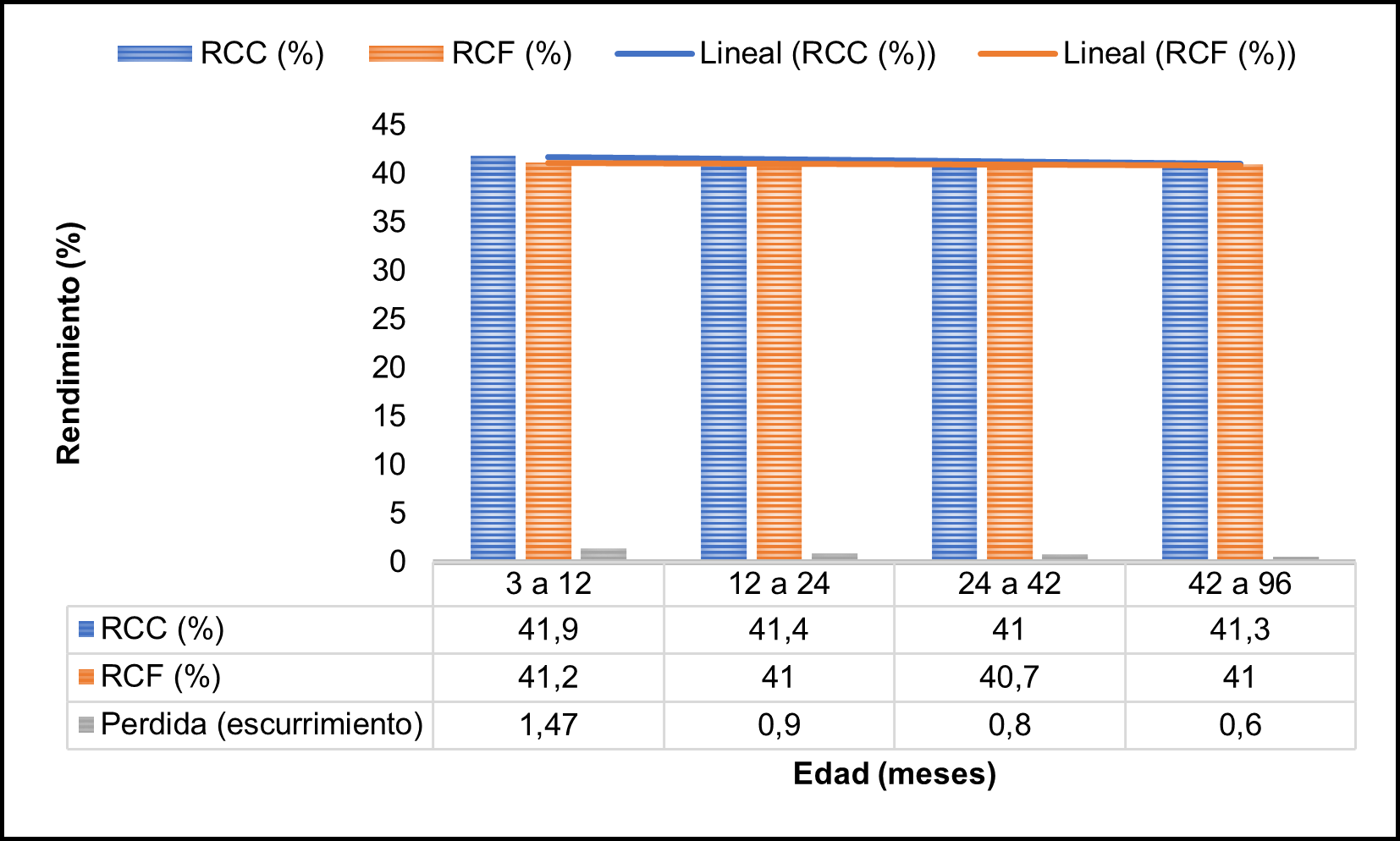
More than 70% of Ecuador’s goat population is found in the south of the country, where they are managed in open fields, with little technological application and support. The objective was to determine the performance of these animals at hot and cold carcasses and the degree of runoff. A total of 457 goats of different ages, genetic groups, and biotypes, slaughtered at the Municipal Slaughter Center of Zapotillo, were included in the study. Information on ante-mortem weights, and hot and cold carcasses was collected, and factors such as sex, age, breed group, and biotype were included in the analysis using an ANOVA with a randomized linear model. The results show a hot and cold carcass yield of 41.8± 2.6% and 41.1± 2.7% respectively, with no statistical difference in the factors analyzed. It is highlighted that carcass yield decreases minimally with increasing age; males present a slightly higher carcass yield (41.9%) compared to females (41.7%); regarding the breed, there were also slight differences with Chuscos Criollos, Mestizos and Anglo Nubian, presenting 41.8%, 42.1% and 41% of the hot carcass yield respectively; analyzing the biotype, presence and absence of horns, the yield was 41.8% and 41.9 % respectively. It is important to note that there was a minimal level of runoff in this population (1.23%). We conclude that these goats have a low carcass yield compared to other populations, possibly due to the type of management and feeding, where water scarcity predominates. It is worth noting the slight superiority of the Mestizo breed, which could be a good option for improving these variables.
Downloads
Metrics
Article Details

This work is licensed under a Creative Commons Attribution-NonCommercial 4.0 International License.
The authors who publish in Siembra know and accept the following conditions:
- Authors retain the copyright and grant Siembra the right of first publication of the work, under the Creative Commons Attribution License. Third parties are allowed to use what has been published as long as they refer to the author or authors of the work and its publication in this journal.
 This content is licensed under a Creative Commons Attribution-Noncommercial 4.0 International (CC BY-NC 4.0).
- Authors maintain the copyright and guarantee Siembra the right to publish the manuscript through the channels it considers appropriate.
- Authors may establish on their own additional agreements for the non-exclusive distribution of the version of the work published in Siembra, acknowledging their initial publication in the same, such as in institutional repositories.
- Authors are authorized to disseminate their work electronically once the manuscript is accepted for publication.




References
Acevedo Cárdenas, R. C., Durán Osorio, D. S., Trujillo Navarro, Y. Y., y Vargas Bayona, J. E. (2024). Contenido de ácidos grasos en la carne de cabra santandereana según la edad al sacrificio. @limentech, Ciencia y Tecnología Alimentaria, 22(1), 42-59. https://doi.org/10.24054/limentech.v22i1.2862 DOI: https://doi.org/10.24054/limentech.v22i1.2862
Aguirre, E. L., Quezada, M., Maza, T., Albito, O., Armijos, D. R., Flores, A., y Camacho, O. (2021). Descripción morfométrica y faneroptica de la cabra “Chusca lojana” del bosque seco del Sur del Ecuador. Archivos de Zootecnia, 70(270), 172-176. https://doi.org/10.21071/az.v70i270.5469 DOI: https://doi.org/10.21071/az.v70i270.5469
Aguirre-Riofrio, E. L., Ullaguari-Ramirez, V. T., Alvarado-Jaramillo, V., Aguirre-Mendoza, Z., y Viñan-Díaz, H. (2024). Shrubby and arboreal species diet preferences of creole goat in extensive husbandry during dry season at different altitude levels of dry forest in southern Ecuador. Livestock Research for Rural Development. 36(3), 30. http://www.lrrd.org/lrrd36/3/3630edga.html DOI: https://doi.org/10.2139/ssrn.4664471
Aguirre-Riofrío, E. L., y Jiménez-Capa, S. (2023). Estudio de la cronometría dentaria y su relación con el peso vivo en la cabra criolla Chusca lojana manejada extensivamente en el bosque seco del sur del Ecuador. En J. Cayambe, X. Coronado, y F. Rivas (eds.), Ciencia, Innovación y Tecnología (pp. 379-392). Centro de Publicaciones PUCE. https://www.pucesi.edu.ec/webs2/libros-docentes/2023/libro-ciencia-innovacion-tecnologia.pdf
Chagra Dib, E. P., Leguiza, H. D., Fernández Madero, J., Vera, T., Tolaba, M., y Rivera, H. (2021). Características y rendimiento de la canal de caponcitos caprinos anglo nNubian engordados a corral con la utilización de dos fuentes de proteína. Ciencia Veterinaria, (Edición Especial). http://dx.doi.org/10.19137/cienvet2021esp01-02 DOI: https://doi.org/10.22533/at.ed.7592203056
de Gea, G. (2005). Características de la canal y de la carne en cabritos tipo criollo. En El ganado caprino en la Argentina (pp. 113-133). Universidad Nacional de Río Cuarto. https://www.produccion-animal.com.ar/produccion_caprina/ganado_caprino_en_argentina/capitulo4.pdf
Ding, W., Kou, L., Cao, B., y Wei, Y. (2010). Meat quality parameters of descendants by grading hybridization of Boer goat and Guanzhong Dairy goat. Meat Science, 84(3), 323-328. https://doi.org/10.1016/j.meatsci.2009.04.015 DOI: https://doi.org/10.1016/j.meatsci.2009.04.015
Guerrero, A., Lemes, J. S., Campo, M. M., Olleta, J. L., Muela, E., Resconi, V. C., Guerra, V. M., Assis-Macedo, F., y Sañudo, C. (2016). Características de la canal y de la carne en la raza caprina Bermeya. Comparación con el Ternasco de Aragón y lechales de la raza Murciano-Granadina. Informacion Tecnica Economica Agraria, 112(3), 271-285. https://doi.org/10.12706/itea.2016.017 DOI: https://doi.org/10.12706/itea.2016.017
Guzmán, J. L., Delgado-Pertiñez, M., Zarazaga, L. A., Celi, I., Flores, A., Puerta, R., Acosta, J. M., y Argüello, A. (2008). Efecto del sexo sobre la calidad de la canal y la carne de cabritos lechales de raza Blanca Andaluza en sistema de explotación convencional. En XXXIII Jornadas Científicas y XII Internacionales de la Sociedad Española de Ovinotecnia y Caprinotecnia (pp. 452-456). Almería. https://www.cabidigitallibrary.org/doi/pdf/10.5555/20163297857
Instituto Nacional de Estadísticas y Censos [INEC]. (2022). Encuesta de Superficie y Producción Agropecuaria Continua 2021. Número de cabezas de ganado al día de la entrevista, según especies por región y provincia. https://www.ecuadorencifras.gob.ec/encuesta-de-produccion-agropecuaria-continua/
López Chasin, J. K. (2023). Características de la canal y organometría de cabras criollas con la suplementación de balanceado y bloque nutricional, zona norte de la provincia de Santa Elena. Universidad Universidad Estatal Península de Santa Elena. https://repositorio.upse.edu.ec/handle/46000/9746
Mellado, M. (1997). La cabra criolla en América Latina. Veterinaria México, 28(4), 333-343. https://www.medigraphic.com/cgi-bin/new/resumen.cgi?IDARTICULO=21065
Mourad, M., Gbanamou, G., y Balde, I. B. (2001). Carcass characteristics of West African dwarf goats under extensive system. Small Ruminant Research, 42(1), 81-85. https://doi.org/10.1016/S0921-4488(01)00211-5 DOI: https://doi.org/10.1016/S0921-4488(01)00211-5
Sañudo, C., Campo, M. M., Muela, E., Olleta, J. L., Delfa, R., Jiménez-Badillo, R., Alcalde, M. J., Horcada, A., Oliveira, I., y Cilla, I. (2012). Carcass characteristics and instrumental meat quality of suckling kids and lambs. Spanish Journal of Agricultural Research, 10(3), 690-700. https://doi.org/10.5424/sjar/2012103-670-11 DOI: https://doi.org/10.5424/sjar/2012103-670-11
Webb, E. C., Casey, N. H., y Simela, L. (2005). Goat meat quality. Small Ruminant Research, 60(1-2), 153-166. https://doi.org/10.1016/j.smallrumres.2005.06.009 DOI: https://doi.org/10.1016/j.smallrumres.2005.06.009