
Effect of aqueous extract of Ocotea quixos leaf on Rhipicephalus microplus in vitro
Article Sidebar
Main Article Content
Abstract
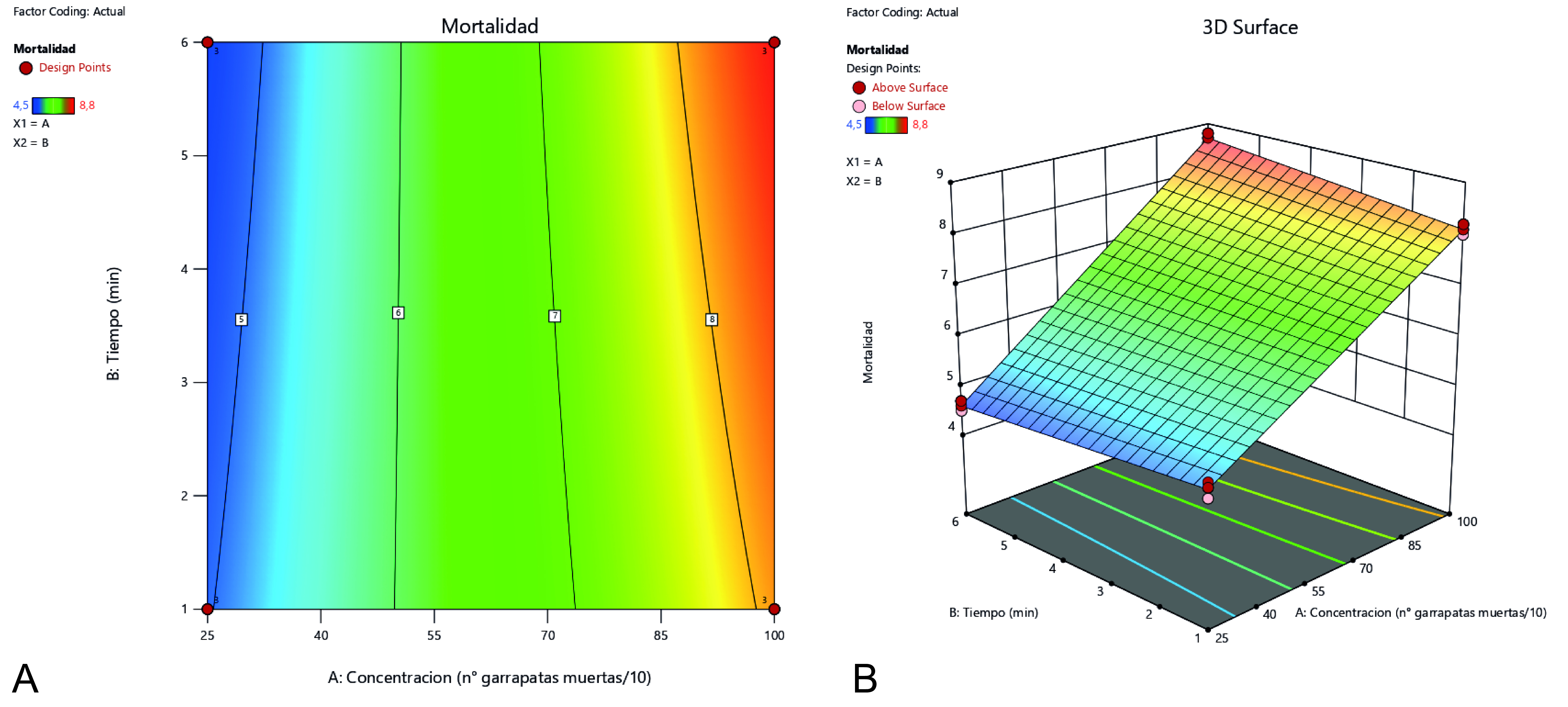
Ticks of the Ixodidae family represent 78% of the known species, affecting 80% of cattle. The objective was to evaluate the tick-killing effect of the aqueous extract of ocotea leaves. The ocotea hydrolate was obtained by steam drag. A completely randomized design with a factorial arrangement and two levels, hydrolate concentration (25%, 62.5% and 100%), three immersion times (1, 3.5 and 6 minutes), and two controls (a positive one with a commercial tick killer Biorbos and a negative one with distilled water) on tick mortality was used. The data were analyzed using the Design-Expert software version 12. The results were experimentally validated, reaching values very similar to those expected, through the polynomial model that presented the best fit with an R2 value of 0.9596. The interaction of the factors indicated that the effect of immersion time on mortality depends on the concentration of the hydrolate. The tick-killing effect of the aqueous extract showed a significantly high mortality with an average of 8 dead ticks per Petri dish (80% mortality), a value similar to the positive control (C+), which reached 100% mortality. The treatments with 62.5% of hydrolate at 3.5 minutes showed an intermediate mortality with an average of 7 dead ticks (70% mortality). It was concluded that the hydrolate at a concentration of 100% with an immersion time of 6 minutes had a positive effect on the mortality of Rhipicephalus microplus ticks
Downloads
Metrics
Article Details

This work is licensed under a Creative Commons Attribution-NonCommercial 4.0 International License.
The authors who publish in Siembra know and accept the following conditions:
- Authors retain the copyright and grant Siembra the right of first publication of the work, under the Creative Commons Attribution License. Third parties are allowed to use what has been published as long as they refer to the author or authors of the work and its publication in this journal.
 This content is licensed under a Creative Commons Attribution-Noncommercial 4.0 International (CC BY-NC 4.0).
- Authors maintain the copyright and guarantee Siembra the right to publish the manuscript through the channels it considers appropriate.
- Authors may establish on their own additional agreements for the non-exclusive distribution of the version of the work published in Siembra, acknowledging their initial publication in the same, such as in institutional repositories.
- Authors are authorized to disseminate their work electronically once the manuscript is accepted for publication.




References
Acevedo-Gutiérrez, L. Y., Paternina, L. E., Pérez-Pérez, J. C., Londoño, A. F., López, G., y Rodas, J. D. (2020). Garrapatas duras (Acari: Ixodidae) de Colombia, una revisión a su conocimiento en el país. Acta Biológica Colombiana, 25(1), 126–139. https://doi.org/10.15446/abc.v25n1.75252 DOI: https://doi.org/10.15446/abc.v25n1.75252
Aćimović, M. G., Tešević, V. V., Smiljanić, K. T., Cvetković, M. T., Stanković, J. M., Kiprovski, B. M., y Sikora, V. S. (2020). Hydrolates: By-products of essential oil distillation: Chemical composition, biological activity and potential uses. Advanced Technologies, 9(2), 54–70. https://doi.org/10.5937/savteh2002054A DOI: https://doi.org/10.5937/savteh2002054A
Alvarado Aguilar, M. C., Recalde Coronel, P. C., Leal Alvarado, D. A., Villa Sanchez, F. E., y Tamayo Alcivar, R. (2019). Oil-in-water (O/W) emulsionable concentrate of ishpink (Ocotea quixos) with thermodynamic stability. Revista Caatinga, 32(3), 590-598. https://doi.org/10.1590/1983-21252019v32n303rc DOI: https://doi.org/10.1590/1983-21252019v32n303rc
Arteaga-Crespo, Y., Ureta-Leones, D., García-Quintana, Y., Montalván, M., Gilardoni, G., y Malagón, O. (2021). Preliminary predictive model of termiticidal and repellent activities of essential oil extracted from Ocotea quixos leaves against Nasutitermes corniger (isoptera: termitidae) Using One-Factor Response Surface Methodology Design. Agronomy, 11(6),1249 . https://doi.org/10.3390/agronomy11061249 DOI: https://doi.org/10.3390/agronomy11061249
Betancur Hurtado, O. J., y Giraldo-Ríos, C. (2018). Economic and health impact of the ticks in production animals. En M. Abubakar y P. K. Perera (eds.), Ticks and Tick-Borne Pathogens. IntechOpen. https://doi.org/10.5772/intechopen.81167 DOI: https://doi.org/10.5772/intechopen.81167
Briones-Sornoza, H. R., y Guerrero-Intriago, D. A. (2019). Extracción de aceites esenciales de mandarina (citrus reticulata) y palo santo (Bursera Graveolens) por el método de arrastre de vapor. Revista Científica INGENIAR: Ingeniería, Tecnología e Investigación, 2(3), 14–23. https://doi.org/10.46296/ig.v2i3.0007 DOI: https://doi.org/10.46296/ig.v2i3.0007
Castañeda Arriola, R. O., Álvarez Martínez, J. A., Rojas Martínez, C., Lira Amaya, J. J., Ríos Utrera, Á., y Martínez Ibáñez, F. (2021). Nivel de infestación de Rhipicephalus microplus y su asociación con factores climatológicos y la ganancia de peso en bovinos Bos taurus x Bos indicus. Revista Mexicana de Ciencias Pecuarias, 12(1), 273–285. https://doi.org/10.22319/rmcp.v12i1.5392 DOI: https://doi.org/10.22319/rmcp.v12i1.5392
Castillo-Garit, J. A., González-Díaz, H., Cañizares-Carmenate, Y., Torrens, F., Pham-The, H., Martínez-López, Y., y Diéguez-Santana, K. (2021). Aplicaciones y potencialidades de los métodos de diseño computacional en estudios ambientales y farmacocinéticos. Anales de la Academia de Ciencias de Cuba, 11(1). http://scielo.sld.cu/scielo.php?script=sci_arttext&pid=S2304-01062021000100013&lng=es&tlng=es
Cuesy León, M., Molina Garza, Z. J., Mercado Hernández, R., y Galaviz Silva, L. (2021). Distribución corporal de garrapatas (Acari: Ixodidae y Argasidae) asociadas a Odocoielus virginianus (Artiodactyla: Cervidae) y Ovis canadensis (Artiodactyla: Bovidae) en tres estados del norte de México. Revista Mexicana de Ciencias Pecuarias, 12(1), 177–193. https://doi.org/10.22319/rmcp.v12i1.528 DOI: https://doi.org/10.22319/rmcp.v12i1.5283
de la Cruz Díaz, A., González Garduño, R., Vila Pena, M., Castañeda Arriola, R. O., y Maldonado Simán, E. (2023). Prevalencia y diagnóstico de resistencia a ixodicidas en garrapatas de ganado bovino en municipios de Chiapas y Tabasco, México. Revista Chapingo Serie Agricultura Tropical, 3(2), 1–14. https://doi.org/10.5154/r.rchsagt.2023.03.09 DOI: https://doi.org/10.5154/r.rchsagt.2023.03.09
De Marchi, B. R., Hennessey, M., Turechek, W., y Smith, H. (2023). A maximum concentration bioassay to assess insecticide efficacy against hemipteran pests of tomato. Florida Entomologist, 106(2). https://doi.org/10.1653/024.106.0211 DOI: https://doi.org/10.1653/024.106.0211
Durán Aguirre, C. E., Pratissoli, D., Carvalho, J. R. de, Pacheco Damascena, A., Araujo Junior, L. M. de, y Bolsoni Zago, H. (2020). Actividad insecticida de aceites esenciales sobre Helicoverpa armígera (Hübner) (Lepidoptera: Noctuidae). Idesia (Arica), 38(4), 59–64. https://doi.org/10.4067/S0718-34292020000400059 DOI: https://doi.org/10.4067/S0718-34292020000400059
Gilardoni, G., Montalván, M., Vélez, M., y Malagón, O. (2021). Chemical and enantioselective analysis of the essential oils from different morphological structures of Ocotea quixos (Lam.) Kosterm. Plants, 10(10), 2171. https://doi.org/10.3390/plants10102171 DOI: https://doi.org/10.3390/plants10102171
González Puetate, I., Arévalo Bozada, M. M., Vélez León, M. F., y Acosta Prócel, J. M. (2023). Aceites esenciales, alternativa frente a plagas y enfermedades en apicultura. LATAM Revista Latinoamericana de Ciencias Sociales y Humanidades, 4(5), 30-44. https://doi.org/10.56712/latam.v4i5.1300 DOI: https://doi.org/10.56712/latam.v4i5.1300
Hagg, F., Erasmus, L., y Stoltsz, W. (2024). The potential effect of Garlium GEM HCTM as a tick control agent in cattle. Journal of the South African Veterinary Association, 95(1), 1–6. https://doi.org/10.36303/JSAVA.560 DOI: https://doi.org/10.36303/JSAVA.560
Henker, L. C., Lorenzett, M. P., Fagundes-Moreira, R., Dalto, A. G. C., Sonne, L., Driemeier, D., Soares, J. F., y Pavarini, S. P. (2020). Bovine abortion, stillbirth and neonatal death associated with Babesia bovis and Anaplasma sp. infections in southern Brazil. Ticks Tick Borne Dis, 11(4), 101443. https://doi.org/10.1016/j.ttbdis.2020.101443 DOI: https://doi.org/10.1016/j.ttbdis.2020.101443
Jian, Y., Yuan, H., Li, D., Guo, Q., Li, X., Zhang, S., Ning, C., Zhang, L., y Jian, F. (2022). Evaluation of the in vitro acaricidal activity of Chinese herbal compounds on the poultry red mite (Dermanyssus gallinae). Frontiers in Veterinary Science, 9(1),1-11. https://doi.org/10.3389/fvets.2022.996422 DOI: https://doi.org/10.3389/fvets.2022.996422
Kasaija, P. D., Estrada-Peña, A., Contreras, M., Kirunda, H., y de la Fuente, J. (2021). Cattle ticks and tick-borne diseases: a review of Uganda's situation. Ticks and Tick-borne Diseases, 12(5), 101756. https://doi.org/10.1016/j.ttbdis.2021.101756 DOI: https://doi.org/10.1016/j.ttbdis.2021.101756
Kemal, J., Zerihun, T., Alemu, S., Sali, K., Nasir, M., Abraha, A., y Feyera, T. (2020). In Vitro acaricidal activity of selected medicinal plants traditionally used against ticks in eastern Ethiopia. Journal of Parasitology Research, 2020, 10. https://doi.org/10.1155/2020/7834026 DOI: https://doi.org/10.1155/2020/7834026
Klafke, G. M., Golo, P. S., Monteiro, C. M. O., Costa-Júnior, L. M., y Reck, J. (2024). Brazil’s battle against Rhipicephalus (Boophilus) microplus ticks: current strategies and future directions. Revista Brasileira de Parasitologia Veterinária, 33(2), e001423. https://doi.org/10.1590/s1984-29612024026 DOI: https://doi.org/10.1590/s1984-29612024026
Lagunes-Quintanilla, R., Gómez-Romero, N., Mendoza-Martínez, N., Castro-Saines, E., Galván-Arellano, D., y Basurto-Alcantara, F. J. (2024). Perspectives on using integrated tick management to control Rhipicephalus microplus in a tropical region of Mexico. Frontiers in Veterinary Science, 11, 1497840. https://doi.org/10.3389/fvets.2024.1497840 DOI: https://doi.org/10.3389/fvets.2024.1497840
Li, G., Zrimec, J., Ji, B., Geng, J., Larsbrink, J., Zelezniak, A., Nielsen, J., y Engqvist, M. K. (2021). Performance of regression models as a function of experiment noise. Bioinformatics and Biology Insights, 15(1), 1-15. https://doi.org/10.1177/11779322211020315 DOI: https://doi.org/10.1177/11779322211020315
Maya-Delgado, A., Madder, M., Benítez-Ortíz, W., Saegerman, C., Berkvens, D., y Ron-Garrido, L. (2020). Molecular screening of cattle ticks, tick-borne pathogens and amitraz resistance in ticks of Santo Domingo de los Tsáchilas province in Ecuador. Ticks and Tick-borne Diseases, 11(5), 101492. https://doi.org/10.1016/j.ttbdis.2020.101492 DOI: https://doi.org/10.1016/j.ttbdis.2020.101492
Mendoza-Roldan, J. A., Mendoza-Roldan, M. A., y Otranto, D. (2021). Reptile vector-borne diseases of zoonotic concern. International Journal for Parasitology: Parasites and Wildlife, 15(1), 132-142. https://doi.org/10.1016/j.ijppaw.2021.04.007 DOI: https://doi.org/10.1016/j.ijppaw.2021.04.007
Miranda Reyes, P. I., Martínez Ibañez, F., Lagunes-Quintanilla, R. E., y Barrera Molina, A. I. (2023). Efecto ixodicida de los extractos vegetales de Cinnamomum zeylanicum y Tagetes erecta sobre garrapatas Rhipicephalus microplus. Revista Mexicana de Ciencias Pecuarias, 14(4), 905-914. https://doi.org/10.22319/rmcp.v14i4.6394 DOI: https://doi.org/10.22319/rmcp.v14i4.6394
Molina, W. D., Diaz-Rivas, I. H., y Serrato-Hurtado, C. (2025). Evaluación de susceptibilidad de las garrapatas Rhipicephalus microplus a los extractos de Nicotiana tabacum y Couroupita guianensis en condiciones de laboratorio en Florencia-Caquetá, Colombia. Revista Científica del Amazonas, 8(15), 23-38. https://doi.org/10.34069/RA/2025.15.02 DOI: https://doi.org/10.34069/RA/2025.15.02
Ojeda-Chi, M. M., Rodriguez-Vivas, R. I., Galindo-Velasco, E., y Lezama-Gutiérrrez, R. (2010). Laboratory and field evaluation of Metarhizium anisopliae (Deuteromycotina: Hyphomycetes) for the control of Rhipicephalus microplus (Acari: Ixodidae) in the Mexican tropics. Veterinary Parasitology, 170(3), 348-354. https://doi.org/10.1016/j.vetpar.2010.02.022 DOI: https://doi.org/10.1016/j.vetpar.2010.02.022
Paucar-Quishpe, V., Cepeda-Bastidas, D., Rodríguez-Hidalgo, R., Pérez-Otáñez, X., Perez, C., Enríquez, S., Guzman, E., Ulcuango, F., Grijalva, J., Vanwambeke, S. O., Ron-Garrido, L., y Saegerman, C. (2024). Evaluating the human risks of consumption of foods of bovine origin with ivermectin residues in Ecuador. Foods, 13(21), 3470. https://doi.org/10.3390/foods13213470 DOI: https://doi.org/10.3390/foods13213470
Pérez-Otáñez, X., Vanwambeke, S. O., Orozco-Alvarez, G., Arciniegas-Ortega, S., Ron-Garrido, L., y Rodríguez-Hidalgo, R. (2024). Widespread acaricide resistance and multi-resistance in Rhipicephalus microplus in Ecuador and associated environmental and management risk factors. Ticks and Tick-borne Diseases, 15(1), 102274. https://doi.org/10.1016/j.ttbdis.2023.102274 DOI: https://doi.org/10.1016/j.ttbdis.2023.102274
Quadros, D. G., Johnson, T. L., Whitney, T. R., Oliver, J. D., y Oliva Chávez, A. S. (2020). Plant-derived natural compounds for tick pest control in livestock and wildlife: pragmatism or utopia? Insects, 11(8), 1-14. https://doi.org/10.3390/insects11080490 DOI: https://doi.org/10.3390/insects11080490
Quirós-Monge, M., León-González, I., y Murillo-Rojas, P. (2025). Efecto repelente de aceites esenciales sobre el ácaro Tetranychus urticae Koch (Acari: Tetranychidae). Agronomía Mesoamericana, 36, Artículo qwj4k754. https://doi.org/10.15517/qwj4k754 DOI: https://doi.org/10.15517/qwj4k754
Rodríguez Trujillo, N., Salazar Loor, J. G., Enríquez, S., y Navarro, J.-C. (2021). Modelo de nicho ecológico de la garrapata Rhipicephalus (Boophilus) microplus incluyendo variables socioambientales dentro de Ecuador continental. Universidad Internacional SEK. https://repositorio.uisek.edu.ec/handle/123456789/4502
Scalvenzi, L., Radice, M., Toma, L., Severini, F., Boccolini, D., Bella, A., Guerrini, A., Tacchini, M., Sacchetti, G., Chiurato, M., Romi, R., y Di Luca, M. (2019). Larvicidal activity of Ocimum campechianum, Ocotea quixos and Piper aduncum essential oils against Aedes aegypti. Parasite, 26, 23. https://doi.org/10.1051/parasite/2019024 DOI: https://doi.org/10.1051/parasite/2019024
Souza, F. de A. L., Braga, J. F. V., Pires, L. V., Carvalho, C. J. S. d., Costa, É. A., Ribeiro, M. F. B., Santos, R. L., y Silva, S. M. M. S. (2013). Babesiosis and anaplasmosis in dairy cattle in northeastern Brazil. Pesquisa Veterinária Brasileira, 33(1), 1-16. https://doi.org/10.1590/S0100-736X2013000900002 DOI: https://doi.org/10.1590/S0100-736X2013000900002
Sultankulova, K. T., Shynybekova, G. O., Issabek, A. U., Mukhami, N. N., Melisbek, A. M., Chervyakova, O. V., Kozhabergenov, N. S., Barmak, S. M., Bopi, A. K., Omarova, Z. D., Alibekova, D. A., Argimbayeva, T. U., Namet, A. M., Zuban, I. A., y Orynbayev, M. B. (2022). The prevalence of pathogens among ticks collected from livestock in Kazakhstan. Pathogens, 11(10), 1-16. https://doi.org/10.3390/pathogens11101206 DOI: https://doi.org/10.3390/pathogens11101206
Torales, J., y Barrios, I. (2023). Diseño de investigaciones: algoritmo de clasificación y características esenciales. Medicina Clínica y Social, 7(3), 210-235. https://doi.org/10.52379/mcs.v7i3.349 DOI: https://doi.org/10.52379/mcs.v7i3.349
Vacacela-Ajila, W., Guzmán-Ordóñez, L., Rey-Valeirón, C., Delgado-Fernández, E., Benítez-Gonzales, E., Chamba-Ochoa, H., Ortega Rojas, R., y Ramírez Robles, J. (2023). Composición química y revisión de las propiedades acaricidas de los aceites esenciales de Melinis minutiflora y Lantana cámara. Boletín latinoamericano y del Caribe de plantas, 22(4), 488-499. https://doi.org/10.37360/blacpma.23.22.4.36 DOI: https://doi.org/10.37360/blacpma.23.22.4.36
Valarezo, E., Vullien, A., y Conde-Rojas, D. (2021). Variability of the Chemical Composition of the Essential Oil from the Amazonian Ishpingo Species (Ocotea quixos). Molecules, 26(13), 3961. https://doi.org/10.3390/molecules26133961 DOI: https://doi.org/10.3390/molecules26133961
Valenzuela Loor, A. J., Laaz López, D. A., y García Paredes, R. I. (2024). Eficiencia del recubrimiento comestible de almidón de yuca y aceite esencial de canela para la conservación de piña IV gama. Revista Ciencia y Tecnología El Higo, 14(2), 162–177. https://doi.org/10.5377/elhigo.v14i2.19641 DOI: https://doi.org/10.5377/elhigo.v14i2.19641
Wang, C.-H., Taso, N.-W., Chen, C.-J., Chang, H.-Y., y Wang, S.-Y. (2024). Composition characterization of cinnamomum osmophloeum kanehira hydrosol and its enhanced effects on erectile function. Plants, 13(11), 1518. https://doi.org/10.3390/plants13111518 DOI: https://doi.org/10.3390/plants13111518