
Synergy between biological and synthetic inputs: optimizing plant nutrition and improving rice (Oryza sativa L.) yield
Article Sidebar
Main Article Content
Abstract
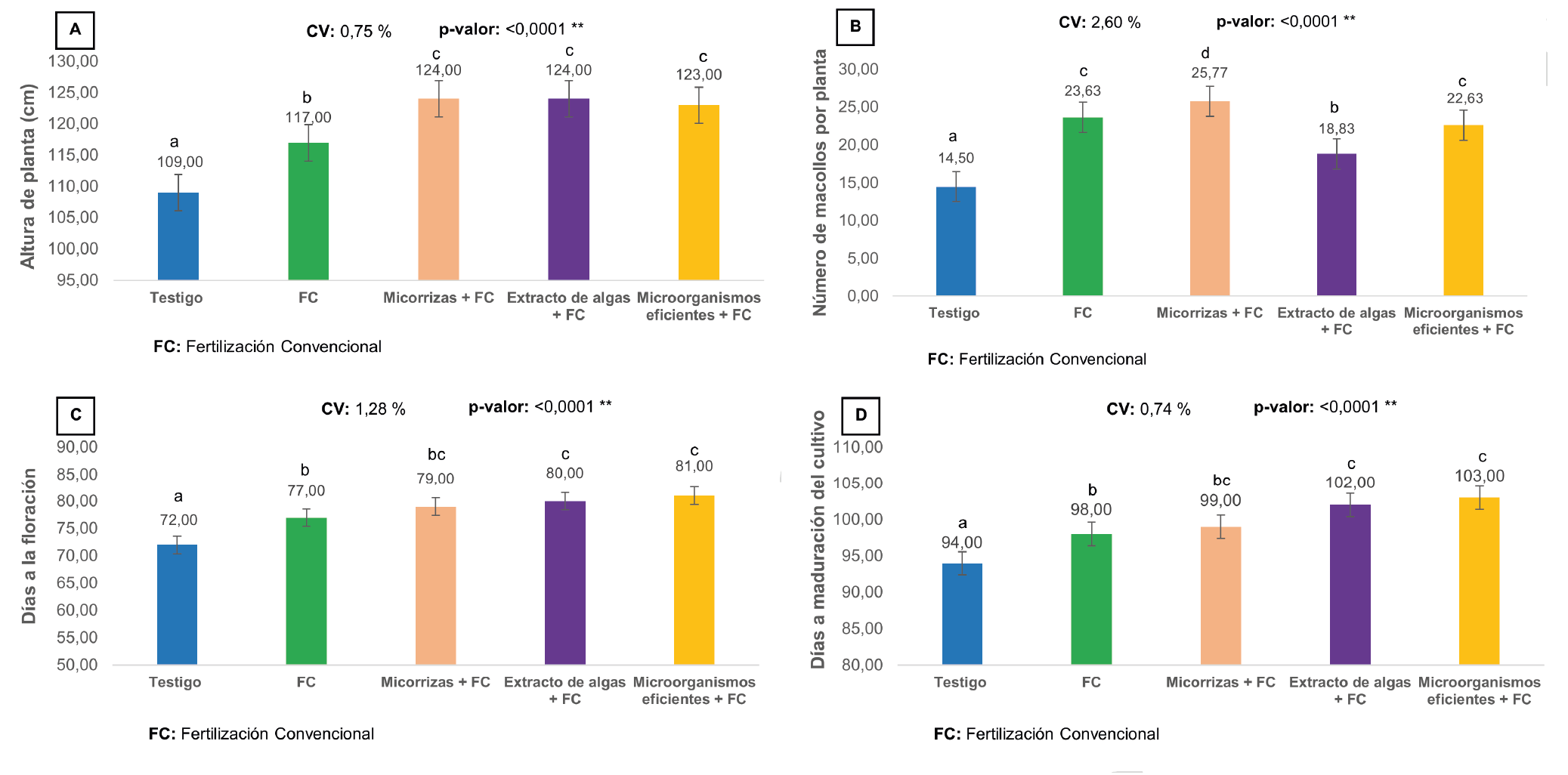
Agricultural bio-inputs offer multiple benefits, such as improving soil texture, maintaining moisture and aeration for the root system, promoting the development of beneficial microorganisms, and enhancing crop nutrition. This research, conducted between November 2022 and February 2023 at the Petrillo site, Nobol canton, Guayas province, Ecuador, aimed to evaluate the effect of three bio-inputs (mycorrhizae, seaweed extracts, and efficient microorganisms) on the morphology and yield of rice. A randomized complete block design was used, with five treatments and three replicates. The data were analyzed using analysis of variance (ANOVA), and the means were compared using Tukey’s test (p ≤ 0.05). Variables evaluated included plant height (cm), number of tillers and panicles, panicle length (cm), grains per panicle, days to flowering and maturity, and grain yield (kg ha⁻¹). The results showed that the mycorrhizal treatment at 1 L ha⁻¹ produced a significant positive effect on crop morphology and yield, reaching an average of 5,407 kg ha⁻¹. This demonstrates that the soil application of agricultural bio-inputs generates a favorable response compared to the control and conventional fertilization, improving nutrient absorption and the productive performance of the rice crop.
Downloads
Metrics
Article Details

This work is licensed under a Creative Commons Attribution-NonCommercial 4.0 International License.
The authors who publish in Siembra know and accept the following conditions:
- Authors retain the copyright and grant Siembra the right of first publication of the work, under the Creative Commons Attribution License. Third parties are allowed to use what has been published as long as they refer to the author or authors of the work and its publication in this journal.
 This content is licensed under a Creative Commons Attribution-Noncommercial 4.0 International (CC BY-NC 4.0).
- Authors maintain the copyright and guarantee Siembra the right to publish the manuscript through the channels it considers appropriate.
- Authors may establish on their own additional agreements for the non-exclusive distribution of the version of the work published in Siembra, acknowledging their initial publication in the same, such as in institutional repositories.
- Authors are authorized to disseminate their work electronically once the manuscript is accepted for publication.




References
AGRIPAC. (2021). Semillas AGRIPAC- Arroz. https://agripac.com.ec/productos/arroz-sfl-11-bioactivado/
Ammar Redza Ahmad Rizal, A., Md Nordin, S., Abd Rashid, R., y Hassim, N. (2024). Decoding the complexity of sustainable rice farming: a systematic review of critical determining factor of farmers’ sustainable practices adoption. Cogent Food & Agriculture, 10(1), 2334994. https://doi.org/10.1080/23311932.2024.2334994 DOI: https://doi.org/10.1080/23311932.2024.2334994
Calero Hurtado, A., Olivera Viciedo, D., Pérez Díaz, Y., Pardo Hurtado, Y. G., Yánez Simón, L. A., y Peña Calzada, K. (2020). Manejo de diferentes densidades de plantación y aplicación de microorganismos eficientes que incrementan la productividad del arroz. IDESIA, 38(2), 109-117. https://www.scielo.cl/pdf/idesia/v38n2/0718-3429-idesia-38-02-109.pdf DOI: https://doi.org/10.4067/S0718-34292020000200109
Cordero Flores, P., y Manzaneda Delgado, F. (2021). Evaluación agronómica de seis variedades de arroz (Oryza sativa L.) sembradas en dos épocas bajo riego, en el municipio de San Buenaventura, Bolivia. Revista de Investigación e Innovación Agropecuaria y de Recursos Naturales, La Paz, 8(1), 7-16. http://www.scielo.org.bo/pdf/riiarn/v8n1/2409-1618-riiarn-8-01-3.pdf DOI: https://doi.org/10.53287/xivu8492oe20n
Das, D., Ullah, H., Himanshu, S. K., Tisarum, R., Cha-um, S., & Datta, A. (2022). Arbuscular mycorrhizal fungi inoculation and phosphorus application improve growth, physiological traits, and grain yield of rice under alternate wetting and drying irrigation. Journal of Plant Physiology, 278, 153829. https://doi.org/10.1016/j.jplph.2022.153829 DOI: https://doi.org/10.1016/j.jplph.2022.153829
Deepana, P., Sudhagar, R., Balasubramanian, S., y Ponnusamy, S. (2021). Effect of seaweed extract on rice (Oryza sativa var. ADT53) productivity and soil fertility in Cauvery delta zone of Tamil Nadu, India. Journal of Applied and Natural Science, 13(3), 1111-1120. DOI: https://doi.org/10.31018/jans.v13i3.2906
Demir, H., Saka, A. K., Uçan, U., Akgün, İ. H., & Yalçı, H. K. (2024). Impact of effective micro-organisms (EM) on the yield, growth and bio-chemical properties of lettuce when applied to soil and leaves. BMC Plant Biology, 24(1), 1-12. https://doi.org/10.1186/s12870-024-05980-y DOI: https://doi.org/10.1186/s12870-024-05980-y
Diaz Almea, Y. M., y Contreras Miranda, J. A. (2022). Respuesta del cultivo de arroz (Oryza sativa L.) a la aplicación foliar de biol, té de estiércol y ácido húmico. Manglar, 19(1), 85-90. https://doi.org/10.17268/manglar.2022.011 DOI: https://doi.org/10.17268/manglar.2022.011
González Pita, A., & Painii Montero, V. F. (2022). Influencia de bioestimulantes foliares a base de algas marinas, sobre el desarrollo y rendimiento del cultivo de arroz en Daule, Ecuador. Revista Ecológica Agropecuaria RECOA, 1(1), 1-16. https://revistas.ug.edu.ec/index.php/recoa/article/view/1750/2556 DOI: https://doi.org/10.53591/recoa.v1i1.682
Guigard, L., Jobert, L., Busset, N., Moulin, L., y Czernic, P. (2023). Symbiotic compatibility between rice cultivars and arbuscular mycorrhizal fungi genotypes affects rice growth and mycorrhiza-induced resistance. Frontiers in Plant Science, 14, 1278990. https://doi.org/10.3389/fpls.2023.1278990 DOI: https://doi.org/10.3389/fpls.2023.1278990
Hernández Quiñónez, J. A., Salazar Mercado, S. A., & Rodríguez Araújo, E. A. (2021). Efecto de los elementos menores en la calidad molinera del arroz (Oryza sativa L.) variedad F-2000. Revista Mutis, 11(1), 8-21. doi:10.21789/22561498.1711 DOI: https://doi.org/10.21789/22561498.1711
Ibrahim, M., Abdulhameed, A., Nayaya, A. J., y Ezra, A. G. (2024). Effect of Arbuscular Mycorrhizal Fungi on the growth and Yield of Rice (Oryza sativa L.) in Bauchi, Nigeria. Journal of Global Ecology and Environment, 20(3), 1–12. https://doi.org/10.56557/jogee/2024/v20i38797 DOI: https://doi.org/10.56557/jogee/2024/v20i38797
International Plant Nutrition Institute [IPNI]. (2016). Requerimientos nutricionales de los cultivos. International Plant Nutrition Institute - Arroz. http://lacs.ipni.net/ipniweb/region/lacs.nsf/0/0B4CDA48FABB666503257967007DD076/$FILE/AA%203.pdf
Lucas J. y Llerena L. 2024. Microorganismos benéficos como biofertilizantes eficientes en el cultivo del arroz (Oryza sativa L.). Universidad Técnica Estatal de Quevedo, Ecuador. 92 pp.
Jupri, A., Fanani, R. A., Syafitri, S. M., Mayshara, S., Nurijawati, S. A. P., y Sunarpi, H. (2019). Growth and yield of rice plants sprayed with Sargassum polycystum extracted with different concentrations. AIP Conference Proceedings, 2199, 070009. https://doi.org/10.1063/1.5141323 DOI: https://doi.org/10.1063/1.5141323
Kumawat, A., Kumar, D., Shivay, Y. S., Bhatia, A., Rashmi, I., Yadav, D., y Kumar, A. (2023). Long-term impact of biofertilization on soil health and nutritional quality of organic basmati rice in a typic ustchrept soil of India. Frontiers in Environmental Science, 10, 1031844. https://doi.org/10.3389/fenvs.2023.1031844 DOI: https://doi.org/10.3389/fenvs.2023.1031844
Martín-Cardoso, H., Castillo, L., Busturia, I., Bücker, G., Marqués, L., Pla, E., Català-Forner, M., Domingo, C., y San Segundo, B. (2025). Arbuscular mycorrhizal fungi increase blast resistance and grain yield in Japonica rice cultivars in flooded fields. Rice, 18(1), 7. https://doi.org/10.1186/s12284-025-00805-4 DOI: https://doi.org/10.1186/s12284-025-00805-4
Mendoza, B. R., y Espinoza, A. (2017). Guía técnica para muestreo de suelos. Universidad Nacional Agraria y Catholic Relief Services.
Meza Aguilar, J. J., y Almeida Veintimilla, A. C. (2022). Efecto de algas marinas como fertilizante para el cultivo de arroz (Oryza sativa L) en Babahoyo, Ecuador. Revista Científica Ecológica Agropecuaria, 2(1), 6-12. https://revistas.ug.edu.ec/index.php/recoa/article/view/1882/2711 DOI: https://doi.org/10.53591/recoa.v1i2.320
Mulyadi, y Jiang, L. (2023). The combined application of biochar and arbuscular mycorrhizal fungi (AMF) enhanced the physical and chemical properties of soil and rice productivity in Indonesia. Sustainability, 15(12), 9782. https://doi.org/10.3390/su15129782 DOI: https://doi.org/10.3390/su15129782
Naranjo Moran, J. A., Mora González, A. F., Moina Quimí, E., Ruíz Barzola, O., Alvarado Cadena, O., Calle Delgado, P., y Barcos Arias, M. S. (2022). Comportamiento en la absorción de Na y Pb en plantas de cucurbitáceas e inoculación de micorrizas arbusculares nativas en especie tolerante y suceptible. Revista Internacional de Contaminación Ambiental, 38, 587-601. https://doi.org/10.20937/RICA.54023 DOI: https://doi.org/10.20937/RICA.54023
Pozo Galves, C., Cabrera Alonso, J. R., Márquez Reina, E., Hernández Hernández, O., Ruiz Sanchez, M., y Domínguez Palacio, D. (2017). Characteristics and classification of Ferruginous Nodular Gley soils under intensive rice crop production from Los Palacios. Cultivos tropicales, 38(4), 58-64. http://scielo.sld.cu/pdf/ctr/v38n4/ctr11417.pdf
Quezada, C., J. Carrillo, M., D, Morales, F., L and Carrillo, R., A. (2016). Nutrient critical levels and availability in soils cultivated with peach palm (Bactris gasipaes Kunth.) in Santo Domingo de Los Tsáchilas, Ecuador. Acta Agronómica, 66(2), 235-240
Ruiz Sánchez, M., Santana Baños, Y., Muñoz Hernández, Y., Martínez, A. Y., Benítez, M., Bharat, B. V., y Peña Chávez, Y. (2015). Simbiosis de micorrizas arbusculares en plantas de arroz (Oryza sativa L.) en condiciones de inundación y secano. Acta Agronómica, 64(2), 123-134. DOI: https://doi.org/10.15446/acag.v64n3.43087
Ruiz Parrales, Y. G., Sánchez Vásquez, V. L., López Izurieta, M. D., y Molina Barbotó, V. (2020). Fertilización química basada en análisis de suelo en dos líneas promisorias de arroz. Magazine De Las Ciencias: Revista De Investigación E Innovación, 5(7), 56–72. https://revistas.utb.edu.ec/index.php/magazine/article/view/927/683
Suárez Baque, D. L., y Durán Mera, C. A. (2023). Aplicación de herbicidas postemergentes para el control de malezas en el cultivo de arroz (Oryza sativa L.). Revista Científica Ecológica Agropecuaria RECOA, 2(1), 1-9. https://revistas.ug.edu.ec/index.php/recoa/article/view/2189/3147 DOI: https://doi.org/10.53591/recoa.v2i1.353
Tahar, S. Z. A., Surugau, N., Eng, H. S., Tan, W.-H., y Sam, L. M. (2023). Biostimulant effects of brown seaweed extract (Sargassum polycystum) on the growth and yield of pigmented upland rice (Oryza sativa cv Tadong). Tropical Open Soil and Land Journal, 11(2), 51-64.
Thaimei, T., Bokadoa, K., y Bera, B. B. (2024). Seaweed extract for sustainable rice production: A review. International Journal of Plant & Soil Science, 36(7), 147–160. https://doi.org/10.9734/ijpss/2024/v36i74716 DOI: https://doi.org/10.9734/ijpss/2024/v36i74716
Thamvithayakorn, P., Phosri, C., Robinson-Boyer, L., Limnonthakul, P., Doonan, J. H., & Suwannasai, N. (2024). The synergistic impact of a novel plant growth-promoting rhizobacterial consortium and Ascophyllum nodosum seaweed extract on rhizosphere microbiome dynamics and growth enhancement in Oryza sativa L. RD79. Agronomy, 14(11), 2698. https://doi.org/10.3390/agronomy14112698 DOI: https://doi.org/10.3390/agronomy14112698
Zuñiga Orozco, A., Montero Jara, K., y Peña Cordero, W. (2020). Análisis de la eficiencia de la fertilización mediante el uso de Zeolita natural y Mucuna pruriensen el cultivo de arroz (Oryza sativa L.) bajo condiciones controladas en microparcelas situadas en Parrita, Puntarenas, Costa Rica. Repertorio científico, 23(2), 23-36. https://revistas.uned.ac.cr/index.php/repertorio/article/view/2985/4271 DOI: https://doi.org/10.22458/rc.v23i2.2985