
Effects of the paramization phenomenon on the ecosystem resilience of the Andean páramo in a climate change context
Article Sidebar
Main Article Content
Abstract
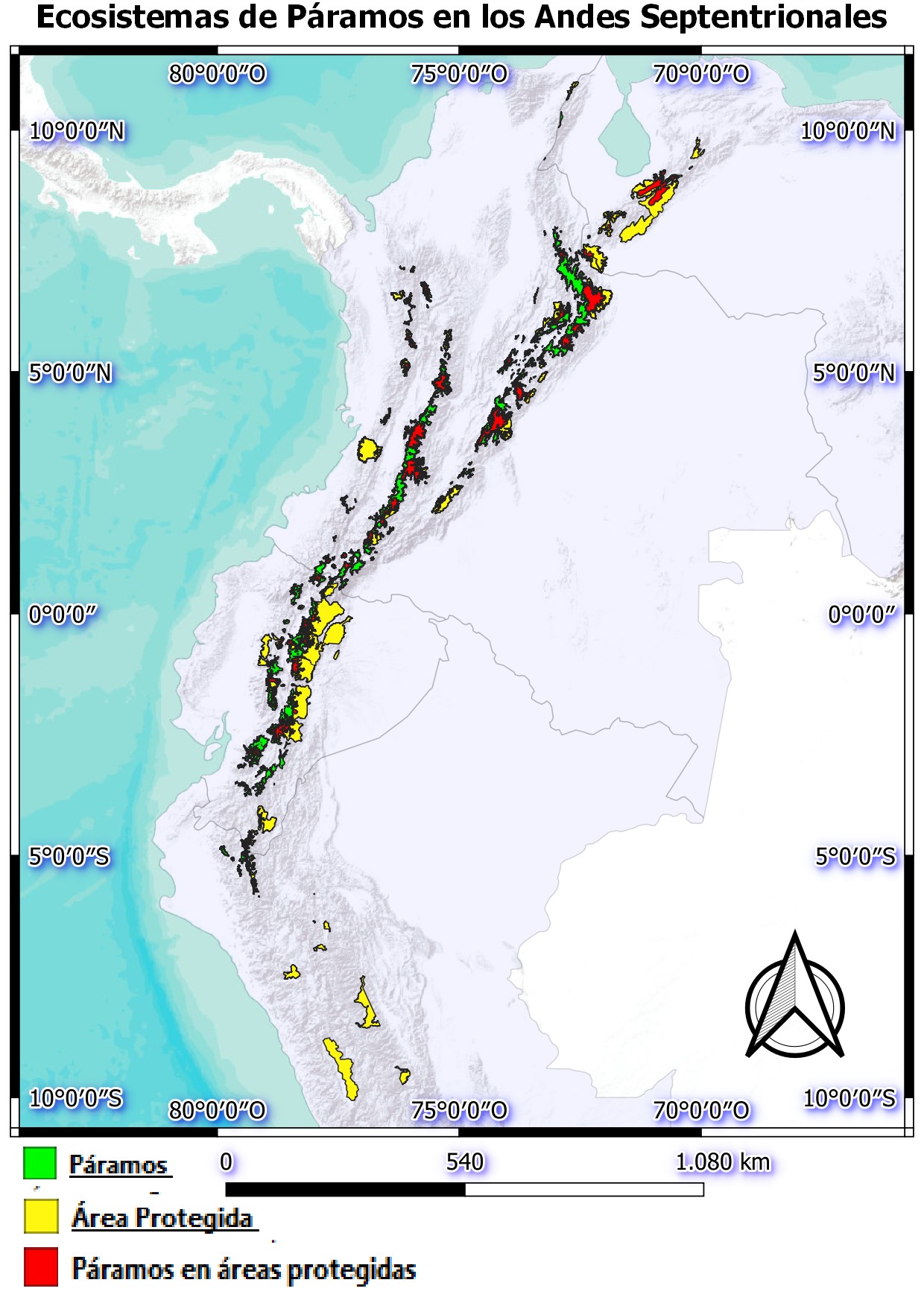
The article synthesizes current knowledge on Andean páramo ecosystems, highlighting their ecological importance and their strategic role in providing essential ecosystem services such as water regulation, carbon sequestration, and the maintenance of high biodiversity. These high-mountain systems are fundamental to human well-being due to their capacity to store and regulate water that supplies millions of people. In this context, the process of “paramization” is analyzed as a transformation of high Andean forests into páramo conditions, driven by human activities such as agricultural expansion, grazing, potato cultivation, and burning, along with rising temperatures. This process leads to land-use changes, biodiversity loss, and alterations in key ecological processes such as vegetation regeneration, carbon retention, and hydrological dynamics. It was found that the ecological resilience of these ecosystems is being weakened by local pressures and climate change, increasing their vulnerability and reducing their adaptive capacity. Spatial analysis reveals fragmentation and variability in protection levels, while knowledge gaps persist, underscoring the need to strengthen conservation, restoration, and sustainable management strategies in the face of growing environmental threats.
Downloads
Metrics
Article Details

This work is licensed under a Creative Commons Attribution-NonCommercial 4.0 International License.
The authors who publish in Siembra know and accept the following conditions:
- Authors retain the copyright and grant Siembra the right of first publication of the work, under the Creative Commons Attribution License. Third parties are allowed to use what has been published as long as they refer to the author or authors of the work and its publication in this journal.
 This content is licensed under a Creative Commons Attribution-Noncommercial 4.0 International (CC BY-NC 4.0).
- Authors maintain the copyright and guarantee Siembra the right to publish the manuscript through the channels it considers appropriate.
- Authors may establish on their own additional agreements for the non-exclusive distribution of the version of the work published in Siembra, acknowledging their initial publication in the same, such as in institutional repositories.
- Authors are authorized to disseminate their work electronically once the manuscript is accepted for publication.




References
Corbelle, F., y Guzmán, S. (2020). Identificación comunitaria de motores de transformación y pérdida de biodiversidad en el páramo de Rabanal, Boyaca, Colombia. Revista Geográfica Venezolana. 61(2), 314-331. https://dialnet.unirioja.es/servlet/articulo?codigo=8144007
Corporación Autónoma Regional de Cundinamarca [CAR]. (2018). Plan de conservación y manejo de los frailejones presentes en el territorio CAR. Pontificia Universidad Javeriana.
Cuatrecasas, J. (1958). Observaciones geobotánicas en Colombia. Trabajos del Museo Nacional de Ciencias Naturales, Serie Botánica, Núm. 27. Madrid. https://www.accefyn.com/revista/Vol_1.pdf
Farley, K. A., y Bremer, L. L. (2017). “Water Is Life”: Local Perceptions of Páramo Grasslands and Land Management Strategies Associated with Payment for Ecosystem Services. Annals of the American Association of Geographers, 107(2), 371–381. https://doi.org/10.1080/24694452.2016.1254020 DOI: https://doi.org/10.1080/24694452.2016.1254020
Hofstede, R. (2020). ¿Sumapaz es o no es el páramo más grande del mundo? Linkedin. https://es.linkedin.com/pulse/sumapaz-es-o-el-p%C3%A1ramo-m%C3%A1s-grande-del-mundo-robert-hofstede
Instituto de Investigación de Recursos Biológicos Alexander von Humboldt y Ministerio de Ambiente y Desarrollo Sostenible. (2011). Plan Nacional para la Prevención, el Control y Manejo de las Especies Introducidas, Trasplantadas e Invasoras: Diagnóstico y listado preliminar de especies introducidas, Trasplantadas e invasoras en Colombia.https://www.minambiente.gov.co/wp-content/uploads/2021/10/PN-Prevencio%CC%81n-el-control-y-Manejo-de-las-especies-introducidas-invasoras.pdf
Instituto Humboldt. (2012). El gran libro de los Páramos. Bogotá, Cundinamarca, Colombia: Instituto de Investigación de Recursos Biológicos Alexander von Humboldt. https://www.researchgate.net/publication/342925795_Gran_Libro_de_los_Paramos
Intergovernmental Science-Policy Platform on Biodiversity and Ecosystem Services [IPBES]. (2019). Summary for policymakers of the global assessment report on biodiversity and ecosystem services. Díaz et al. (Eds.). IPBES Secretariat. https://doi.org/10.5281/zenodo.3553579
International Union for Conservation of Nature [IUCN]. (2010). Páramos: Enhancing capacities and coordination to cope with climate change effects. https://iucn.org/sites/default/files/import/downloads/paramosactionplan.pdf
Llambí, L. D. y Cuesta, F. (Eds.). (2014). La diversidad de los páramos andinos en el espacio y en el tiempo. Avances en investigación para la conservación de los páramos andinos (pp.7-40). CONDESAN.http://www.saber.ula.ve/handle/123456789/39563
Organización de las Naciones Unidad para para la Alimentación [FAO]. (2014). Los Andes: Una oportunidad para el desarrollo sostenible e integración. http://www.fao.org/fileadmin/templates/mountain_partnership/doc/TCP_Andes/Diagnostico_Los_AndesUna_oportunidad_para_el_desarrollo_sostenible_e_integracion.pdf
Quintero-Vallejo, E., Benavides, A. M., Moreno, N., y González-Caro, S. (Eds.). (2018). Bosques Andinos: estado actual y retos para su conservación en Antioquia (1ed.). COSUDE.
Vargas, O. (2013). Disturbios en los páramos andinos. Visión socioecosistémica de los páramos y la alta montaña colombiana: memorias del proceso de definición de criterios para la delimitación de páramos (pp. 39 - 57). Instituto de Investigación de Recursos Biológicos Alexander von Humboldt. http://biblioteca.humboldt.org.co/en/biodiversity/item/409-vision-socioecositemica-de-los-paramos-y-la-alta-montana-colombiana-memorias-del-proceso-de-definicion-de-criterios-para-la-delimitacion-de-paramos
Wohlin, C. (2014). Guidelines for snowballing in systematic literature studies and a replication in software engineering. Proceedings of the 18th International Conference on Evaluation and Assessment in Software Engineering [EASE´14], 1–10. https://doi.org/10.1145/2601248.2601268 DOI: https://doi.org/10.1145/2601248.2601268
World Wildlife Fund [WWF]. (2016). Ecorregions https://www.worldwildlife.org/biomes
Wunder, S., Wertz-Kanounnikoff, S., y Moreno-Sánchez, R. (2007). Pago por servicios ambientales: una nueva forma de conservar la biodiversidad. Gaceta Ecológica, 84(85), 39–52. https://www.redalyc.org/pdf/539/53908505.pdf
Zaccarelli, N., Petrosillo, I., y Zurlini, G. (2008). Retrospective Analysis. In Encyclopedia of Ecology (pp. 3020–3029). Elsevier. https://doi.org/10.1016/B978-008045405-4.00705-9 DOI: https://doi.org/10.1016/B978-008045405-4.00705-9
Zomer, M. A., y Ramsay, P. M. (2021). Post‐fire changes in plant growth form composition and diversity in Andean páramo grassland. Applied Vegetation Science, 24(1), e12554. https://doi.org/10.1111/avsc.12554 DOI: https://doi.org/10.1111/avsc.12554