
Assessment of Avitourism Potential in Otavalo Canton, Ecuador: A Multi-Criteria Approach Based on the Analytic Hierarchy Process
Article Sidebar
Main Article Content
Abstract
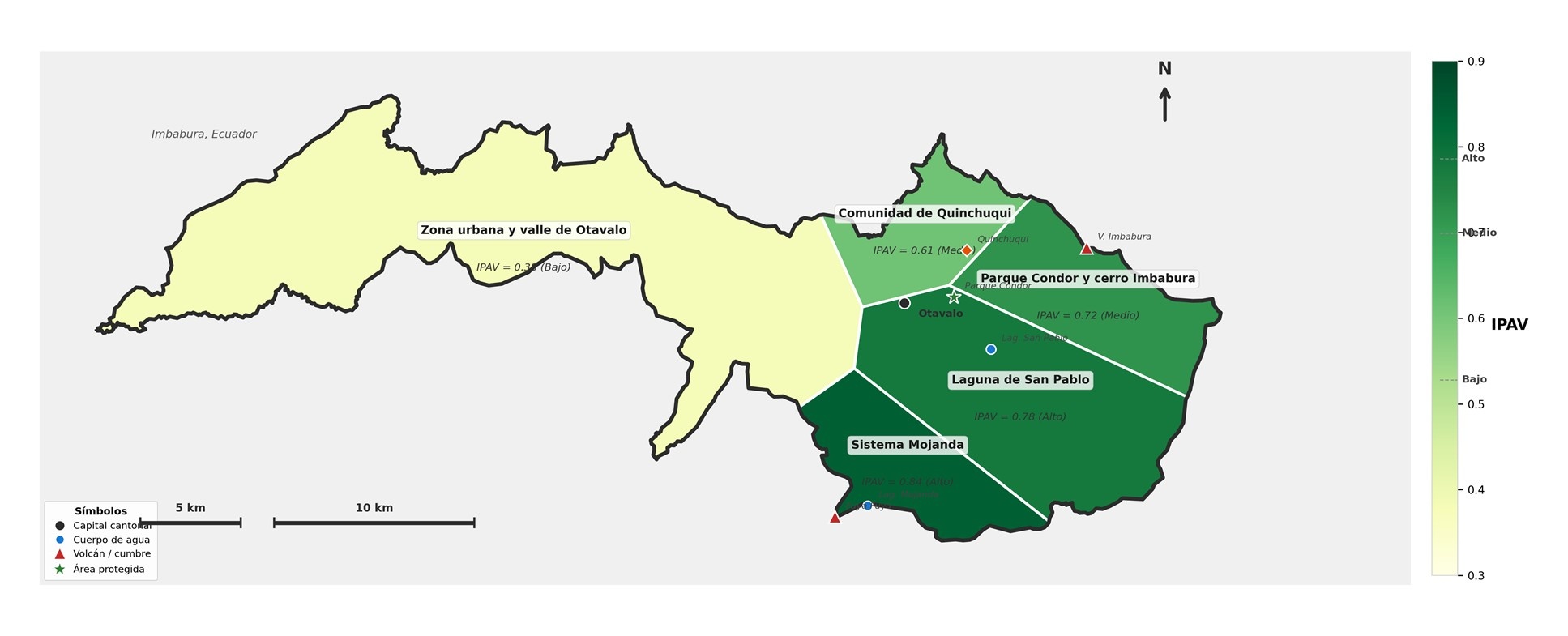
Avitourism is an emerging form of ecotourism that integrates birdwatching with biodiversity conservation and local development. This study evaluates the avitourism potential in Otavalo canton, located in Imbabura Province in the northern Andes of Ecuador, a region within the Tropical Andes biodiversity hotspot. A mixed methodological approach was employed, combining territorial characterization with the Analytic Hierarchy Process [AHP] for multi-criteria weighting of avitourism potential indicators. Four main criteria were established: avifaunal richness and singularity, territorial conditions, local sociocultural capital, and institutional framework. These were weighted by a panel of seven experts through pairwise comparisons. The results indicate that avifaunal richness holds the highest weight (0.35), followed by territorial conditions (0.25), sociocultural capital (0.22), and institutional framework (0.18). An Avitourism Potential Index [IPAV] was developed to classify the evaluated routes into high-, medium-, and low-potential categories. The findings show that the highest potential zones are located in the protected areas of the Mojanda system and around San Pablo Lake. This study provides a replicable methodology for systematically assessing avitourism potential in Andean contexts, thereby strengthening the technical foundation for nature tourism planning in Ecuador.
Downloads
Metrics
Article Details

This work is licensed under a Creative Commons Attribution-NonCommercial 4.0 International License.
The authors who publish in Siembra know and accept the following conditions:
- Authors retain the copyright and grant Siembra the right of first publication of the work, under the Creative Commons Attribution License. Third parties are allowed to use what has been published as long as they refer to the author or authors of the work and its publication in this journal.
 This content is licensed under a Creative Commons Attribution-Noncommercial 4.0 International (CC BY-NC 4.0).
- Authors maintain the copyright and guarantee Siembra the right to publish the manuscript through the channels it considers appropriate.
- Authors may establish on their own additional agreements for the non-exclusive distribution of the version of the work published in Siembra, acknowledging their initial publication in the same, such as in institutional repositories.
- Authors are authorized to disseminate their work electronically once the manuscript is accepted for publication.




References
Buckley, R. (2010). Conservation Tourism. CABI. https://www.cabidigitallibrary.org/doi/book/10.1079/9781845936655.0000 DOI: https://doi.org/10.1079/9781845936655.0000
Cartay, R., Mayoral-Izaguirre, M. L. E., y Izaguirre-Mayoral, M. L. (2020). Revisión y visión prospectiva del aviturismo en Ecuador. Gestión Turística, (34), 8–26. https://doi.org/10.4206/gest.tur.2020.n34-01 DOI: https://doi.org/10.4206/gest.tur.2020.n34-01
Caula, S. (2024). Actualización de los registros de aves en la provincia de Imbabura, ubicada en los Andes tropicales de Ecuador. El Hornero, 39(1), 79–89. https://doi.org/10.56178/eh.v39i1.1476 DOI: https://doi.org/10.56178/eh.v39i1.1476
Fjeldsa, J. (2006). Diversification of tanagers, a species rich bird group, from lowlands to montane regions of south america. Integrative and Comparative Biology, 46(1), 72–81. https://doi.org/10.1093/icb/icj009 DOI: https://doi.org/10.1093/icb/icj009
González, A., Gonçalves, G. y Naranjo, J. (2016). Proceso Analítico Jerárquico (AHP) para la determinación de los indicadores del turismo rural. En X CITURDES: Congreso Internacional de Turismo Rural y Desarrollo Sostenible (pp. 475-486). Santiago de Compostela. https://dialnet.unirioja.es/servlet/libro?codigo=698143
Ishizaka, A., y Labib, A. (2011). Review of the main developments in the analytic hierarchy process. Expert Systems with Applications, 38(11), 14336-14345. https://doi.org/10.1016/j.eswa.2011.04.143 DOI: https://doi.org/10.1016/j.eswa.2011.04.143
Kruger, O. (2005). The role of ecotourism in conservation: panacea or Pandora’s box? Biodiversity and Conservation, 14(3), 579–600. https://doi.org/10.1007/s10531-004-3917-4 DOI: https://doi.org/10.1007/s10531-004-3917-4
Mejía Barreiros, B. F., Marcillo Chasy, J. N., y Castillo Ortega, Y. (2024). Valoración del potencial ecoturístico en áreas naturales protegidas, caso: Parque Nacional Sumaco – Napo – Galeras, provincia de Napo. Runas. Journal of Education and Culture, 5(9), e240165. https://doi.org/10.46652/runas.v5i9.165 DOI: https://doi.org/10.46652/runas.v5i9.165
Myers, N., Mittermeier, R. A., Mittermeier, C. G., da Fonseca, G. A. B., y Kent, J. (2000). Biodiversity hotspots for conservation priorities. Nature, 403(6772), 853–858. https://doi.org/10.1038/35002501 DOI: https://doi.org/10.1038/35002501
Newsome, D., Moore, S. A., y Dowling, R. K. (2012). Natural Area Tourism: Ecology, Impacts and Management (Vol. 58). Channel View Publications. https://dokumen.pub/natural-area-tourism-ecology-impacts-and-management-9781845413835.html DOI: https://doi.org/10.21832/9781845413835
Puhakka, L., Salo, M., y Sääksjärvi, I. E. (2011). Bird Diversity, Birdwatching Tourism and Conservation in Peru: A Geographic Analysis. PLoS ONE, 6(11), e26786. https://doi.org/10.1371/journal.pone.0026786 DOI: https://doi.org/10.1371/journal.pone.0026786
Rivera, M., Doumet, Y., y Mendoza, I. (2025). Evaluation of the territorial potentials for the practice of avitourism in the Carrizal-Chone water corridor (Ecuador). TOURISM An International Interdisciplinary Journal, 73(1), 43-54. https://doi.org/10.37741/t.73.1.3 DOI: https://doi.org/10.37741/t.73.1.3
Saaty, T. L. (2008). Decision making with the analytic hierarchy process. International Journal of Services Sciences, 1(1), 83. https://doi.org/10.1504/IJSSCI.2008.017590 DOI: https://doi.org/10.1504/IJSSCI.2008.017590
Saaty, T. L., & Vargas, L. G. (2012). Models, methods, concepts & applications of the analytic hierarchy process. Springer. https://doi.org/10.1007/978-1-4614-3597-6 DOI: https://doi.org/10.1007/978-1-4614-3597-6
Sekercioglu, C. H. (2002). Impacts of birdwatching on human and avian communities. Environmental Conservation, 29(3), 282–289. https://doi.org/10.1017/S0376892902000206 DOI: https://doi.org/10.1017/S0376892902000206
Stattersfield, A. J., Crosby, M. J., Long, A. J., y Wege, D. C. (1998). Endemic Bird Areas of the World: Priorities for Biodiversity Conservation. BirdLife International. https://datazone.birdlife.org/publications/endemic-bird-areas-of-the-world-priorities-for-biodiversity-conservation
Steven, R., Morrison, C., y Castley, J. G. (2015). Birdwatching and avitourism: a global review of research into its participant markets, distribution and impacts, highlighting future research priorities to inform sustainable avitourism management. Journal of Sustainable Tourism, 23(8–9), 1257–1276. https://doi.org/10.1080/09669582.2014.924955 DOI: https://doi.org/10.1080/09669582.2014.924955
Vaidya, O. S., y Kumar, S. (2006). Analytic hierarchy process: An overview of applications. European Journal of Operational Research, 169(1), 1–29. https://doi.org/10.1016/j.ejor.2004.04.028 DOI: https://doi.org/10.1016/j.ejor.2004.04.028
Vera Fernández, J. L., Castillo Merino, J. M., y Fernández Sánchez, L. del R. (2024). Biodiversidad ornitológica como recurso turístico especializado en la comunidad Limoncocha, Amazonía-Ecuador. Ciencia Latina Revista Científica Multidisciplinar, 8(5), 6354–6366. https://doi.org/10.37811/cl_rcm.v8i5.14055 DOI: https://doi.org/10.37811/cl_rcm.v8i5.14055
Yépez, A. J. C., y Carranco, Y. B. M. (2025). El aviturismo como motor de desarrollo sostenible en comunidades locales del parque nacional Cotacachi Cayapas – Ecuador. RedCiencia 360, 2(2), 1–14. https://redciencia360-redicalc.org/index.php/redciencia360/article/view/12/2