
Conocimientos tradicionales e interacciones socioecológicas en el uso de la biodiversidad en Jama, Manabí
Barra lateral del artículo
Contenido principal del artículo
Resumen
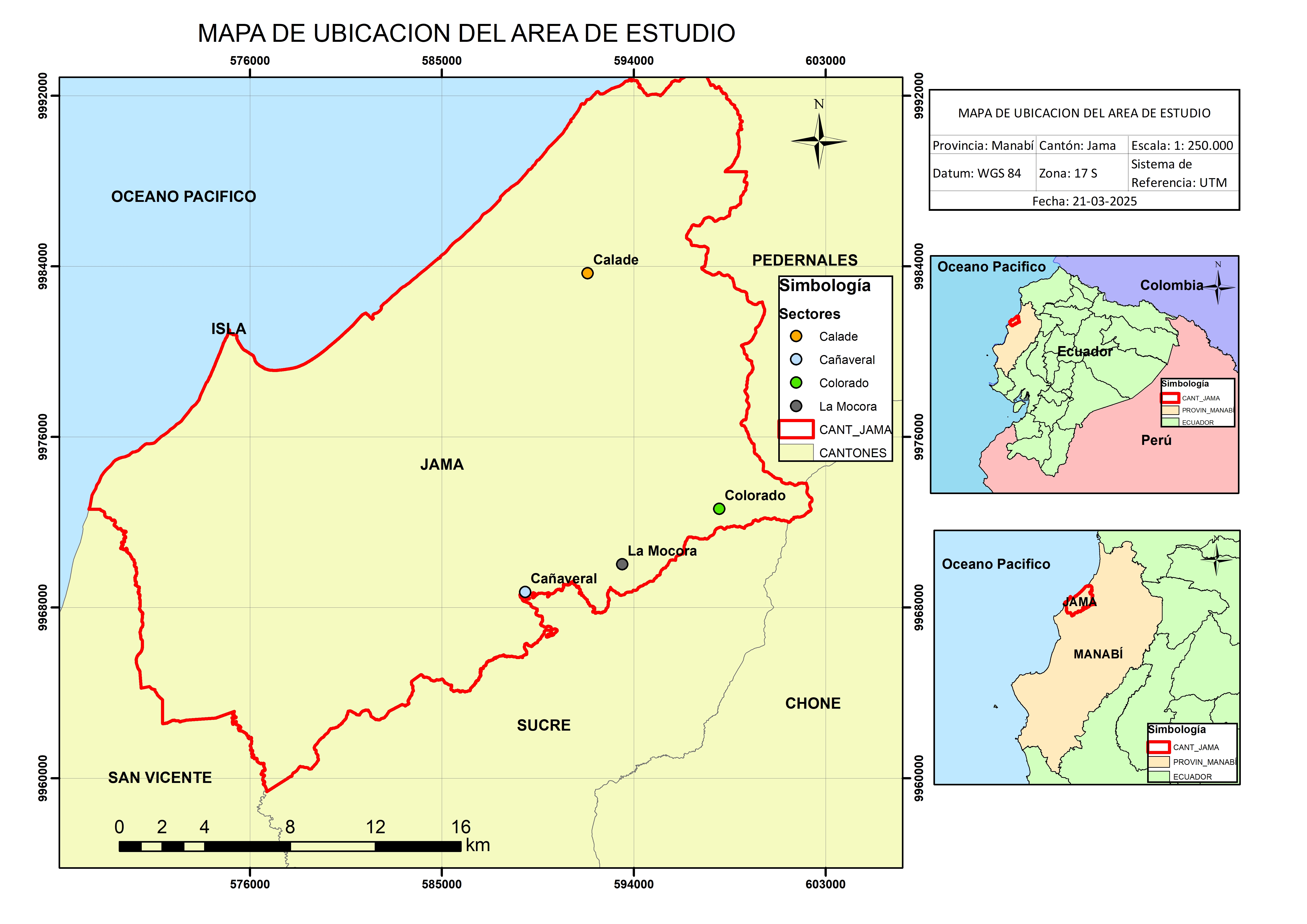
En las comunidades de La Mocora, Colorado, Calade y Cañaveral, del cantón Jama (Manabí, Ecuador), se realizó un estudio etnobiológico para analizar las interacciones socioecológicas y documentar la transmisión de conocimientos tradicionales sobre el uso de la biodiversidad. Se aplicaron entrevistas semiestructuradas a 190 personas, considerando variables como edad, género y nivel educativo, así como indicadores de valor de uso y frecuencia. La mayoría de los participantes tenían entre 46 y 55 años, con predominio masculino del 75 % en Colorado y mayor equilibrio de género en Calade. Más del 50 % de los habitantes de Colorado y Cañaveral carecen de educación formal, predominando la educación primaria en La Mocora. Se identificaron 23 especies vegetales utilizadas con fines alimenticios, medicinales y culturales, siendo Citrus reticulata la más mencionada (13,33 %), seguida de Eucalyptus globulus y Passiflora edulis. Además, se registró el uso de 14 especies animales, entre ellas Gallus gallus, Oryctolagus cuniculus, Anas platyrhynchos y Ortalis erythroptera, con variaciones entre comunidades: en Colorado se prefirió el pato, en Calade el conejo y en La Mocora y Cañaveral la gallina. El 75 % de los encuestados recolectó recursos a menos de 500 metros de sus viviendas. Los resultados evidencian un conocimiento integral del entorno natural y una estrecha relación entre biodiversidad y prácticas culturales, destacando la importancia de fortalecer la transmisión intergeneracional de saberes e integrar estrategias de conservación con la preservación del patrimonio biocultural de las comunidades locales.
Descargas
Métricas
Detalles del artículo

Esta obra está bajo una licencia internacional Creative Commons Atribución-NoComercial 4.0.
Los autores que publican en Siembra conocen y aceptan las siguientes condiciones:
- Los autores retienen los derechos de copia (copyright) y ceden a Siembra el derecho de primera publicación del trabajo, bajo licencia Creative Commons Attribution License, que permite a terceros utilizar lo publicado siempre que hagan referencia al autor o autores del trabajo y a su publicación en esta revista.
 Esta obra está bajo una Licencia Creative Commons Reconocimiento-NoComercial 4.0 Internacional (CC BY-NC 4.0).
- Los autores conservan los derechos de autor y garantizan a Siembra el derecho de publicar el manuscrito a través de los canales que considere adecuados.
- Los autores pueden establecer por su cuenta acuerdos adicionales para la distribución no exclusiva de la versión de la obra publicada en Siembra, haciendo reconocimiento de su publicación inicial en la misma, como por ejemplo en repositorios institucionales.
Se autoriza a los autores a difundir sus trabajos electrónicamente una vez sea aceptado el manuscrito para su publicación.




Citas
Bánki, O., Roskov, Y., Döring, M., Ower, G., Hernández Robles, D. R., Plata Corredor, C. A., Stjernegaard Jeppesen, T., Örn, A., Pape, T., Hobern, D., Garnett, S., Little, H., DeWalt, R. E., Ma, K., Miller, J., Orrell, T., Aalbu, R., Abbott, J., Aedo, C., et al. (2024). Catalogue of Life (Versión 2024-12-19). Catalogue of Life, Amsterdam, Netherlands. https://doi.org/10.48580/dglq4
Barahona, A., y Almeida-Leñero, L. (2005). Educación para la conservación. Universidad Nacional Autónoma de México. https://librosoa.unam.mx/handle/123456789/253
Berkes, F., Colding, J., y Folke, C. (2000). Rediscovery of Traditional Ecological Knowledge as Adaptive Management. Ecological Applications, 10(5), 1251-1262. https://doi.org/10.2307/2641280 DOI: https://doi.org/10.1890/1051-0761(2000)010[1251:ROTEKA]2.0.CO;2
Bermúdez del Sol, A., Cárdenas Pazmiño, Á., y Neira Briones, J. (2022). Uso tradicional de las plantas medicinales por la población del Cantón Salcedo, Cotopaxi, Ecuador. Archivos Venezolanos de Farmacología y Terapéutica, 41(3), 208–215. https://doi.org/10.5281/zenodo.6743038
Brito, J., Camacho, M. A., Romero, V., y Vallejo, A. F. 2023. Mamíferos del Ecuador. Versión 2023.0. Museo de Zoología, Pontificia Universidad Católica del Ecuador. https://bioweb.bio/faunaweb/mammaliaweb/
Carranza Patiño, H. M., Tubay Moreira, M. F., Espinoza Briones, H. B., y Chang Muñoz, W. L. (2021). Saberes ancestrales: una revisión para fomentar el rescate y revalorización en las comunidades indígenas del Ecuador. Journal of Science and Research, 6(3), 112–128. https://revistas.utb.edu.ec/index.php/sr/article/view/1205
Fernández-Cusimamani, E., Espinel-Jara, V., Gordillo Alarcón, S., Castillo Andrade, R. E., Žiarovská, J., Zepeda-Del Valle. J. M., y Lara-Reimers, E. A. (2019). Estudio etnobotánico de plantas medicinales utilizadas en tres cantones de la provincia Imbabura, Ecuador. Agrociencia, 53, 797-810. https://agrociencia-colpos.org/index.php/agrociencia/article/view/1844
Freile, J. F., y Poveda, C. 2019. Aves del Ecuador. Versión 2019.0. Museo de Zoología, Pontificia Universidad Católica del Ecuador. https://bioweb.bio/faunaweb/avesweb
Guerra, A. M. N. de M., Silva, P. S., Sá, H. T. S. de, Santos, D. S. dos, Medeiros, A. C. de, y Coelho, D. C. (2016). Uso de plantas com fins medicinais no Município de Barra – BA. Revista Verde de Agroecologia e Desenvolvimento Sustentável, 11(2), 08-15. https://doi.org/10.18378/rvads.v11i2.4244 DOI: https://doi.org/10.18378/rvads.v11i2.4244
Hagberg, A. A., Schult, D. A., y Swart, P. J. (2008). Exploring network structure, dynamics, and function using NetworkX. En G. Varoquaux, T. Vaught, y J. Millman (eds), Proceedings of the 7th Python in Science Conference (SciPy2008) (pp. 11–15). https://doi.org/10.25080/TCWV9851 DOI: https://doi.org/10.25080/TCWV9851
Hashemi, R., Darabi, H., Hashemi, M., y Wang, J. (2024). Graph theory in ecological network analysis: A systematic review for connectivity assessment. Journal of Cleaner Production, 472, 143504. https://doi.org/10.1016/j.jclepro.2024.143504 DOI: https://doi.org/10.1016/j.jclepro.2024.143504
Hernández-Robles, D., Plata, C., Döring, M., y Bánki, O. (2023). Towards a more comprehensive catalogue of life checklist. Biodiversity Information Science and Standards, 7. e111684 https://doi.org/10.3897/biss.7.111684 DOI: https://doi.org/10.3897/biss.7.111684
Hunter, J. D. (2007). Matplotlib: A 2D Graphics Environment. Computing in Science & Engineering, 9(3), 90–95. https://doi.org/10.1109/MCSE.2007.55 DOI: https://doi.org/10.1109/MCSE.2007.55
Jiménez González, A., Pincay Alcivar, F. A., Ramos Rodríguez, M. P., Mero Jalca, O. F., y Cabrera Verdesoto, C. A. (2017). Utilización de productos forestales no madereros por pobladores que conviven en el bosque seco tropical. Revista Cubana de Ciencias Forestales, 5(3), 270–286. https://cfores.upr.edu.cu/index.php/cfores/article/view/264
Jiménez-González, A., Macías-Ruiz, K., Sánchez-Cisneros, E., y Pionce-Andrade, G. (2022). Utilización de especies vegetales en los recintos San Ramón y Sántima del cantón Quinindé – Esmeraldas. Bosques Latitud Cero, 12(2), 26–39. https://doi.org/10.54753/blc.v12i2.1606 DOI: https://doi.org/10.54753/blc.v12i2.1606
Jiménez-González, A., Mora Zamora, K. J., Rosete Blandariz, S., y Cabrera Verdesoto, C. A. (2021). Utilización de plantas medicinales en cuatro localidades de la zona sur de Manabí, Ecuador. Siembra, 8(2), e3223. https://doi.org/10.29166/siembra.v8i2.3223 DOI: https://doi.org/10.29166/siembra.v8i2.3223
Lima López, Y., Guzmán Guzmán, V., López Linares, Y., y Satchwell Robinson, R. (2019). La medicina tradicional herbolaria en los sistemas de salud convencionales. Humanidades Médicas, 19(1), 201-217. http://scielo.sld.cu/scielo.php?script=sci_arttext&pid=S1727-81202019000100201&lng=es&tlng=es
López-Tobar, R., Herrera-Feijoo, R. J., Mateo, R. G., García-Robredo, F., y Torres, B. (2023). Botanical collection patterns and conservation categories of the most traded timber species from the Ecuadorian Amazon: The role of protected areas. Plants, 12(18), 3327. https://doi.org/10.3390/plants12183327 DOI: https://doi.org/10.3390/plants12183327
Manzano-García, J., Jiménez-Escobar, N. D., Martínez, G. J., & Luján, C. (2023). Usos medicinales y alimenticios de flora introducida en el Chaco Seco argentino: Contrastes entre el conocimiento local y el científico. Boletín Latinoamericano y del Caribe de Plantas Medicinales y Aromáticas, 22(4), 508-523. https://doi.org/10.37360/blacpma.23.22.4.38 DOI: https://doi.org/10.37360/blacpma.23.22.4.38
Martínez-López, G., Guízar Nolazco, E., Villanueva Morales, A., y Palacios-Rangel, M. I. (2021). Usos locales y tradición: estudio etnobotánico de plantas útiles en San Pablo Cuatro Venados (Valles Centrales, Oaxaca). Polibotánica, (52), 194-212. https://doi.org/10.18387/polibotanica.52.13 DOI: https://doi.org/10.18387/polibotanica.52.13
Millán-Rojas, L., Arteaga-Reyes, T. T., Moctezuma-Pérez, S., Velasco-Orozco, J. J., y Arzate-Salvador, J. C. (2016). Conocimiento Ecológico Tradicional de la Biodiversidad de Bosques en una comunidad Matlatzinca, México. Ambiente y Desarrollo, 20(38), 111. https://doi.org/10.11144/Javeriana.ayd20-38.cetb DOI: https://doi.org/10.11144/Javeriana.ayd20-38.cetb
Ministerio del Ambiente del Ecuador [MAE]. (2015). Estrategia Nacional de Biodiversidad del Ecuador 2015-2030. Ministerio del Ambiente del Ecuador. http://maetransparente.ambiente.gob.ec/documentacion/WebAPs/Estrategia%20Nacional%20de%20Biodiversidad%202015-2030%20-%20CALIDAD%20WEB.pdf
Olvera Cuessy, I. (2022). Género y generación en usos y conocimientos ancentrales y actuales de la herbolaria en la Sierra Nevada Poblana. Colegio de Postgraduados. http://193.122.196.39:8080/xmlui/handle/10521/4853
Organización Mundial de la Salud [OMS]. (2019). Medicina tradicional: definiciones. OMS. https://www.who.int/es/news-room/questions-and-answers/item/traditional-medicine
Peñarrieta Carranza, W. A. (2013). Diseño de una ruta turística Playa Verde, entre los cantones San Vicente–Jamas–Pedernales, provincia de Manabí Escuela Superior Politécnica Agropecuaria de Manabí. https://biblioteca.espam.edu.ec/cgi-bin/koha/opac-detail.pl?biblionumber=3456&shelfbrowse_itemnumber=4891
Pérez, M., M., Sueiro, O., M. L., Boffill, C., M. D. L. A., Moron, R, F., Marrero, F, E., Rodriguez R, M., Méndez, O., M. y González, M, D. M. (2011). Estudio etnobotánico de las plantas más utilizadas como diuréticas en la Provincia de Villa Clara, Cuba. Boletín Latinoamericano y del Caribe de Plantas Medicinales y Aromáticas, 10(1), 46-55. https://www.redalyc.org/articulo.oa?id=85618182006
R Core Team. (2023). R: A language and environment for statistical computing. R Foundation for Statistical Computing. https://www.R-project.org/
Sánchez-Capa, M., Corell González, M., y Mestanza-Ramón, C. (2023). Edible fruits from the Ecuadorian Amazon: Ethnobotany, physicochemical characteristics, and bioactive components. Plants, 12(20), 3635. https://doi.org/10.3390/plants12203635 DOI: https://doi.org/10.3390/plants12203635
Santes Hernández, I. (2018). Identificación de especies vegetales de interés antropocéntrico como alternativa sustentable en un ejido de Rayones, Nuevo León, México. Universidad Autónoma de Nuevo León. http://eprints.uanl.mx/16029/
Tirira, D., y Solórzano, M. F. (2025). Mamíferos ecuatorianos depositados en museos de historia natural y colecciones científicas: 9. La Academia de Ciencias de California. Revista Ecuatoriana de Medicina y Ciencias Biológicas, 46(1). https://doi.org/10.26807/remcb.v46i1.1038 DOI: https://doi.org/10.26807/remcb.v46i1.1038
Toledo, V. M., y Barrera Bassols, N. (2009). La memoria biocultural. La importancia ecológica de las sabidurías tradicionales. Ciencias, 96(096). https://www.revistas.unam.mx/index.php/cns/article/view/17958
Toro Chacon, L. C., Robles Valderrama, N. R. F., Trigos Aguilera, D. F., Trujillo González, J. M., y Torres Mora, M. A. (2019). Uso de los recursos de la biodiversidad: estudio de caso de la oleorresina de copaiba (copaifera spp.) en la medicina tradicional en el departamento del Meta - Colombia. Revista de Investigación Agraria y Ambiental, 11(1), 53–64. https://doi.org/10.22490/21456453.3091 DOI: https://doi.org/10.22490/21456453.3091
Torres, M., Paz, K., y Salazar, F. (2006). Tamaño de una muestra para una investigación de mercado. Boletín Electrónico. https://fgsalazar.net/LANDIVAR/ING-PRIMERO/boletin02/URL_02_BAS02.pdfik
Tropicos.org. (2025). Jardín Botánico de Missouri. http://www.tropicos.org/Name/13006413
Vanegas Romero, M. Á., Chitiva, L. C., Bravo-Chaucanés, C. P., Hernández, A. X., Parra-Giraldo, C. M., y Costa, G. M. (2023). Black-eyed Susan vine (Thunbergia alata): chemical and antifungal potential evaluation of an invasive plant species in Colombia. Universitas Scientiarum, 28(2), 217–229. https://doi.org/10.11144/Javeriana.SC282.besv DOI: https://doi.org/10.11144/Javeriana.SC282.besv
Zeni, A. L., y Bosio, F. (2011). O uso de plantas medicinais em uma comunidade rural de Mata Atlântica – Nova Rússia, SC. Neotropical Biology and Conservation, 6(1), 55–63. https://doi.org/10.4013/nbc.2011.61.07 DOI: https://doi.org/10.4013/nbc.2011.61.07
Zent, S. (2009) Traditional ecological knowledge (TEK) and biocultural diversity: a close-up look at linkages, delearning trends & changing patterns of transmission. En P. Bates, M. Chiba, S. Kube y D. Nakashima (eds.), Learning and Knowing in Indigenous Societies Today. (pp. 39-57) UNESCO. https://unesdoc.unesco.org/ark:/48223/pf0000180754