
In vitro effect of native Trichoderma spp. strains on Sclerotium sp. and Fusarium sp.
Article Sidebar
Main Article Content
Abstract
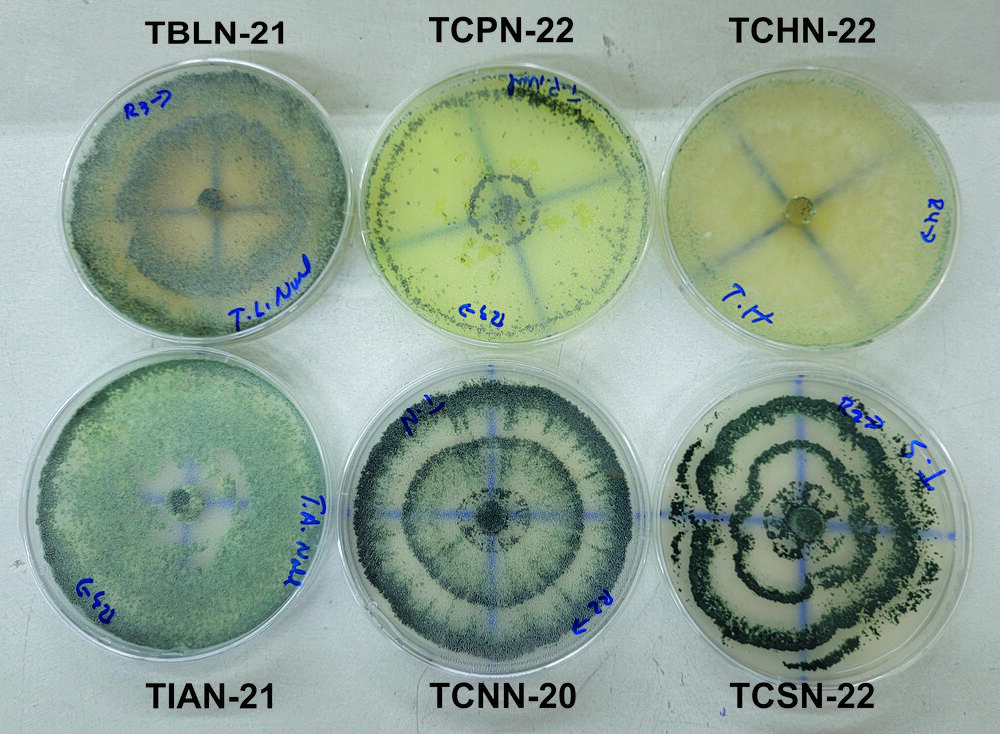
The search for biological control alternatives against plant pathogens has increased in recent years. This study aimed to determine the biological control efficiency of six native strains of Trichoderma spp. isolated from different ecosystems, against Sclerotium sp. and Fusarium sp. Strains of Trichoderma spp. were isolated from Persea americana, Coffea arabica, Passiflora edulis, Mangifera indica, Saccharum officinarum, Citrus spp., while two pathogens Sclerotium sp. and Fusarium sp., were extracted from Solanum lycopersicum. The isolates were cultured on PDA medium and incubated at 27 °C. Fungal identification was performed using taxonomic keys. The experiment followed a completely randomized design with six treatments and five replications, where the radial growth, antagonism and antibiosis of Trichoderma spp. on pathogens were quantified. Data were analyzed using analysis of variance and Tukey’s mean separation test (p < 0.05). The results showed that the native Trichoderma spp. strain (TCHN-22) exhibited the highest radial growth. However, strains TIAN-21, TBLN-21 and TCRN-20 were found to inhibit the growth of Sclerotium sp., while strains TCHN-22 and TCPN-22 exhibited enhanced control of Fusarium sp. Regarding antagonistic activity, strains TIAN-21 and TCSN-22 showed higher levels, whereas the strains TCPN-22 and TBLN-21 stood out in terms of antibiosis. These findings suggest that native strains represent a viable alternative for biological control of both pathogens.
Downloads
Metrics
Article Details

This work is licensed under a Creative Commons Attribution-NonCommercial 4.0 International License.
The authors who publish in Siembra know and accept the following conditions:
- Authors retain the copyright and grant Siembra the right of first publication of the work, under the Creative Commons Attribution License. Third parties are allowed to use what has been published as long as they refer to the author or authors of the work and its publication in this journal.
 This content is licensed under a Creative Commons Attribution-Noncommercial 4.0 International (CC BY-NC 4.0).
- Authors maintain the copyright and guarantee Siembra the right to publish the manuscript through the channels it considers appropriate.
- Authors may establish on their own additional agreements for the non-exclusive distribution of the version of the work published in Siembra, acknowledging their initial publication in the same, such as in institutional repositories.
- Authors are authorized to disseminate their work electronically once the manuscript is accepted for publication.




References
Adhikari, P., Shrestha, S. M., Manandhar, H. K., y Marahatta, S. (2022). Effect of Trichoderma isolates on Sclerotium rolfsii Sacc. Journal of Agriculture and Forestry University, 5, 299–310. https://doi.org/10.3126/jafu.v5i1.48478 DOI: https://doi.org/10.3126/jafu.v5i1.48478
Aguilar-Anccota, R., Arévalo-Quinde, C. G., Morales-Pizarro, A., y Galecio-Julca, M. (2021). Fungi associated with necrosis of vascular bundles in organic banana crop: Symptoms, isolation and identification, and integrated management alternatives. Scientia Agropecuaria, 12(2), 249–256. https://doi.org/10.17268/SCI.AGROPECU.2021.028 DOI: https://doi.org/10.17268/sci.agropecu.2021.028
Ahluwalia, V., Kumar, J., Rana, V. S., Sati, O. P., y Walia, S. (2015). Comparative evaluation of two Trichoderma harzianum strains for major secondary metabolite production and antifungal activity. Natural Product Research, 29(10), 914–920. https://doi.org/10.1080/14786419.2014.958739 DOI: https://doi.org/10.1080/14786419.2014.958739
Álvarez-García, S., Mayo-Prieto, S., Gutiérrez, S., y Casquero, P. A. (2020). Self-inhibitory activity of Trichoderma soluble metabolites and their antifungal effects on Fusarium oxysporum. Journal of Fungi, 6(3), 1–11. https://doi.org/10.3390/jof6030176 DOI: https://doi.org/10.3390/jof6030176
Andrade Hoyos, P., Luna Cruz, A., Osorio Hernández, E., Molina Gayosso, E., Landero Valenzuela, N., y Barrales Cureño, H. J. (2019). Antagonismo de Trichoderma spp. vs hongos asociados a la marchitez de chile. Revista Mexicana de Ciencias Agrícolas, 10(6), 1259–1272. https://doi.org/10.29312/remexca.v10i6.1326 DOI: https://doi.org/10.29312/remexca.v10i6.1326
Andrade-Hoyos, P., Silva-Rojas, H. V., y Romero-Arenas, O. (2020). Endophytic Trichoderma species isolated from Persea americana and Cinnamomum verum roots reduce symptoms caused by Phytophthora cinnamomi in avocado. Plants, 9(9), 1–17. https://doi.org/10.3390/plants9091220 DOI: https://doi.org/10.3390/plants9091220
Bell, D., Wells, H., y Markham, C. (1980). In vitro antagonism of Trichoderma species against six fungal plant pathogens. Ecology and Epidemiology, 72(4), 379–382. https://doi.org/DOI:10.1094/Phyto-72-379 DOI: https://doi.org/10.1094/Phyto-72-379
Cai, F., Chen, W., Wei, Z., Pang, G., Li, R., Ran, W., y Shen, Q. (2015). Colonization of Trichoderma harzianum strain SQR-T037 on tomato roots and its relationship to plant growth, nutrient availability and soil microflora. Plant and Soil, 388(1–2), 337–350. https://doi.org/10.1007/s11104-014-2326-z DOI: https://doi.org/10.1007/s11104-014-2326-z
Cubilla-Ríos, A. A., Ruíz-Díaz-Mendoza, D. D., Romero-Rodríguez, M. C., Flores-Giubi, M. E., y Barúa-Chamorro, J. E. (2019). Antibiosis of proteins and metabolites of three species of Trichoderma against paraguayan isolates of Macrophomina phaseolina. Agronomia Mesoamericana, 30(1), 63–77. https://doi.org/10.15517/am.v30i1.34423 DOI: https://doi.org/10.15517/am.v30i1.34423
del Carmen H. Rodríguez, M., Evans, H. C., de Abreu, L. M., de Macedo, D. M., Ndacnou, M. K., Bekele, K. B., y Barreto, R. W. (2021). New species and records of Trichoderma isolated as mycoparasites and endophytes from cultivated and wild coffee in Africa. Scientific Reports, 11(1). https://doi.org/10.1038/s41598-021-84111-1 DOI: https://doi.org/10.1038/s41598-021-84111-1
Dennis, C., y Webster, J. (1971a). Antagonistic properties of species-groups of Trichoderma. Transactions of the British Mycological Society, 57(1), 25-IN3. https://doi.org/10.1016/S0007-1536(71)80077-3 DOI: https://doi.org/10.1016/S0007-1536(71)80077-3
Dennis, C., y Webster, J. (1971b). Antagonistic properties of species-groups of Trichoderma. Transactions of the British Mycological Society, 57(3), 363-IN2. https://doi.org/10.1016/S0007-1536(71)80050-5 DOI: https://doi.org/10.1016/S0007-1536(71)80050-5
Duarte Leal, Y., Coca, B. M., Filho, A. C. C., Luiz, I., y Blum, E. B. (2020). Caracterización fisio-cultural y compatibilidad micelial de aislamientos de Sclerotium sp. procedentes de siete hospedantes. Revista de Protección Vegetal, 35(1), 2224–4697. https://censa.edicionescervantes.com/index.php/RPV/article/view/1086
Duarte-Leal, Y., Pozo-Martínez, L., y Martínez-Coca, B. (2018). Antagonismo in vitro de cepas de Trichoderma asperellum Samuels, Lieckfeldt & Nirenberg frente a aislados de Fusarium spp. Revista de Protección Vegetal, 33(1), 2224–4697. http://scielo.sld.cu/scielo.php?script=sci_arttext&pid=S1010-27522018000100005&lng=es&nrm=iso
El-Komy, M. H., Saleh, A. A., Eranthodi, A., y Molan, Y. Y. (2015). Characterization of novel Trichoderma asperellum isolates to select effective biocontrol agents against tomato Fusarium wilt. The Plant Pathology Journal, 31(1), 50–60. https://doi.org/10.5423/PPJ.OA.09.2014.0087 DOI: https://doi.org/10.5423/PPJ.OA.09.2014.0087
French, E., y Herbert, T. (1982). Métodos de investigación fitopatológica. IICA.
Garrido, M., y Vilela, N. (2019). Antagonistic capacity of Trichoderma harzianum compared to Rhizotecnia, Nakataea sigmoidea, Sclerotium rolfsii and its effect in native strains of Trichoderma isolated form rice crops. Scientia Agropecuaria, 10(2), 199–206. https://doi.org/10.17268/sci.agropecu.2019.02.05 DOI: https://doi.org/10.17268/sci.agropecu.2019.02.05
Guedez, C., Cañizalez, L., Castillo, C., y Olivar, R. (2012). Evaluación in vitro de aislamientos de Trichoderma harzianum para el control de Rhizoctonia solani, Sclerotium rolfsii y Fusarium oxysporum en plantas de tomate. Revista de La Sociedad Venezolana de Microbiología, 32(1), 44–49. http://ve.scielo.org/scielo.php?script=sci_arttext&pid=S1315-25562012000100009&lng=es&tlng=es
Hernández, F. D., Flores, W., Castillo, F., Gallegis, G., y Castro, E. (2014). Antibiosis in vitro of Trichoderma strains metabolic extract on mycelial growth and reproductive capacity of Fusarium oxysporum isolated from pepper plants (Capsicum annuum L.). British Biotechnology, 4(4), 387–399. https://journalbji.com/index.php/BJI/article/view/516/1037 DOI: https://doi.org/10.9734/BBJ/2014/7341
Khan, R. A. A., Najeeb, S., Hussain, S., Xie, B., y Li, Y. (2020). Bioactive secondary metabolites from Trichoderma spp. against phytopathogenic fungi. Microorganisms, 8(6), 817. https://doi.org/10.3390/microorganisms8060817 DOI: https://doi.org/10.3390/microorganisms8060817
Lezcano Escobar, R. N., Cubilla Ríos, A. A., Flores Giubi, M. E., y Barúa Chamorro, J. E. (2018). Producción de metabolitos por aislados nativos de Trichoderma spp. y su actividad antifúngica frente a Rhizoctonia solani y Sclerotinia sclerotiorum, patógenos del pimiento (Capsicum annuum var. Natalie). En Jornadas de Jóvenes Investigadores AUGM. Mendoza. https://bdigital.uncu.edu.ar/fichas.php?idobjeto=12847
Mahato, A. (2017). Effect of age on susceptibility of tomato plants to Sclerotium Rolfsii (Sacc.) caused collar rot disease. International Journal of Pure & Applied Bioscience, 5(6), 1108–1112. https://doi.org/10.18782/2320-7051.5843 DOI: https://doi.org/10.18782/2320-7051.5843
Martínez, F. E., Andrade, G., Hernández, E., Hernández, L., Holguín, R., y Rueda, E. (2019). Antisuero vs hongos fitopatógenos en el cultivo de tomate en Sonora, México. Revista Mexicana de Ciencias Agrícolas, 10(4), 873–884. https://www.scielo.org.mx/scielo.php?script=sci_arttext&pid=S2007-09342019000400873 DOI: https://doi.org/10.29312/remexca.v10i4.1706
Martínez-Coca, B., Infante, D., Caraballo, W., Duarte-Leal, Y., y Echevarría-Hernández, A. (2018). Antagonismo de cepas de Trichoderma asperellum Samuels, Lieckfeldt & Nirenberg frente a aislamientos de Fusarium spp. procedentes de garbanzo. Revista de Protección Vegetal, 33(2). https://www.censa.edicionescervantes.com/index.php/RPV/article/view/962
Matroudi, Z., y Motallebi, M. (2009). Antagonistic effects of three species of Trichoderma sp. on Sclerotinia sclerotiorum, the causal agent of canola stem rot. Egyptian Journal of Biology, 11(1), 37–44. https://doi.org/DOI:10.4314/ejb.v11i1.56560
Michel-Aceves, A. C., Otero-Sánchez, M. A., Ariza-Flores, R., Barrios-Ayala, A., y Alarcón-Cruz, N. (2013). Eficiencia biológica de cepas nativas de Trichoderma spp., en el control de Sclerotium rolfsii Sacc., en cacahuate. Revista de Investigación y Difusión Científica Agropecuaria, 17(3), 89–107. http://ww.ucol.mx/revaia/pdf/2013/sept/7.pdf
Miguel-Ferrer, L., Romero-Arenas, O., Andrade-Hoyos, P., Sánchez-Morales, P., Rivera-Tapia, J. A., y Fernández-Pavía, S. P. (2021). Antifungal activity of Trichoderma harzianum and T. koningiopsis against Fusarium solani in seed germination and vigor of Miahuateco chili seedlings. Revista Mexicana de Fitopatología, 39(2), 228-247. https://doi.org/10.18781/r.mex.fit.2101-5 DOI: https://doi.org/10.18781/R.MEX.FIT.2101-5
R Core Team. (2023). R: A language and environment for statistical computing. R Foundation for Statistical Computing, https://www.R-project.org/
Rodríguez-García, D., y Wang-Wong, A. (2020). Efectividad a nivel in vitro de Trichoderma spp. Nativos e importados contra Fusarium oxysporum. Agronomía Costarricense, 44(2), 109–125. http://dx.doi.org/10.15517/rac.v44i2.43096 DOI: https://doi.org/10.15517/rac.v44i2.43096
Sánchez Miranda, M. D. (2022). Evaluación del potencial de aislados de Trichoderma spp. como inhibidor a nivel in vitro del crecimiento de tres aislados del género Fusarium spp. Nexo Revista Científica, 35(02), 425–432. https://doi.org/10.5377/nexo.v35i02.14618 DOI: https://doi.org/10.5377/nexo.v35i02.14618
Sánchez-Montesinos, B., Santos, M., Moreno-Gavíra, A., Marín-Rodulfo, T., Gea, F. J., y Diánez, F. (2021). Biological control of fungal diseases by Trichoderma aggressivum f. Europaeum and its compatibility with fungicides. Journal of Fungi, 7(8), 598. https://doi.org/10.3390/jof7080598 DOI: https://doi.org/10.3390/jof7080598
Sanoubar, R., y Barbanti, L. (2017). Fungal diseases on tomato plant under greenhouse condition. European Journal of Biological Research, 7(4), 299–308. https://doi.org/10.5281/zenodo.1011161
Stefanova, M., Leiva, A., Larrinaga, L., y Coronado, M. (1999). Actividad metabólica de cepas de Trichoderma spp para el control de hongos fitopatógenos del suelo. Revista de la Facultad de Agronomía de la Universidad del Zulia, 16(5), 509–516. https://www.revfacagronluz.org.ve/v16_5/v165z006.html
Tang, G. T., Li, Y., Zhou, Y., Zhu, Y. H., Zheng, X. J., Chang, X. L., Zhang, S. R., y Gong, G. S. (2022). Diversity of Trichoderma species associated with soil in the Zoige alpine wetland of Southwest China. Scientific Reports, 12(1). https://doi.org/10.1038/s41598-022-25223-0 DOI: https://doi.org/10.1038/s41598-022-25223-0
Zapata-Narváez, Y. A., y Gómez-Marroquín, M. R. (2022). Control of Sclerotium cepivorum and growth promotion in garlic (Allium sativum) with antagonist microorganisms. Agronomia Mesoamericana, 33(2), 46462. https://doi.org/10.15517/am.v33i2.46462 DOI: https://doi.org/10.15517/am.v33i2.46462
Zazueta Torres, N. D., Ayala Tafoya, F., González Morales, S., Velázquez Alcaraz, T. de J., Yáñez Juaréz, M. G., y Partida Ruvalcaba, L. (2021). Crecimiento in vitro de Sclerotium rolfsii en respuesta a la calidad de luz de tres tipos de lámparas fluorescentes. Revista Mexicana de Ciencias Agrícolas, 12(1), 141–147. https://doi.org/https://doi.org/10.29312/remexca.v12i1.2313 DOI: https://doi.org/10.29312/remexca.v12i1.2313
Zhu, L., Zhao, X., Wang, C., Wang, J., Wang, P., y Tian, C. (2022). Trichoderma affects plant growth and soil ecological environment: A review. Zemdirbyste, 109(4), 341–348. https://doi.org/10.13080/z-a.2022.109.044 DOI: https://doi.org/10.13080/z-a.2022.109.044
Zin, N. A., y Badaluddin, N. A. (2020). Biological functions of Trichoderma spp. for agriculture applications. Annals of Agricultural Sciences, 65(2), 168–178. https://doi.org/10.1016/j.aoas.2020.09.003 DOI: https://doi.org/10.1016/j.aoas.2020.09.003