Rediseño de un sendero interpretativo turístico para la observación de anfibios y aplicación de herramientas lúdicas evaluativas en la empresa de biocomercio Wikiri, cantón Rumiñahui
Barra lateral del artículo
Contenido principal del artículo
Resumen
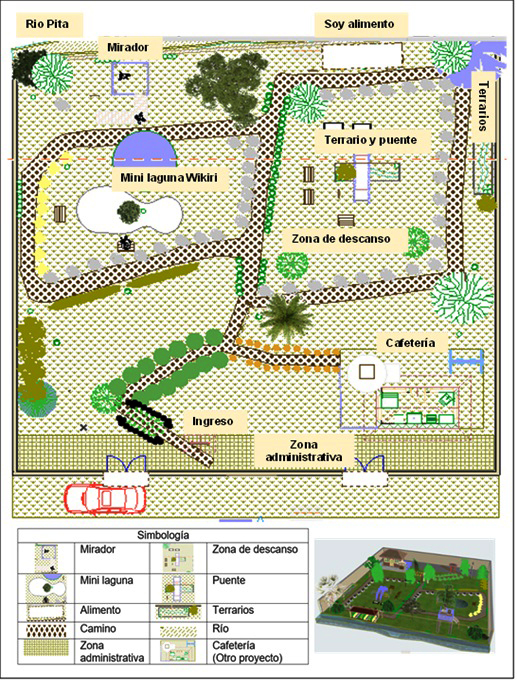
El presente trabajo de investigación muestra los resultados de dos propuestas turísticas para la empresa ecuatoriana Wikiri (empresa privada dedicada al biocomercio sostenible de especies de anfibios del Ecuador). La primera propuesta se enfoca en el rediseño del sendero de interpretación ambiental que existe actualmente en Wikiri para la observación de anfibios in situ; la segunda propuesta corresponde a la aplicación de herramientas lúdicas para identificar el nivel de captación de conocimientos adquiridos, por parte de los visitantes, después de efectuar los recorridos en el centro de investigación, con el objetivo de generar conciencia sobre la conservación ambiental. La investigación se llevó a cabo bajo el enfoque mixto cualitativo y cuantitativo, con la aplicación de encuesta, entrevistas, búsqueda bibliográfica y visitas de campo. Se obtuvieron 92 respuestas de personas que visitaron las instalaciones de Wikiri. Los resultados obtenidos evidencian el diagnóstico de las visitas del público a la empresa, determinando el perfil e interés del visitante, el estado actual del sendero, para proponer su rediseño, y su respectiva señalética. Estos son puntos clave, en los cuales debe enfocarse la empresa para incrementar el número de visitas que recibe. Finalmente, se determinó cuáles son las herramientas lúdicas idóneas para aplicarlas dentro de Wikiri Sapoparque y evaluar el conocimiento adquirido por sus visitantes.
Descargas
Métricas
Detalles del artículo

Esta obra está bajo una licencia internacional Creative Commons Atribución-NoComercial 4.0.
Los autores que publican en Siembra conocen y aceptan las siguientes condiciones:
- Los autores retienen los derechos de copia (copyright) y ceden a Siembra el derecho de primera publicación del trabajo, bajo licencia Creative Commons Attribution License, que permite a terceros utilizar lo publicado siempre que hagan referencia al autor o autores del trabajo y a su publicación en esta revista.
 Esta obra está bajo una Licencia Creative Commons Reconocimiento-NoComercial 4.0 Internacional (CC BY-NC 4.0).
- Los autores conservan los derechos de autor y garantizan a Siembra el derecho de publicar el manuscrito a través de los canales que considere adecuados.
- Los autores pueden establecer por su cuenta acuerdos adicionales para la distribución no exclusiva de la versión de la obra publicada en Siembra, haciendo reconocimiento de su publicación inicial en la misma, como por ejemplo en repositorios institucionales.
Se autoriza a los autores a difundir sus trabajos electrónicamente una vez sea aceptado el manuscrito para su publicación.




Citas
Arias González, M. C., Lina Manjarre, P., y Márquez Linar, M. A. (2019). Descripción de la apropiación del paisaje por parte del visitante de Cancún (México). Estudios y Perspectivas en Turismo, 28(2), 526-550. https://www.estudiosenturismo.com.ar/PDF/V28/N02/v28n2a15.pdf
Carranza, B. (2019). La ciudad que croaba. Ñan Magazine. https://www.nanmagazine.com/la-ciudad-que-croaba/
Céspedez, J. A., Zaracho, V. H., Álvarez, B. B., y Colombo, M. C. (2008). Diversidad de anfibios: su importancia en los ecosistemas y declinación de poblaciones. En S. L. Casco (comp.), Manual de Biodiversidad de Chaco, Corrientes y Formosa (pp. 125-135). Universidad Nacional del Nordeste. https://ri.conicet.gov.ar/handle/11336/123058
Cifuentes Cuichán, E. V. (2017). Diseño de la ruta turística de las cascadas en el cantón Rumiñahui - provincia de Pichincha. Universidad Central del Ecuador. http://www.dspace.uce.edu.ec/handle/25000/13400
García Gajardo, F., Fonseca Grandón, G., y Concha Gfell, L. (2015). Aprendizaje y rendimiento académico en educación superior: Un estudio comparado. Actualidades Investigativas en Educación, 15(3), 1-26. http://dx.doi.org/10.15517/aie.v15i3.21072 DOI: https://doi.org/10.15517/aie.v15i3.21072
Gil Álvarez, J. L., Morales Cruz, M. M., y Meza Salvatierra, M. J. (2017). La evaluación educativa como proceso histórico social. Perspectivas para el mejoramiento de la calidad de los sistemas educativos. Universidad y Sociedad, 9(4), 162-167. https://rus.ucf.edu.cu/index.php/rus/article/view/677
Gil Álvarez, J. L., Morales Cruz, M., y Chou Rodríguez, R. (2018). La actividad de estudio y el proceso de asimilación consciente de los conocimientos. ¿Están preparados los estudiantes universitarios?. Conrado, 14(62), 12-17. http://scielo.sld.cu/scielo.php?script=sci_arttext&pid=S1990-86442018000200002&lng=pt&tlng=es
Gobierno Autónomo Descentralizado del Cantón Rumiñahui. (2015). Plan de Desarrollo y Ordenamiento Territorial - Cantón Rumiñahui periodo 2012-2025. Actualización 2014-2019. Gobierno Autónomo Descentralizado del Cantón Rumiñahui. http://app.sni.gob.ec/sni-link/sni/PORTAL_SNI/data_sigad_plus/sigadplusdiagnostico/1760003920001_DOCUMENTO%20DIGANOSTICO_10-03-2015_19-55-43.pdf
Ministerio de Turismo [MINTUR]. (2017). Guía para el levantamiento de atractivos turísticos del Ecuador. MINTUR. https://servicios.turismo.gob.ec/descargas/InventarioAtractivosTuristicos/Parte2_GuiaLevantamientoDeAtractivosTuristicos2017_2daEd.pdf
Ojeda-Ojeda, D. M. (2014). Influencia de la atención y las estrategias de aprendizaje en el rendimiento académico. Universidad Internacional de La Rioja. https://reunir.unir.net/handle/123456789/2396
Parrales Rodríguez, S., y Solórzano Salas, J. (2014). Motivación y estrategias de aprendizaje del estudiantado de la escuela de orientación y educación especial. Actualidades Investigativas en Educación, 14(1), 1-20. http://dx.doi.org/10.15517/aie.v14i1.13201 DOI: https://doi.org/10.15517/aie.v14i1.13201
Pérez Ariza, K., y Hernández Sánchez, J. E. (2014). Aprendizaje y comprensión. Una mirada desde las humanidades. Humanidades Médicas, 14(3), 699-709. http://scielo.sld.cu/scielo.php?script=sci_arttext&pid=S1727-81202014000300010
Phillips, V. D., Tschida, R., Hernández, M., y Zárate Hernández, J. M. (2014). Manual para la modificación de senderos interpretativos en ecoturismo. Global Environmental Management. http://www.ecoingenieros.com.ar/lc/bibliografia/manual%20senderos%20interpretativos-mexico%20.pdf
Programa Nacional de Biocomercio Sostenible – Ecuador. (2005). Estrategia del Cacao Sabor “Arriba” 2006 - 2008. Biotrade. http://www.biotrade.org/resourcesnewsassess/ecuador-strategy-cocoaarriba.pdf
Rubio Hurtado, M. J., Vilà Baños, R., y Sánchez Martí, A. (2018). Una comunidad de práctica virtual para la transferencia del conocimiento entre la universidad y las organizaciones. Revista Tecnología, Ciencia y Educación, (10), 91-108. https://doi.org/10.51302/tce.2018.197 DOI: https://doi.org/10.51302/tce.2018.197
Vásquez Hidalgo, I. (2005). Tipos de estudio y métodos de investigación. Gestiopolis. https://www.gestiopolis.com/tipos-estudio-metodos-investigacion/
Wikiri. (2020a). Wikiri apoya la educación integral y la difusión de la ciencia para construir una relación armoniosa entre hombres, anfibios y naturaleza. Wikiri. http://www.wikiri.com.ec/educacion.html
Wikiri. (2020b). Wikiri y su producto EcuaFrog produce ranas en granjas para su comercio sustentable. Wikiri. http://www.wikiri.com.ec/productos/ecuafrog/index.html
Yánez, P. (2016). El proceso de aprendizaje: fases y elementos fundamentales. Revista San Gregorio, 1(11), 70-81. http://dx.doi.org/10.36097/rsan.v1i11.19