
Morphological characterization and growth analysis of three Helianthus annuus L. varieties for cutting flower
Article Sidebar
Main Article Content
Abstract
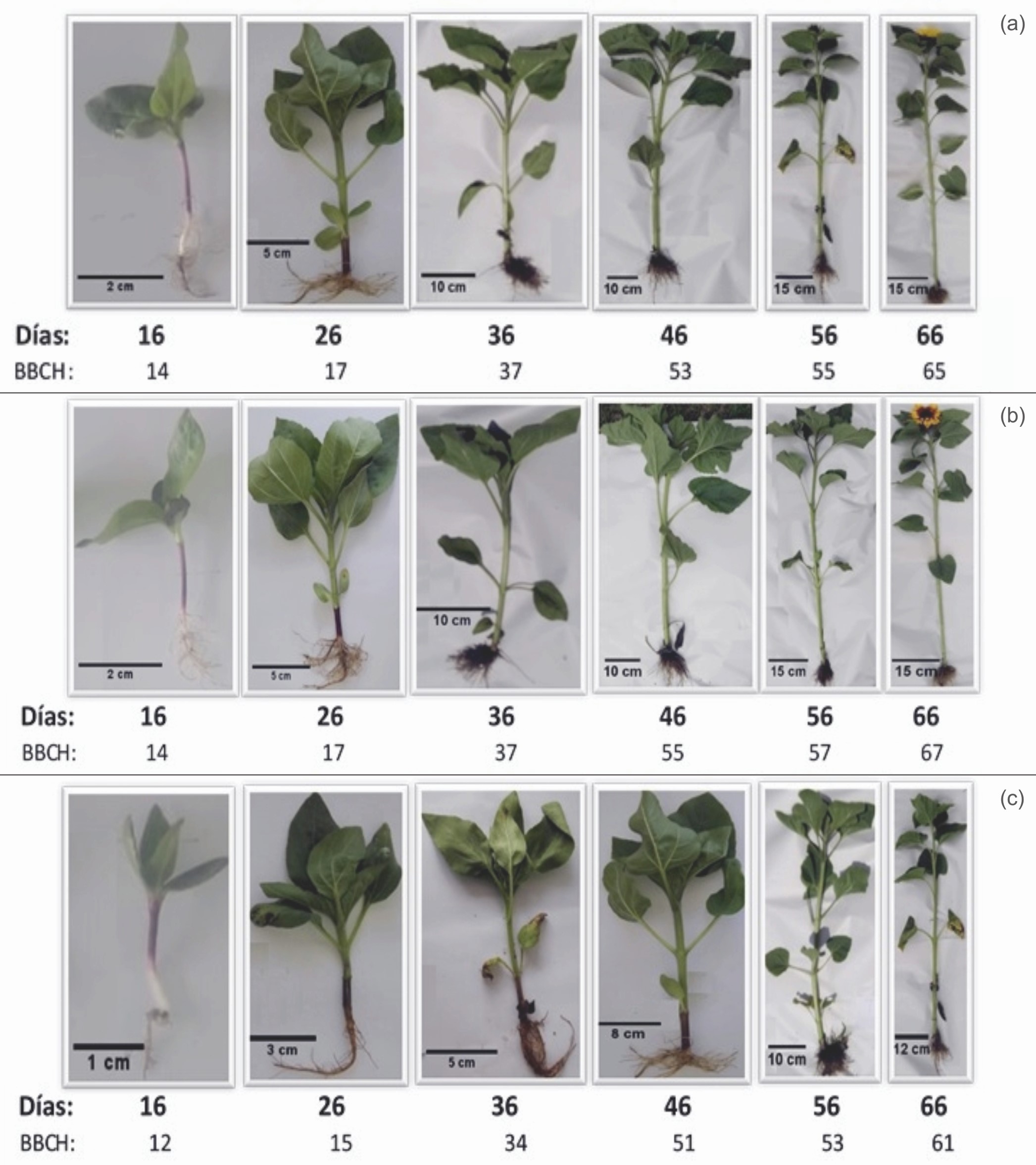
The aim of this study was to evaluate the flower morphological characteristics and analyze the growth parameters for cut-flower of three sunflower hybrid cultivars (Helianthus annuus L.), coming from open field cultivation. Hybrid cultivars Vicent Choice, Sunrich Orange and SM-373 were evaluated in a Complete Block Design with four replicates. The cycle of sunflower cultivation was finalized at 40% flower opening, which occurred at 53 days after planting for Vicent Choice, 55 days for Sunrich Orange and 63 days for SM-373. In this study, the three hybrid cultivars stem length average was 87.36 cm. The growth dynamic of the three varieties was adjusted to a quadratic model, in which the stem yielded in average 50.12% of dry matter, and the Vicent Choice hybrid cultivar recorded the highest total dry matter accumulation (42.54g). Flowering was the development stage with highest photosynthetic efficacy, the average foliar area index of the three varieties was 1.33 at 46 days after planting, and Vicent Choice produced 679 exportable stems, representing 70.72% of the study's total production.
Downloads
Metrics
Article Details

This work is licensed under a Creative Commons Attribution-NonCommercial 4.0 International License.
The authors who publish in Siembra know and accept the following conditions:
- Authors retain the copyright and grant Siembra the right of first publication of the work, under the Creative Commons Attribution License. Third parties are allowed to use what has been published as long as they refer to the author or authors of the work and its publication in this journal.
 This content is licensed under a Creative Commons Attribution-Noncommercial 4.0 International (CC BY-NC 4.0).
- Authors maintain the copyright and guarantee Siembra the right to publish the manuscript through the channels it considers appropriate.
- Authors may establish on their own additional agreements for the non-exclusive distribution of the version of the work published in Siembra, acknowledging their initial publication in the same, such as in institutional repositories.
- Authors are authorized to disseminate their work electronically once the manuscript is accepted for publication.




References
Arriagada González, C. D. (2016). Efecto de la fecha de siembra en el rendimiento en grano en chia (Salvia hispanica L.) y su relación con el crecimiento y desarrollo. Universidad de Chile. https://repositorio.uchile.cl/handle/2250/152812
Asociación de Productores y Exportadores de Flores [Expoflores]. (2020). Reporte estadístico anual 2020. Expoflores. https://expoflores.com/wp-content/uploads/2021/03/Anual-Expoflores.pdf
Barrera, J., Suárez, D., y Melgarejo, L. M. (2010). Análisis de crecimiento en plantas. En L. M. Melgarejo (ed.) Experimentos en Fisiología Vegetal (pp. 25-38). Universidad Nacional de Colombia. https://repositorio.unal.edu.co/handle/unal/11144?locale-attribute=en
Biologische Bundesanstait Bundessortenamt and Chemical Industry [BBCH]. (1998). Compendio para la identificación de los estadios fenológicos de especies mono y dicotiledóneas cultivadas, escala BBCH extendida. BBA, BSA, IGZ, IVA, AgrEvo, BASF, Bayer, y Novartis. https://www.agro.basf.es/Documents/es_files/pdf_1_files/services_files/descarga.pdf
Borrego, F., Fernández, J. M., López, A., Parga, V. M., Murillo, M., y Carvajal, A. (2000). Análisis de crecimiento en siete variedades de papa (Solanum tuberosum L.). Agronomía Mesoamericana, 11(1), 145-149. http://dx.doi.org/10.15517/am.v11i1.17364 DOI: https://doi.org/10.15517/am.v11i1.17364
Corral, A. C., Irigoyen, A. I., Díaz, V. N., Echarte, L., y Cambareri, M. A. (2014). Crecimiento y dinámica del área foliar verde por planta en maíz bajo tres densidades sin limitaciones de agua y nutrientes. Reunión Binacional Uruguay-Argentina de Agrometeorología y XV Reunión Argentina de Agrometeorología. Piriápolis, Uruguay.
Di Benedetto, A., y Tognetti, J. (2016). Técnicas de análisis de crecimiento de plantas: su aplicación a cultivos intensivos. RIA. Revista de Investigaciones Agropecuarias, 42(3), 258-282. http://ria.inta.gob.ar/contenido/tecnicas-de-analisis-de-crecimiento-de-plantas-su-aplicacion-cultivos-intensivos
Di Rienzo, J. A., Balzarini, M. G., González, L., Casanoves, F., Tablada, M. y Robledo, C. W. (2012). InfoStat versión 1.0. Universidad Nacional de Córdoba (FCA-UNC).
dos-Santos, J. B., Marenco-Centeno, C. R., Vieira de-Azevedo, C. A., Raj-Gheyi, H., de-Lima, G. S., y de-Lira, V. M. (2017). Crecimiento del girasol (Helianthus annuus L.) en función de la salinidad del agua de riego con fertilización nitrogenada. Agrociencia, 51(6), 649-660. https://agrociencia-colpos.mx/index.php/agrociencia/article/view/1317
Escalante Estrada, J. A. (1999). Área foliar, senescencia y rendimiento del girasol de humedad residual en funcion del nitrógeno. Terra Latinoamericana, 17(2), 149-157. https://www.redalyc.org/articulo.oa?id=57317208
Escalante Estrada, Y. I., Escalante Estrada, J. A., Escalante Estrada, L. E., y Escalante, A. (2015). Producción del girasol (Helianthus annuus L.) a diferentes densidades de población cultivado en Chilpancingo, Guerrero, México. Revista de Sistemas Experimentales, 2(5), 174-177. https://www.ecorfan.org/bolivia/researchjournals/Sistemas_Experimentales/vol2num5/Revista_de_Sistemas_Experimentales_V2_N5-28-31.pdf
Gabriel, J., Angulo, A., Altamirano, O., Rojas, S., y Villegas, J. (2016). Análisis de la distinción, homogeneidad y estabilidad (DHE) de nuevos cultivares de papa (Solanum tuberosum L.) en Bolivia. Revista Latinoamericana de la Papa, 20(1), 56-65. https://doi.org/10.37066/ralap.v20i1.244 DOI: https://doi.org/10.37066/ralap.v20i1.244
Gómez-Arnau, J. (2004). El cultivo del girasol. Hojas Divulgadoras núm. 20/88 HD. Ministerio de Agricultura, Pesca y Alimentación. https://www.miteco.gob.es/ministerio/pags/biblioteca/hojas/hd_1988_20.pdf
Jerez Mompie, E. I., Martín Martín, R., Morales Guevara, D., y Díaz Hernández, Y. (2016). Análisis clásico del crecimiento en tres variedades de papa (Solanum tuberosum L.). Cultivos Tropicales, 37(2), 79-87. http://scielo.sld.cu/scielo.php?script=sci_arttext&pid=S0258-59362016000200009&lng=es&tlng=es
Lancashire, P. D., Bleiholder, H., Van den Boom, T., Langelüddecke, P., Stauss, R., Weber, E., y Witzenberger, A. (1991). An uniform decimalcode for growth stages of crops and weeds. Annals of Applied Biology, 119(3), 561-601. https://doi.org/10.1111/j.1744-7348.1991.tb04895.x DOI: https://doi.org/10.1111/j.1744-7348.1991.tb04895.x
Montoya, M., Rodríguez, N., Pérez-Almeida, I., Cova, J., y Alemán, l. (2007). Caracterizacion morfológica de 13 variedades de arroz venezolanas. Agronomía Tropical, 57(4), 299-311. http://ve.scielo.org/scielo.php?script=sci_arttext&pid=S0002-192X2007000400006
Mora-Aguilar, R., Ortíz-Cereceres, J., Rivera-Peña, A., Mendoza-Castillo, M. C., Colinas-León, M. T., y Lozoya-Saldaña, H. (2006). Índices de eficiencia de genotipos de papa establecidos en condiciones de secano. Revista Chapingo Serie Horticultura, 12(1), 85-94. http://doi.org/10.5154/r.rchsh.2004.09.049 DOI: https://doi.org/10.5154/r.rchsh.2004.09.049
Olalde Gutiérrez, V. M., Escalante Estrada, J. A., Sánchez García, P, Tijerina Chávez, L., Mastache Lagunas, Á. A., y Carreño Román, E. (2000). Crecimiento y distribución de biomasa en girasol en funcióndel nitrógeno y densidad de población en clima cálido. Terra Latinoamericana, 18(4),313-323. https://www.redalyc.org/articulo.oa?id=57318405
Ortiz, N., Barbón, R., Capote, A., Pérez, A., y Robaina, M. (2017). Caracterización morfológica en vivero de plantas de Coffea arabica L. cv. Caturra rojo J-884 obtenidas por embriogénesis somática. Biotecnología Vegetal, 17(4), 251-257. https://revista.ibp.co.cu/index.php/BV/article/view/568
Penichet Cortiza, M., Guerra Garcés, M., y Carballo García, P., y Cortiza, M. (2008). El girasol. Sus posibilidades económico-productivas en el desarrollo agropecuario. Observatorio de la Economía Latinoamericana, 95. https://www.eumed.net/cursecon/ecolat/cu/2008/cgg.htm
Pereira Crespo, S., Fernández Lorenzo, B., Valladares Alonso, J., Díaz Díaz, N., Resch Zafra, C., González Arráez, A., y Flores Calvete, G. (2014). Evolución del rendimiento y calidad del girasol (Helianthus annuus L.) aprovechado para forraje tras la floración y desarrollo de calibraciones NIRS para la predicción del valor nutricional de los componentes morfológicos. Revista Pastos, 44(2), 19-30. http://polired.upm.es/index.php/pastos/article/view/3109
Rincón Guerrero, N., Olarte Quintero, M. A., y Pérez Naranjo, J. C. (2012). Determinación del Área Foliar en Fotografías Tomadas con una Cámara Web, un Teléfono Celular o una Cámara Semiprofesional. Revista Facultad Nacional de Agronomía Medellín, 65(1), 6399-6405. https://revistas.unal.edu.co/index.php/refame/article/view/30766
Sakata. (2021). Flower Catalogue Seeds 2021-2022. https://sakataornamentals.eu/catalogues/sakata-catalogus-2021-seeds/
Tenesaca, M. (2015). Fenología y profundidad radical del cultivo de girasol (Helianthus annuus) var. Sunbright, en el sector Querochaca, cantón Cevallos, provincia de Tungurahua. Universidad Técnica de Ambato. https://repositorio.uta.edu.ec/handle/123456789/10401
Trápani, N. (2004). Fases de desarrollo del cultivo de girasol y los factores determinantes del rendimiento. Boletín Técnico Pioneer. Pioneer. https://www.pioneer.com/CMRoot/International/Argentina/productos_y_servicios/Girasol_boletin.pdf
Weber, E., y Bleiholder, H. P. (1990) Erläuterungen zu den BBCH-Dezimal-Codes für die Entwicklungsstadien von Mais, Raps, Faba-Bohne, Sonnenblume und Erbse –mit Abbildungen.Gesunde Pflanzen, 42, 308-321.