
Diagnosis of lead in the blood of dogs and cats in urban and rural areas of the Calceta parish, Manabí
Article Sidebar
Main Article Content
Abstract
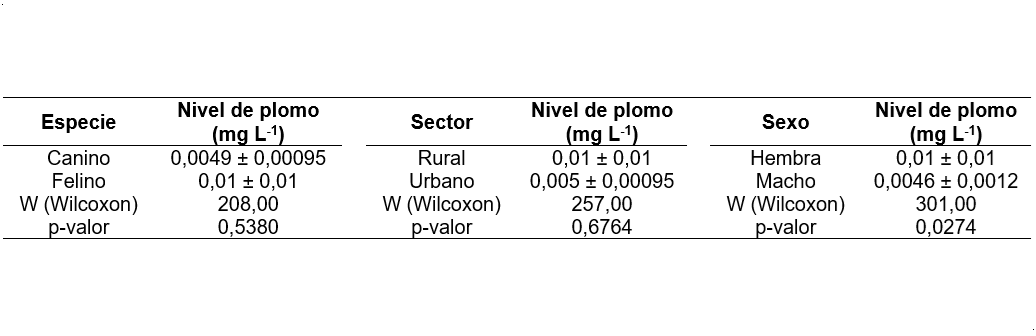
The objective of this study was to determine blood lead levels in dogs and cats from urban and rural areas in Calceta parish, Bolívar canton, Manabí, Ecuador, where 32 blood samples (20 from dogs and 12 from cats) were collected. These samples were analyzed using atomic absorption spectrophotometry, additionally, surveys were conducted with pet owners to assess animal management conditions. The results showed that most samples had concentrations below the detectable limit (0.005 ppm). Animals from rural areas presented a mean of 0.01 mg L-1, exceeding the reference values. However, statistical analysis did not reveal significant differences between species or location (urban vs. rural). On the other hand, a significant variation was found according to sex (p = 0.0274), with females being more susceptible to higher blood lead levels than males. This finding is attributed to physiological processes involving bone mobilization of lead into the bloodstream during gestation and lactation. Furthermore, several risk factors were identified, including mixed feeding practices (62.5%), constant outdoor exposure (53.1%), a marked lack of veterinary check-ups (59.4%), and absence of prior blood testing (93.8%). Although 87.5% of the animals did not show clinical signs, lead levels were detected in asymptomatic individuals, highlighting the importance of preventive diagnosis. In conclusion, companion animals in Calceta act as environmental sentinels for lead exposure, emphasizing the need to promote education on animal welfare and preventive veterinary medicine.
Downloads
Metrics
Article Details

This work is licensed under a Creative Commons Attribution-NonCommercial 4.0 International License.
The authors who publish in Siembra know and accept the following conditions:
- Authors retain the copyright and grant Siembra the right of first publication of the work, under the Creative Commons Attribution License. Third parties are allowed to use what has been published as long as they refer to the author or authors of the work and its publication in this journal.
 This content is licensed under a Creative Commons Attribution-Noncommercial 4.0 International (CC BY-NC 4.0).
- Authors maintain the copyright and guarantee Siembra the right to publish the manuscript through the channels it considers appropriate.
- Authors may establish on their own additional agreements for the non-exclusive distribution of the version of the work published in Siembra, acknowledging their initial publication in the same, such as in institutional repositories.
- Authors are authorized to disseminate their work electronically once the manuscript is accepted for publication.




References
Aeluro, S., y Kavanagh, T. J. (2021). Domestic cats as environmental lead sentinels in low-income populations: a One Health pilot study sampling the fur of animals presented to a high-volume spay/neuter clinic. Environmental Science and Pollution Research, 28(41), 57925-57938. https://doi.org/10.1007/s11356-021-14769-7 DOI: https://doi.org/10.1007/s11356-021-14769-7
Alcántara-Villar, G., Villanueva, C. J., y Vargas, L. (2025). Exposición a plomo en caninos de talleres mecánicos: estudio piloto en la ciudad de Cajamarca, Perú. Innovaciencia, 13(1). https://doi.org/10.15649/2346075X.5174 DOI: https://doi.org/10.15649/2346075X.5174
Baranda, C., Álvarez, J., Señalada, J., Carranza, R., Escribano, E., Lozano, J., Parras, T., Riquelme, E., Robles, P., y Simarro, M. (2022). Manual de recogida, transporte y conservación de muestras (6a Ed). Universitario de Albacete. https://www.chospab.es/area_medica/microbiologia/docTomaMuestras/1_Manual_recogida_transporte_conservacion_muestras_microbiologia.pdf
Blakley, B. (2021). Intoxicación por plomo en animales. MSD Veterinary Manual. https://www.msdvetmanual.com/toxicology/lead-poisoning/lead-poisoning-in-animals
Chipugsi Albán, C. N., Jiménez González, M. X., Veloz Veloz, D. M., y Beltrán Romero, C. F. (2025). Impacto de la vinculación social de la carrera de medicina veterinaria de la UTC en la salud animal comunitaria. RECIMUNDO, 9(Especial), 316–323. https://doi.org/10.26820/recimundo/9.(esp).mayo.2025.316-323 DOI: https://doi.org/10.26820/recimundo/9.(esp).mayo.2025.316-323
Ensley, S. (2020). Intoxicación (envenenamiento) por plomo. MSD Veterinary Manual. https://www.msdvetmanual.com/es/temas-especiales-para-
mascotas/envenenamiento/intoxicaci%C3%B3n-envenenamiento-por-plomo
González Martínez, V., Fernández, N., Disalvo, L., Varea, A., Finkelstein, J., y García, S. (2019). Niveles de plomo en sangre de perros de la Cuenca Matanza-Riachuelo. Su función como centinelas de riesgo ambiental. Revista de salud ambiental, 19(2),159-168. https://ojs.diffundit.com/index.php/rsa/article/view/956/952
Herrera Vargas, A. K., Nava Tapia, D. A., Anastacio Navarro, M., García Rendón, A. L., y Navarro Tito, N. (2025). Exposición al Plomo y su Implicación en el Desarrollo del Cáncer Humano: Una Revisión Narrativa. Ciencia y Reflexión, 4(1), 2057–2088. https://doi.org/10.70747/cr.v4i1.177 DOI: https://doi.org/10.70747/cr.v4i1.177
Instituto Nacional de Estadísticas y Censos [INEC]. (2022). Mascotas. VIII Censo de Población y VII de Vivienda. Instituto Nacional de Estadísticas y Censos. https://www.ecuadorencifras.gob.ec/
Lima Cazorla, L., Olivares Rieumont, S., Columbie, I., De la Rosa Mederos, D., y Gil Castillo, R. (2010). Niveles de plomo, zinc, cadmio y cobre en el RÌo Almendares, Ciudad Habana, Cuba. Revista Internacional De Contaminación Ambiental, 21(3), 115-124. https://www.revistascca.unam.mx/rica/index.php/rica/article/view/22548
López, A., Miranda, M., García, P., Cantero, F., Hernández, J., y Benedito, J. L. (2007). Use of dogs as indicators of metal exposure in rural and urban habitats in NW Spain. Science of The Total Environment, 372(2 y 3). 668-675. https://doi.org/10.1016/j.scitotenv.2006.10.003 DOI: https://doi.org/10.1016/j.scitotenv.2006.10.003
Martínez, M. (2020). Análisis instrumental: Espectrometría de Absorción Atómica (EAA). Universitat Politècnica de València. https://riunet.upv.es/server/api/core/bitstreams/719cefbe-588e-455b-827a-aa4d8de5ffe8/content
Monfrinotii, A. (2020). Intoxicación por plomo etilenglicol, metaldehído, estricnina y anticoagulantes rodenticidas. Temas selectos de clínica médica de pequeños animales (pp. 502- 515). Universidad de Buenos Aires.
Rădulescu, A., y Lundgren, S. (2019). A pharmacokinetic model of lead absorption and calcium competitive dynamics. Scientific reports, 9(1), 14225. https://doi.org/10.1038/s41598-019-50654-7 DOI: https://doi.org/10.1038/s41598-019-50654-7
Rivera, K., y Pernía, B. (2021). Determinación de los niveles de plomo en sangre en trabajadores de fábricas de baterías ubicadas en Guayaquil-Ecuador. Enfoque UTE, 12(2), 1-18. https://doi.org/10.29019/enfoqueute.727 DOI: https://doi.org/10.29019/enfoqueute.727
Rodríguez, D. (2017). Intoxicación ocupacional por metales pesados. MEDISAN, 21(12),3372. http://scielo.sld.cu/pdf/san/v21n12/san122112.pdf
Rosendahl, S., Anturaniemi, J., Vuori, K. A., Moore, R., Hemida, M., y Hielm-Björkman, A. (2022). Diet and dog characteristics affect major and trace elements in hair and blood of healthy dogs. Veterinary Research Communications, 46(1), 261–275. https://doi.org/10.1007/s11259-021-09854-8 DOI: https://doi.org/10.1007/s11259-021-09854-8
Santander, C. (2007). Detección de cadmio, mercurio y plomo en gatos. Universidad de Chile. https://repositorio.uchile.cl/handle/2250/131233
Valladares, B., Peña, S., Zamora, J., Velázquez, V., Ortega, C., Zaragoza, A., Rivero, N.y García, O. (2014). Determinación de plomo en sangre de perros de la ciudad de Toluca, México. Revista Electrónica de Veterinaria, 15 (4), 1-10. https://www.redalyc.org/pdf/636/63632459008.pdf