
Evaluation of arbuscular mycorrhizal fungi isolated from the rhizosphere of two wild plants inoculated in Zea mays and Phaseolus vulgaris, crops of economic importance
Article Sidebar
Main Article Content
Abstract
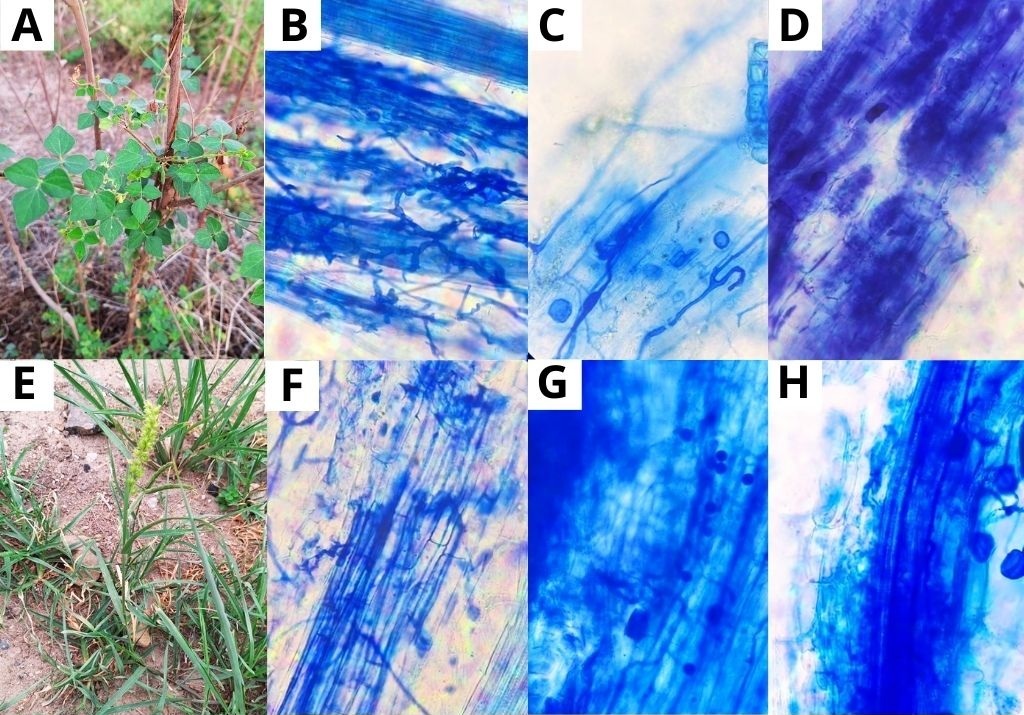
Arbuscular mycorrhizal fungi [AMF] establish mutualistic symbioses with plant roots, enhancing nutrient and water uptake in exchange for carbohydrates, which boosts plant growth, stress resistance, and ecosystem health. This study focused on developing a biological inoculant from native AMF of a dry forest, utilizing Rhynchosia minima and Cenchrus echinatus as trap plants for their collection. The methodology involved the identification of arbuscular mycorrhizae from the rhizospheric soil of each plant species, where root and soil samples were collected, followed by the preparation of the inoculum with antibiotics (gentamicin and streptomycin). Inoculation was performed by direct application of the inoculum to the roots of maize (Zea mays) and bean (Phaseolus vulgaris) plants in a randomized block design with three treatments (T1 = control without mycorrhizal inoculum; T2 = mycorrhizae + antibiotic; T3 = mycorrhizal inoculum only) and six replicates; the sterilized substrate consisted of a 1:1 ratio of peat and sand. Plant growth and mycorrhizal colonization were evaluated and compared using Student's t-test. The results revealed a mycorrhizal colonization exceeding 50% and a spore abundance (101–132 spores g⁻¹ of soil) in the trap plants, with a predominance of the genera Acaulospora, Glomus, Gigaspora, and Scutellospora. Inoculation with these native AMF increased colonization in maize (32%) and beans (37%) compared to the non-inoculated controls of each species, demonstrating the effectiveness of the developed inoculant. In conclusion, the use of native arbuscular mycorrhizal fungi represents an effective strategy to improve the growth of important crops such as maize and beans, contributing to more sustainable agricultural practices.
Downloads
Metrics
Article Details

This work is licensed under a Creative Commons Attribution-NonCommercial 4.0 International License.
The authors who publish in Siembra know and accept the following conditions:
- Authors retain the copyright and grant Siembra the right of first publication of the work, under the Creative Commons Attribution License. Third parties are allowed to use what has been published as long as they refer to the author or authors of the work and its publication in this journal.
 This content is licensed under a Creative Commons Attribution-Noncommercial 4.0 International (CC BY-NC 4.0).
- Authors maintain the copyright and guarantee Siembra the right to publish the manuscript through the channels it considers appropriate.
- Authors may establish on their own additional agreements for the non-exclusive distribution of the version of the work published in Siembra, acknowledging their initial publication in the same, such as in institutional repositories.
- Authors are authorized to disseminate their work electronically once the manuscript is accepted for publication.




References
Akram, M., Kamaal, N., Kumar, D., Datta, D., y Agnihotri, A. K. (2025). Characterization, phylogeny and recombination of Rhynchosia yellow mosaic virus infecting Rhynchosia minima, a wild relative of pigeonpea (Cajanus cajan) from India. Virus Genes, 61(1), 110–120. https://doi.org/10.1007/s11262-024-02120-4 DOI: https://doi.org/10.1007/s11262-024-02120-4
Andrade, O. F., Nunes, M. S., Teixeira, J. S. M., Oliveira, M. M., Berbara, R. L. L., y Saraiva, V. B. (2015). Fungos Micorrízicos Arbusculares (FMAs) em uma formação vegetal de restinga: ecologia e potencial para micorrizorremediação de hidrocarboneto do petróleo. Revista Vértices, 17(3), 7–33. https://doi.org/10.19180/1809-2667.v17n315-01 DOI: https://doi.org/10.19180/1809-2667.v17n315-01
Balzarini, M., di Rienzo, J., Tablada, M., Gonzalez, L., Bruno, C., Córdoba, M., Robledo, W., y Casanoves, F. (2015). Estadística y biometría. Ilustraciones del uso de Infostat en problemas de agronomía (2ª ed.). Editorial Brujas, Encuentro Grupo Editor, Liber Books. https://ri.conicet.gov.ar/handle/11336/264161
Barros, S., Turchetto, R., Magalhães, J. B., Canepelle, E., Andreola, D. S., Ros, C. O., Basso, C. J., Silva, V. R., y Silva, R. F. (2024). Arbuscular mycorrhizal fungi on the development and copper content in corn and sorghum plants. Brazilian Journal of Biology, 84, e283238. https://doi.org/10.1590/1519-6984.283238 DOI: https://doi.org/10.1590/1519-6984.283238
Bianco, L. (2020). Principales aspectos de la nodulación y fijación biológica de nitrógeno en Fabáceas. Idesia (Arica), 38(2), 21-29. http://dx.doi.org/10.4067/S0718-34292020000200021 DOI: https://doi.org/10.4067/S0718-34292020000200021
Bilgili, A. (2025). The effectiveness of arbuscular mycorrhizal fungal species (Funneliformis mosseae , Rhizophagus intraradices, and Claroideoglomus etunicatum) in the biocontrol of root and crown rot pathogens, Fusarium solani and Fusarium mixture in pepper. PeerJ, 13, e18438. https://doi.org/10.7717/peerj.18438 DOI: https://doi.org/10.7717/peerj.18438
Bonfante P. (2022). Microbe Profile: Gigaspora margarita, a multifaceted arbuscular mycorrhizal fungus. Microbiology (Reading, England), 168(6), 001202. https://doi.org/10.1099/mic.0.001202 DOI: https://doi.org/10.1099/mic.0.001202
Bonifaz, C. (2023). Composición florística de las riberas de la cuenca del río Taura, Golfo de Guayaquil, Ecuador. Ecología aplicada, 22(2), 123-128. http://dx.doi.org/10.21704/rea.v22i2.2088 DOI: https://doi.org/10.21704/rea.v22i2.2088
Chávez-Hernández, C. G., Barrera Aguilar, C. C., Téllez Espinosa, G. J., Chimal-Sánchez, E., y García-Sánchez, R. (2021). Colonización micorrízica y comunidades de hongos micorrizógenos arbusculares en plantas medicinales del bosque templado “Agua Escondida”, Taxco, Guerrero, México. Scientia Fungorum, 51, e1325. https://doi.org/10.33885/sf.2021.51.1325 DOI: https://doi.org/10.33885/sf.2021.51.1325
Correa-Álvarez, E. M., León-Pacheco, R. I., Lobato-Ureche, M. A., García-Davila, M. A., Muñoz-Perea, C. G., y Aramendiz-Tatis, H. (2019). Caracterización morfoagronómica de la colección de germoplasma de ají dulce (Capsicum spp.) del caribe colombiano. Temas Agrarios, 24(2), 81-95. https://doi.org/10.21897/rta.v24i2.1998 DOI: https://doi.org/10.21897/rta.v24i2.1998
da Silva, K. J. G., Fernandes, J. A. L., Magurno, F., Leandro, L. B. A., Goto, B. T., y Theodoro, R. C. (2022). Phylogenetic review of Acaulospora (Diversisporales, Glomeromycota) and the homoplasic nature of its ornamentations. Journal of Fungi, 8(9), 892. https://doi.org/10.3390/jof8090892 DOI: https://doi.org/10.3390/jof8090892
de Souza, F. A., Declerck, S., Smit, E., y Kowalchuk, G. A. (2005). Morphological, ontogenetic and molecular characterization of Scutellospora reticulata (Glomeromycota). Mycological Research, 109(6), 697–706. https://doi.org/10.1017/S0953756205002546 DOI: https://doi.org/10.1017/S0953756205002546
Delgado-Bohórquez, A., Ávila-Beneras, C., y Vasco-Palacios, K. L. (2024). Bosques y desarrollo urbano sostenible en Guayaquil Metropolitano: un análisis multiescalar y comparativo. Revista de Arquitectura (Bogotá), 26(2), 29-51. https://doi.org/10.14718/revarq.2024.26.4938 DOI: https://doi.org/10.14718/RevArq.2024.26.4938
Eck, J. L., Stump, S. M., Delavaux, C. S., Mangan, S. A., y Comita, L. S. (2019). Evidence of within-species specialization by soil microbes and the implications for plant community diversity. Proceedings of the National Academy of Sciences of the United States of America, 116(15), 7371–7376. https://doi.org/10.1073/pnas.1810767116 DOI: https://doi.org/10.1073/pnas.1810767116
Fan, L., Zhang, C., Li, J., Zhao, Z., y Liu, Y. (2024). Metabolomics revealed the tolerance and growth dynamics of Arbuscular Mycorrhizal Fungi (AMF) to soil salinity in licorice. Plants, 13(18), 2652. https://doi.org/10.3390/plants13182652 DOI: https://doi.org/10.3390/plants13182652
Guillén, A., Serrano-Tamay, F. J., Peris, J. B., y Arrillaga, I. (2020). Glomus ibericum, Septoglomus mediterraneum , and Funneliformis pilosus, three new species of arbuscular mycorrhizal fungi. Mycologia, 112(4), 819–828. https://doi.org/10.1080/00275514.2020.1771992 DOI: https://doi.org/10.1080/00275514.2020.1771992
Hawkins, H.-J., Cargill, R. I. M., van Nuland, M. E., Hagen, S. C., Field, K. J., Sheldrake, M., Soudzilovskaia, N. A., y Kiers, E. T. (2023). Mycorrhizal mycelium as a global carbon pool. Current Biology, 33(11), R560–R573. https://doi.org/10.1016/j.cub.2023.02.027 DOI: https://doi.org/10.1016/j.cub.2023.02.027
Ho-Plágaro, T., Tamayo-Navarrete, M. I., y García-Garrido, J. M. (2020). Histochemical staining and quantification of arbuscular mycorrhizal fungal colonization. En N. Ferrol, y L. Lanfranco (eds.) Arbuscular mycorrhizal fungi. Methods in molecular biology, vol 2146 (pp. 43–52). Humana. https://doi.org/10.1007/978-1-0716-0603-2_4 DOI: https://doi.org/10.1007/978-1-0716-0603-2_4
Infostat - Statistical software. (2017). Versión 2017. https://www.infostat.com.ar/index.php?mod=noticia&id=49
Jin, Z., Jiang, F., Wang, L., Declerck, S., Feng, G., y Zhang, L. (2024). Arbuscular mycorrhizal fungi and Streptomyces: brothers in arms to shape the structure and function of the hyphosphere microbiome in the early stage of interaction. Microbiome, 12(1), 83. https://doi.org/10.1186/s40168-024-01811-2 DOI: https://doi.org/10.1186/s40168-024-01811-2
Liu, J., Zhang, J., Li, D., Xu, C., y Xiang, X. (2020). Differential responses of arbuscular mycorrhizal fungal communities to mineral and organic fertilization. MicrobiologyOpen, 9(1), e00920. https://doi.org/10.1002/mbo3.920 DOI: https://doi.org/10.1002/mbo3.920
Ma, Y., Zhang, H., Wang, D., Guo, X., Yang, T., Xiang, X., Walder, F., y Chu, H. (2021). Differential responses of arbuscular mycorrhizal fungal communities to long-term fertilization in the wheat rhizosphere and root endosphere. Applied and Environmental Microbiology, 87(17), e0034921. https://doi.org/10.1128/AEM.00349-21 DOI: https://doi.org/10.1128/AEM.00349-21
Martin, F. M., y van der Heijden, M. G. A. (2024). The mycorrhizal symbiosis: research frontiers in genomics, ecology, and agricultural application. The New phytologist, 242(4), 1486–1506. https://doi.org/10.1111/nph.19541 DOI: https://doi.org/10.1111/nph.19541
Matteoli, F. P., Silva, A. M. M., de Araújo, V. L. V. P., Feiler, H. P., y Cardoso, E. J. B. N. (2024). Organic farming promotes the abundance of fungi keystone taxa in bacteria-fungi interkingdom networks. World Journal of Microbiology & Biotechnology, 40(4), 119. https://doi.org/10.1007/s11274-024-03926-y DOI: https://doi.org/10.1007/s11274-024-03926-y
Mujica-Pérez, Y. (2020). Nuevos desafíos en la producción de inoculantes a partir de hongos micorrízicos arbusculares en Cuba. Cultivos Tropicales, 41(1), e09. https://ediciones.inca.edu.cu/index.php/ediciones/article/view/1543
Naranjo-Moran, J., Vera-Morales, M., Solorzano-Muñoz, J., y Pino-Acosta, A. (2024). Fotografía botánica: una herramienta para la educación artística en un remanente de bosque seco tropical, Guayaquil - Ecuador. Revista Ciencias Pedagógicas e Innovación, 12(1), 23-32. https://doi.org/10.26423/rcpi.v12i1.753 DOI: https://doi.org/10.26423/rcpi.v12i1.753
Noguchi, M., y Toju, H. (2024). Mycorrhizal and endophytic fungi structure forest below-ground symbiosis through contrasting but interdependent assembly processes. Environmental Microbiome, 19(1), 84. https://doi.org/10.1186/s40793-024-00628-8 DOI: https://doi.org/10.1186/s40793-024-00628-8
Peralta-Valencia, A. L., Castillo-Argüero, S., Hernández-Cuevas, L. V., y Vázquez-Santos, Y. (2023). Variación temporal en la composición de hongos micorrizógenos arbusculares en un bosque templado. Ecosistemas, 32(3), 2572-2572. https://doi.org/10.7818/ECOS.2572 DOI: https://doi.org/10.7818/ECOS.2572
Pérez, U. A., Ramírez, M. M., Moreno, L. M., y Franco, M. (2011). Metodología para la desinfección y germinación de esporas y fragmentos de raíces micorrizados con Glomus sp.(GEV02) para su uso bajo condiciones in vitro. Ciencia y Tecnología Agropecuaria, 12(2), 143-150. https://doi.org/10.21930/rcta.vol12_num2_art:224 DOI: https://doi.org/10.21930/rcta.vol12_num2_art:224
Rodríguez-Larramendi, L. A., Guevara-Hernández, F., la O-Arias, M. A., Romero-José, E., Hernández-García, V., y Salas-Marina, M. Á. (2022). Efecto del aluminio en el crecimiento y contenido de clorofila en plántulas de maíz. Revista Fitotecnia Mexicana, 44(1), 25-31. https://doi.org/10.35196/rfm.2021.1.25 DOI: https://doi.org/10.35196/rfm.2021.1.25
Shao, Y., Jiang, S., Peng, H., Li, H., Li, P., Jiang, R., Fang, W., Chen, T., Jiang, G., Yang, T., Nambeesan, S. U., Xu, Y., y Dong, C. (2023). Indigenous and commercial isolates of arbuscular mycorrhizal fungi display differential effects in Pyrus betulaefolia roots and elicit divergent transcriptomic and metabolomic responses. Frontiers in Plant Science, 13, 1040134. https://doi.org/10.3389/fpls.2022.1040134 DOI: https://doi.org/10.3389/fpls.2022.1040134
Sheng, Q., Dong, L., y Liu, Z. (2024). Driving forces of herbaceous species diversity in natural broadleaf forests from in Maoershan from Northeast China. Frontiers in Plant Science, 15, 1449421. https://doi.org/10.3389/fpls.2024.1449421 DOI: https://doi.org/10.3389/fpls.2024.1449421
Shi, J., Wang, X., y Wang, E. (2023). Mycorrhizal symbiosis in plant growth and stress adaptation: from genes to ecosystems. Annual Review of Plant Biology, 74, 569–607. https://doi.org/10.1146/annurev-arplant-061722-090342 DOI: https://doi.org/10.1146/annurev-arplant-061722-090342
Sieverding, E. (1983). Manual de métodos para la investigación de la micorriza vesículo-arbuscular en el laboratorio. Centro Internacional de Agricultura Tropical. https://hdl.handle.net/10568/54137
Sieverding, E., Friedrichsen, J., y Suden, W. (1991). Vesicular-arbuscular mycorrhiza management in tropical agrosystems (No. 224).
Souza, G. G., Santos, S. C., Santos, C. C., Dias, A. S., Silverio, J. M., Trovato, V. W., y Flauzino, D. S. (2023). Arbuscular mycorrhizal fungi promote the growth of Dipteryx alata Vogel. Brazilian Journal of Biology, 83, e275172. https://doi.org/10.1590/1519-6984.275172 DOI: https://doi.org/10.1590/1519-6984.275172
Tedersoo, L., Bahram, M., y Zobel, M. (2020). How mycorrhizal associations drive plant population and community biology. Science, 367(6480), eaba1223. https://doi.org/10.1126/science.aba1223 DOI: https://doi.org/10.1126/science.aba1223
Tedersoo, L., y Bahram, M. (2019). Mycorrhizal types differ in ecophysiology and alter plant nutrition and soil processes. Biological reviews of the Cambridge Philosophical Society, 94(5), 1857–1880. https://doi.org/10.1111/brv.12538 DOI: https://doi.org/10.1111/brv.12538
Tenzin, U. W., Noirungsee, N., Runsaeng, P., Noppradit, P., y Klinnawee, L. (2022). Dry-season soil and co-cultivated host plants enhanced propagation of arbuscular mycorrhizal fungal spores from sand dune vegetation in trap culture. Journal of Fungi, 8(10), 1061. https://doi.org/10.3390/jof8101061 DOI: https://doi.org/10.3390/jof8101061
Wang, Y., Lin, J., Yang, F., Tao, S., Yan, X., Zhou, Z., y Zhang, Y. (2022). Arbuscular mycorrhizal fungi improve the growth and performance in the seedlings of Leymus chinensis under alkali and drought stresses. PeerJ, 10, e12890. https://doi.org/10.7717/peerj.12890 DOI: https://doi.org/10.7717/peerj.12890
Zhang, W., Xue, W., Liu, J., Zhu, H., y Zhao, Z. (2024). Molecular diversity of ectomycorrhizal fungi in relation to the diversity of neighboring plant species. Microorganisms, 12(8), 1718. https://doi.org/10.3390/microorganisms12081718 DOI: https://doi.org/10.3390/microorganisms12081718
Zhou, J., Chai, X., Zhang, L., George, T. S., Wang, F., y Feng, G. (2020). Different arbuscular mycorrhizal fungi cocolonizing on a single plant root system recruit distinct microbiomes. mSystems, 5(6), 10.1128/msystems.00929-20. https://doi.org/10.1128/mSystems.00929-20 DOI: https://doi.org/10.1128/mSystems.00929-20